The artificial intelligence landscape moves at a breathless pace, and social media feeds are perpetually primed to declare the latest release an industry-altering revolution. Recently, much of that online enthusiasm has converged around Jev, a newly introduced model from TypeSafe AI. Hailed by various tech influencers and YouTube commentators as a paradigm shift, Jev has sparked intense curiosity across the machine learning community. However, cutting through the marketing hype reveals a more nuanced reality—one that requires a grounded technical assessment rather than blind acceptance of viral claims.
Drawing from years of practical experience working with machine learning and natural language processing systems, including advanced classifiers, zero-shot classifiers, and large language models, a closer examination of Jev shows that much of its underlying mechanics actually look quite familiar. That realization, however, does not render the technology uninteresting. TypeSafe AI has clearly invested significant engineering effort into building a specialized architecture and training approach tailored to a very specific set of computational challenges. Yet, a vast gap remains between incrementally improving an established class of natural language processing systems and inventing an entirely novel category of artificial intelligence. Furthermore, because public knowledge regarding Jev’s internal architecture, model size, and precise training setup remains sparse, many of the most dramatic claims currently rely heavily on TypeSafe AI’s internal benchmarks rather than independent verification.
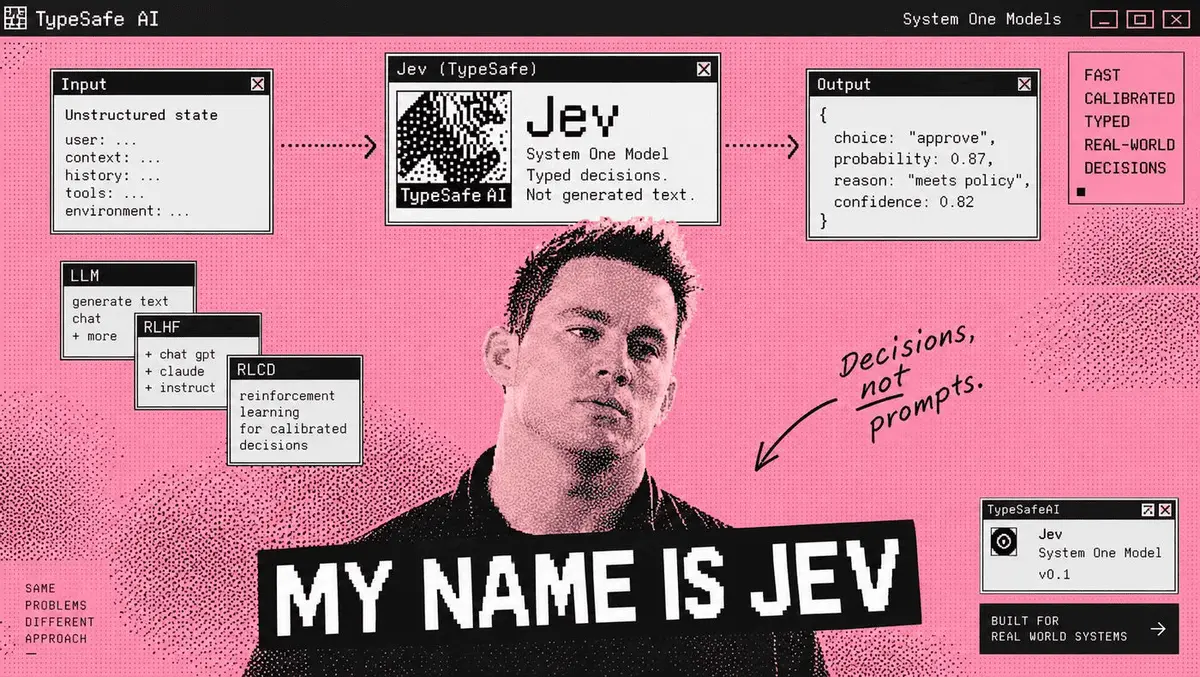
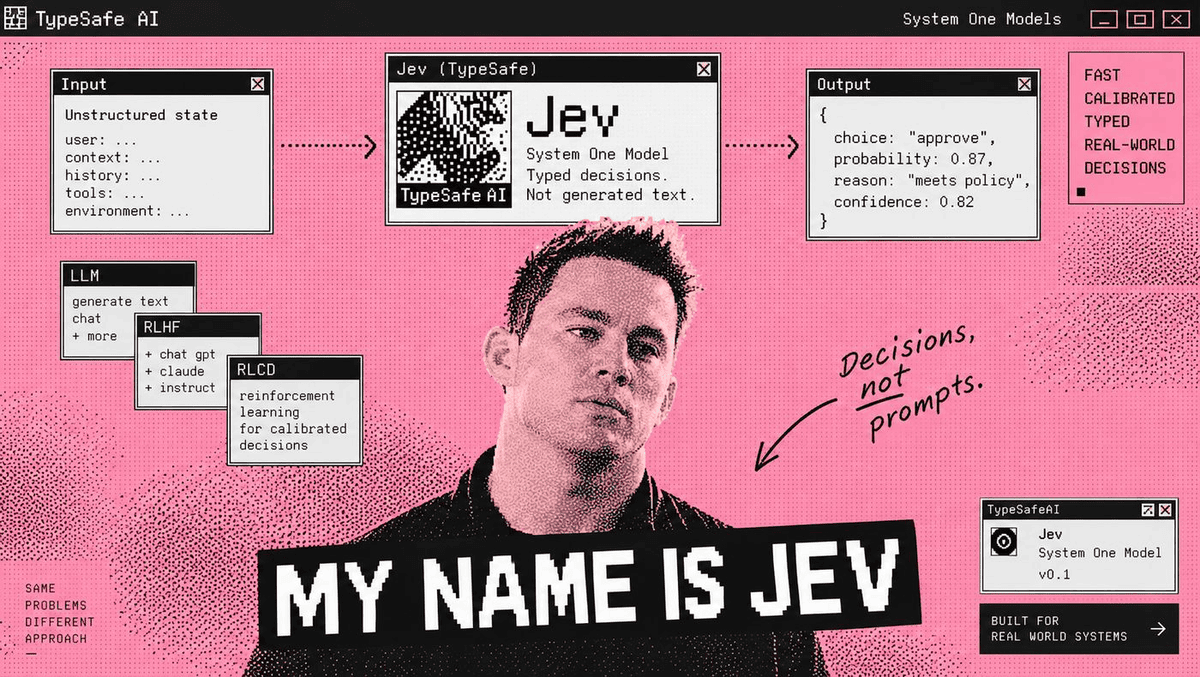
To understand the core utility of the technology, it is necessary to examine what Jev was actually built to do. Unlike conventional large language models designed for open-ended text generation, creative writing, or complex coding tasks, Jev is engineered specifically for fast, structured decision-making. TypeSafe AI characterizes it as a "System One Model," deliberately distinguishing its operational scope from traditional large language models. When fed a routine customer support message—such as a complaint about paid features remaining locked following a recent upgrade—Jev does not generate a lengthy, conversational support response. Instead, it evaluates the incoming text against a predefined, fixed set of choices and returns a precise probability distribution.
In a typical operational scenario, such an inquiry might yield a breakdown assigning high probability to a technical issue, moderate likelihood to a sales inquiry, a minor percentage to billing, and zero percent to a cancellation request. While the model ultimately selects the highest-probability category—such as technical support—the surrounding probability distribution provides critical context. This allows downstream software applications to utilize both the categorical decision and the model’s inherent confidence level to dictate subsequent automated workflows, whether that means instantly routing a high-confidence ticket to the appropriate department or flagging ambiguous cases for human review.
Classification, semantic scoring, workflow routing, and intent detection are far from novel problems within the broader discipline of machine learning. What sets TypeSafe AI’s approach apart is the deliberate design of a model centered squarely around these typed, probabilistic decisions, bypassing the traditional workaround of forcing a general-purpose language model to mimic a classifier through complex prompting strategies.
Understanding the "System One" Designation
TypeSafe AI frames Jev within the psychological framework of System 1 and System 2 thinking, popularized to describe human cognitive processes. System 1 thinking is characterized as fast, instinctive, and automatic, relying on immediate heuristic evaluations based on available information. Jev emulates this rapid processing paradigm by generating structured decisions and probabilistic outputs instantaneously, completely bypassing the token-by-token generation of elaborate text chains.
Conversely, System 2 thinking represents a slower, more deliberate, and analytical cognitive mode. This aligns more closely with modern reasoning-focused large language models that must deliberate, plan across multiple steps, or methodically work through intricate problems. In practical enterprise architectures, these two modes are intended to complement rather than replace one another. System One operations excel at high-speed, high-volume triage and decision-making, while System Two capabilities remain essential when deep analytical reasoning, multi-step problem solving, or complex synthesis is required.
The Relationship to Zero-Shot Classification
Despite the novel framing, experienced natural language processing engineers will find that Jev bears a striking conceptual resemblance to zero-shot classification systems. For years, zero-shot text classifiers have enabled developers to supply arbitrary candidate labels alongside raw text without requiring the costly training of a dedicated model tailored exclusively to those exact categories.
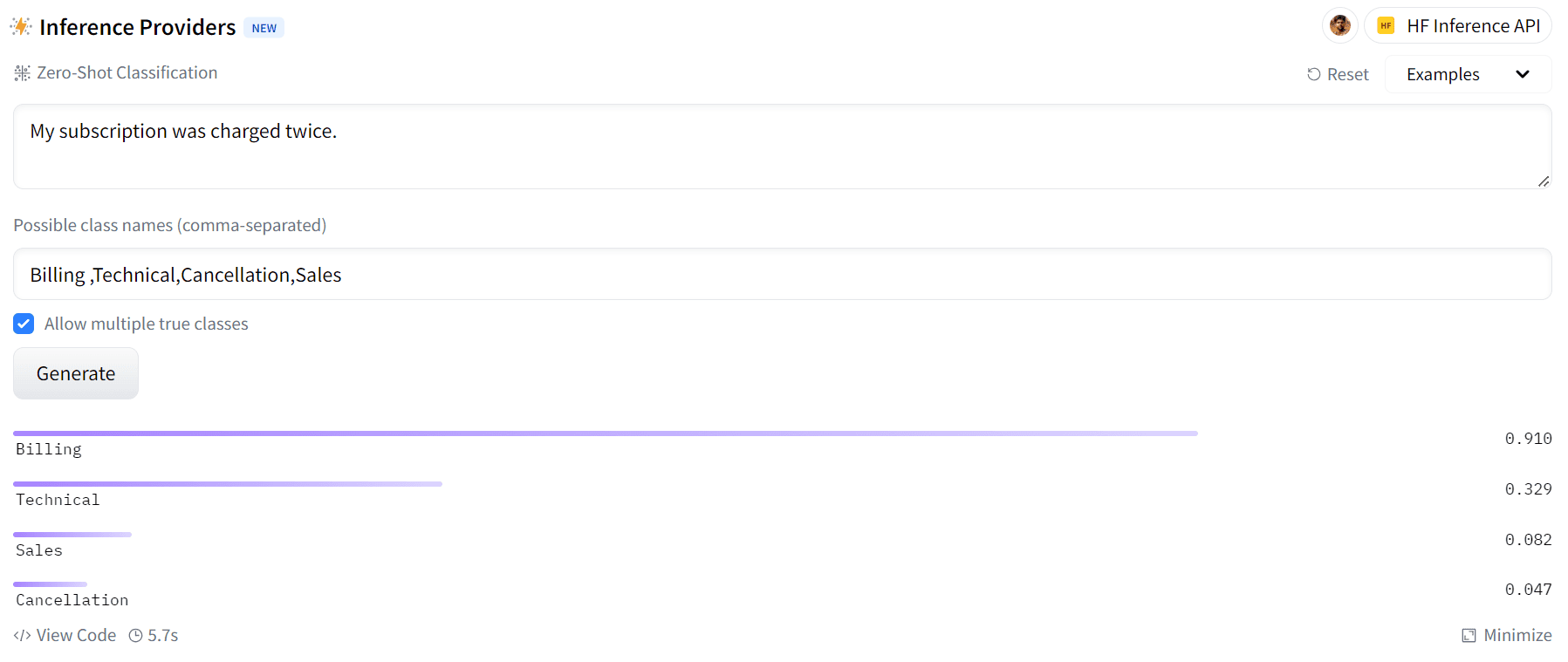
Modern natural language inference-based zero-shot classification gained widespread traction in the research community around 2019 and 2020, though the underlying concepts of zero-shot learning extend significantly further back in machine learning history. Providing an existing zero-shot model with a customer grievance regarding double-billing alongside candidate labels such as billing, technical, cancellation, and sales yields a similar probability distribution across those categories.
Dismissing Jev merely as an old zero-shot classifier under a new name, however, would be equally inaccurate. TypeSafe AI has engineered the platform around multiple concurrent structured decisions, parallel inference pathways, and a specialized, calibration-focused training regimen. The overarching reality of the technology is straightforward: while the underlying problem domain is mature, the surrounding product architecture and optimization strategy represent a fresh iteration.
Architectural Boundaries and Efficiency
A critical distinction must be made regarding whether Jev qualifies as a large language model in the traditional sense. It does not occupy the same category as frontier foundational models like GPT, Claude, or Gemini. Those general-purpose systems are engineered for expansive utility, including complex software engineering, advanced reasoning, tool utilization, and open-ended generative writing. Jev is intentionally narrow in its operational mandate, optimized explicitly for ingesting text and rendering structured categorical decisions.
While developers can compel modern general-purpose large language models to perform similar classification tasks through structured outputs, constrained decoding, or advanced function calling, doing so often incurs unnecessary computational overhead. Deploying a massive, expensive general-purpose model for a task fundamentally rooted in classification is inefficient. By designing Jev around that narrower operational scope from the ground up, the system achieves significant advantages in both computational speed and cost-effectiveness.

Jev’s operational efficiency stems directly from its specialized architecture, parallel samplers, and calibration-focused training methodology. Rather than autoregressively generating text token by token, it computes structured decisions directly and in parallel. Because models like Meta’s bart-large-mnli have long demonstrated the viability of lightweight zero-shot classification, the true technological intrigue lies not merely in Jev’s affordability relative to frontier models, but in the specific optimizations that enable its rapid structured inference pipeline.
Evaluating Accuracy and Hallucination Claims
Assessing Jev’s real-world accuracy remains challenging due to limited independent verification. TypeSafe AI reports performance metrics hovering around 68 percent on its internal workflow evaluations, but internal benchmarks do not necessarily equate to real-world reliability, particularly when reference answers are derived from other frontier models rather than independently verified ground truth data.
Early independent testing has shown flashes of promise, with small-scale fact-checking evaluations reporting high accuracy and multi-document tests demonstrating strong categorical agreement. Nevertheless, these preliminary assessments remain limited in scope. Robust, independent benchmarking across diverse enterprise environments will be required before the broader AI community can fully quantify Jev’s generalization capabilities.
Discussions surrounding Jev frequently highlight claims regarding an absence of hallucinations, a point that requires careful contextualization. From a strict structural standpoint, the claim holds true: if Jev is constrained to a schema containing only billing, technical, and sales options, it cannot output an out-of-schema label such as legal. However, the model remains fully capable of misclassifying a technical issue as a billing inquiry. Consequently, the absence of hallucinations functions more accurately as a guarantee of zero out-of-schema outputs rather than an absolute immunity to incorrect decisions.
Positioning Alongside Frontier Models
When weighed against frontier large language models, Jev’s primary competitive advantages lie clearly within the domains of computational speed and operational economics. Because it addresses a constrained problem space, it requires substantially less computing power and generates minimal output volume compared to systems built for open-ended generation, coding, and multi-turn conversations.
The most meaningful metric for developers is not whether Jev outpaces a frontier model in raw speed, but whether it maintains sufficient quality on narrow tasks to replace expensive model calls without degrading overall application performance. If Jev can deliver adequate classification accuracy at a fraction of the latency and cost, its value proposition as a specialized middleware layer becomes immediately apparent.
The Role of Calibrated Decisions
A core innovation highlighted by TypeSafe AI is its proprietary training methodology known as Reinforcement Learning for Calibrated Decisions, or RLCD. The emphasis on calibration is critical in machine learning systems. A model can generate accurate predictions while remaining poorly calibrated regarding its own certainty. Proper calibration ensures that the numerical probabilities returned by the system accurately reflect the empirical frequency with which those predictions prove correct.
In practical software deployment, well-calibrated uncertainty transforms how automated systems handle edge cases. If a decision executed with high statistical confidence correlates reliably with correctness, enterprise applications can safely automate downstream workflows. Conversely, low-confidence predictions can be automatically routed to human operators for review. Unlike standard Reinforcement Learning from Human Feedback, which optimizes models toward subjective human preferences, RLCD targets the alignment of probability distributions with genuine statistical certainty.
Practical Enterprise Applications
Jev finds its most effective application within larger software architectures that require continuous, high-volume automated triage, document routing, intent detection, and multi-step agent coordination. Developers are actively exploring its integration as a high-speed decision engine embedded deep within broader application logic, allowing the system to direct workflows efficiently before delegating heavier generative or reasoning tasks to specialized models only when strictly necessary.
Ultimately, viewing Jev through the lens of an absolute revolution overlooks the evolutionary nature of its underlying components. Classification, intent detection, zero-shot learning, and probability calibration are well-established pillars of data science, and specialized models have long held cost and speed advantages over generalized architectures. What TypeSafe AI has accomplished is a thoughtful re-engineering of the developer experience, inference pipeline, and calibration methodology surrounding these familiar computational challenges. That achievement positions Jev as a highly optimized product for specific enterprise use cases, even if it stops short of inventing an entirely new paradigm of artificial intelligence.