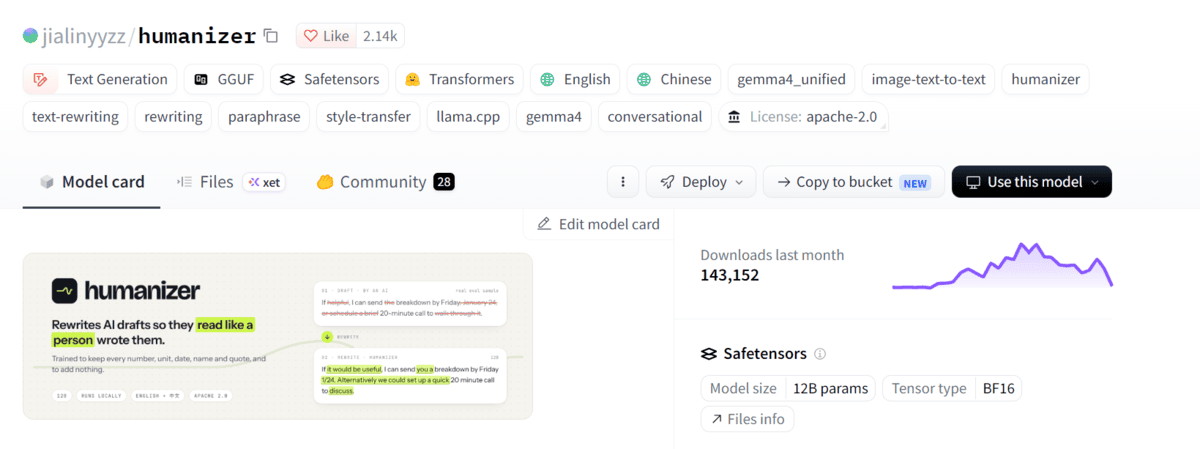
The landscape of content creation and artificial intelligence text processing has shifted significantly following the rapid adoption of open-source alternatives designed to bypass costly proprietary subscription services. A newly prominent open-source model known as Humanizer is drawing considerable attention across the developer and machine learning communities for its ability to rewrite AI-generated content locally. Operating without monthly fees, cloud API costs, or the necessity of transmitting sensitive writing drafts to third-party services, the tool has emerged as a focal point for researchers and writers seeking privacy and cost efficiency.
By early October 2026, the project accumulated more than 143,000 downloads and 2,100 likes on Hugging Face, signaling a robust appetite for decentralized solutions to modern writing challenges. The model’s developer has claimed that approximately 95 percent of 210 rewritten English drafts processed through the system were successfully classified as human-written by Originality.ai, a prominent commercial AI detection platform. While these specific internal figures have not yet been independently verified on a broad scale, the broader open-source ecosystem has enthusiastically embraced the technology for experimentation, local deployment, and performance analysis.

Understanding the Humanizer Model
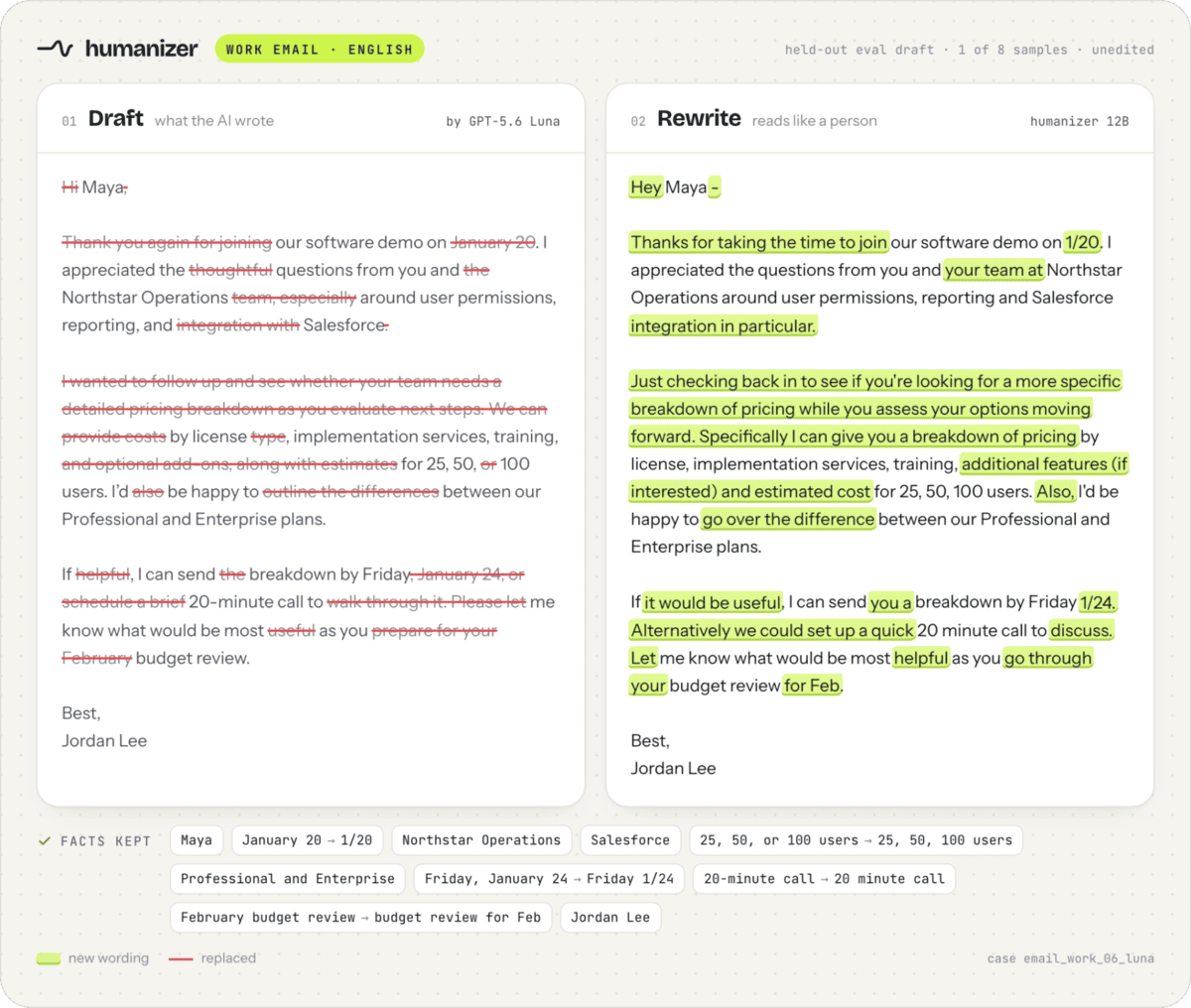
At its technical core, Humanizer is a 12-billion-parameter open-source model constructed upon Google’s Gemma 4 12B architecture. Unlike general-purpose language models designed for broad conversational tasks or creative writing from scratch, this system is specifically fine-tuned for a singular, specialized purpose: transforming robotic or formulaic AI-generated prose into natural, fluent human-like writing. Crucially, the model is engineered to preserve the core meaning, factual integrity, and essential details of the original text while restructuring the phrasing and syntax.
The training methodology behind the model involved a curated dataset comprising 28,598 pairs of raw AI-generated drafts and corresponding human-written text. These training samples were gathered from a diverse array of real-world domains, including academic research papers, government reports, professional correspondence, and online community discussions from platforms like Reddit and Hacker News. Through initial supervised fine-tuning, the model learned to bridge the stylistic gap between machine-produced output and organic human prose.
To refine its performance further, the developers implemented advanced alignment techniques. This included Direct Preference Optimization utilizing nearly 4,000 preference pairs, followed by Group Relative Policy Optimization. In the latter phase, a large language model judge evaluated potential rewrites to ensure factual accuracy, prevent unnecessary word duplication, and guard against unintended semantic drift. Interestingly, the development team deliberately avoided incorporating AI detectors into the training loop, choosing instead to concentrate entirely on foundational writing quality, stylistic variation, and factual consistency.
When a user submits a draft, Humanizer systematically modifies the vocabulary, alters sentence structures, eliminates repetitive phrasing patterns typical of automated generation tools, and introduces natural variations in sentence length. Beyond command-line and server setups, the project also offers accessible desktop applications for Windows and macOS, allowing users to run the software completely offline without writing code. For advanced engineers and researchers, the model supports standard inference frameworks such as llama.cpp, Ollama, Transformers, MLX, and vLLM.
Local Deployment and Technical Implementation
Running the model locally involves deploying the 8-bit quantized version, designated as Q8_0, which achieves a practical balance between memory consumption and output quality. Quantization reduces the precise numerical weight requirements of large models, enabling them to execute efficiently on consumer-grade graphics processing units without demanding massive enterprise infrastructure. For Linux environments equipped with NVIDIA hardware, administrators typically leverage inference engines like llama.cpp configured with CUDA support to accelerate text generation speeds.
The deployment process generally begins by compiling the necessary server components from source with GPU acceleration enabled. Once built, users download the quantized model weights and associated prompt configuration files directly from Hugging Face using command-line utilities. Due to the substantial memory footprint of a 12-billion-parameter model, systems with limited video RAM can alternatively utilize smaller quantized variants to prevent memory allocation errors.

Upon launching a local server instance—often configured with an optimized context window, tensor offloading, and Flash Attention parameters—the system establishes a local HTTP API endpoint. This local architecture ensures that all text processing occurs entirely on the user’s hardware, addressing privacy concerns associated with cloud-based rewriting tools. Developers can then interact with the local server programmatically by sending structured JSON payloads that combine the model’s recommended prompt formatting instructions with the source text requiring transformation.
Practical Testing and Empirical Results
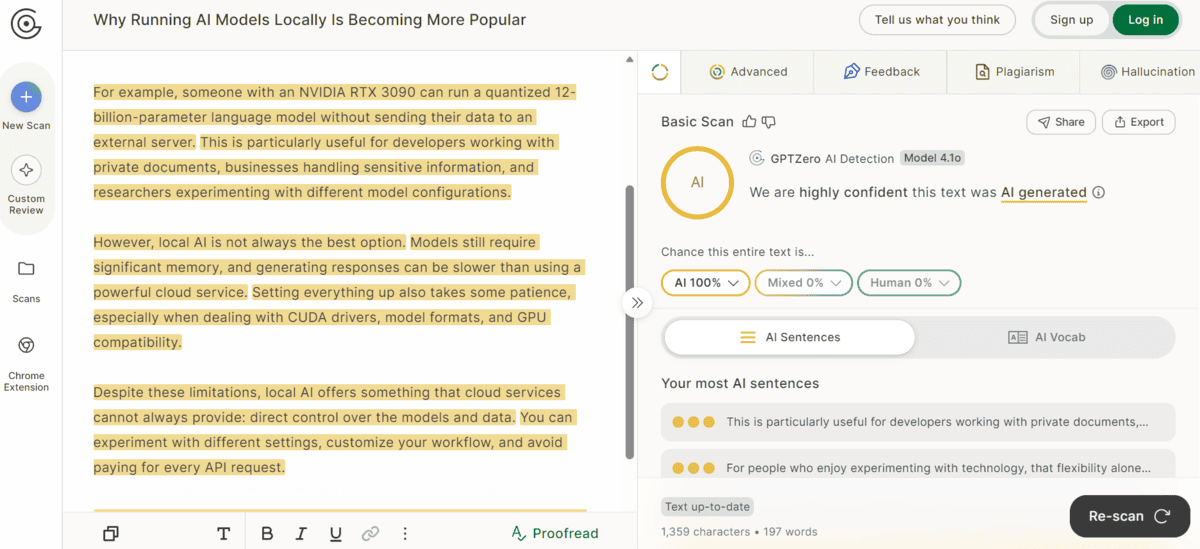
When subjected to empirical testing against popular commercial AI detection services such as Originality.ai, GPTZero, and Copyleaks, the real-world performance of locally executed rewrites reveals a complex picture. In practical experiments involving standard AI-generated articles, the unedited drafts consistently register near-zero human scores on verification platforms. After processing through the local Humanizer pipeline, however, the detection metrics frequently shift.

For instance, documents that initially register as entirely machine-generated on platforms like GPTZero often see their classification metrics alter substantially following a single pass through the local model. In typical test cases, the detected probability of artificial generation drops significantly, while the corresponding human-written classification metric rises. Rather than definitive immunity from detection, detectors often exhibit uncertainty regarding the processed text, frequently indicating that the prose shares characteristics closer to human compositions.
At the same time, practical evaluations underscore a degree of inconsistency in day-to-day use. While the developer-reported benchmarks indicate high success rates under controlled conditions, independent testing across diverse subject matters often yields mixed outcomes. In many practical scenarios, rewritten content successfully bypasses detection tools on some attempts while remaining flagged as machine-generated on others, leading many practitioners to characterize the effectiveness as roughly even.
Broader Implications and Limitations
The inconsistent performance observed across different tests points to a wider challenge within the modern digital publishing ecosystem: the inherent unreliability of automated AI detectors. Security researchers and technical analysts have frequently noted that detection algorithms are susceptible to false positives, occasionally misclassifying entirely human-authored documents as machine-generated due to formal vocabulary or structured syntax. Consequently, relying strictly on detector scores as a definitive measure of writing authenticity remains problematic.
Despite these empirical variances, the emergence of localized, open-source rewriting tools underscores a growing demand for autonomy among content creators. By shifting processing capabilities away from centralized subscription platforms and onto local hardware, tools like Humanizer provide a viable avenue for writers and researchers to refine drafts privately and cost-effectively. Experts generally advise treating such tools as stylistic aids rather than foolproof solutions, emphasizing the importance of human editorial review to verify factual accuracy and maintain high editorial standards, regardless of automated detection scores.