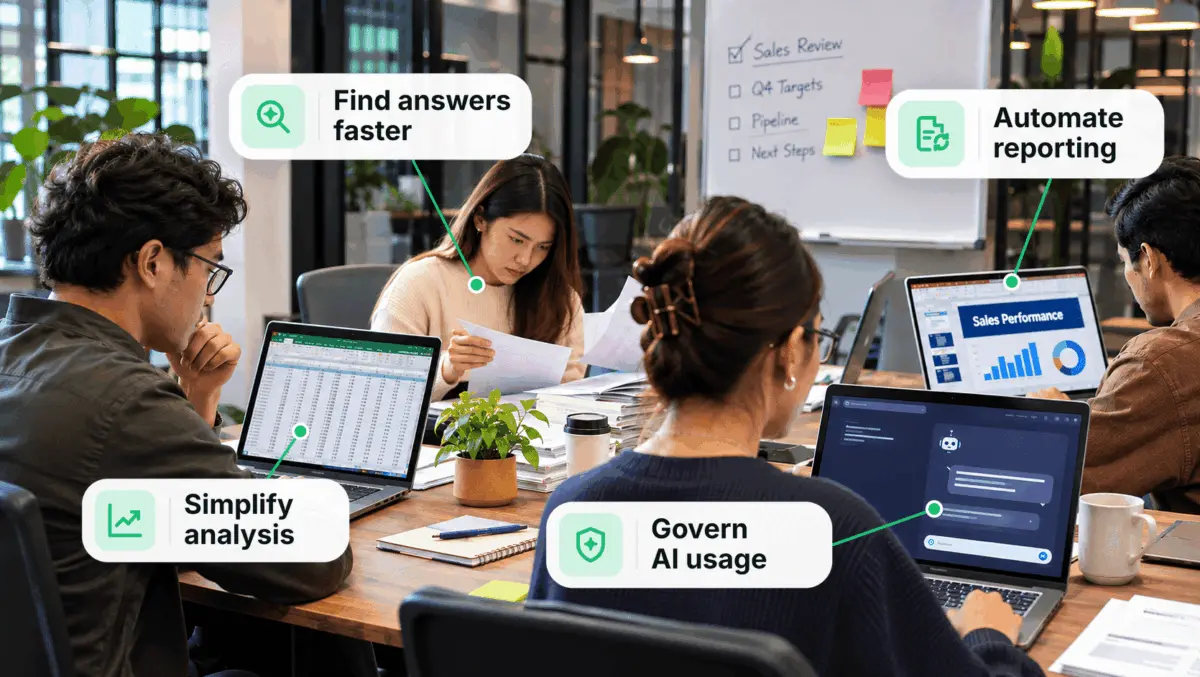
As modern enterprises continue to navigate an increasingly complex digital landscape, businesses face a persistent set of challenges centered around fragmented data architectures, labor-intensive reporting cycles, and critically poor visibility into actionable operational insights. While some organizations remain tethered to legacy spreadsheets and disconnected software silos, others have made substantial capital investments in traditional business intelligence platforms. Yet, despite these investments, many companies still struggle to make advanced analytics genuinely accessible, intuitive, and broadly useful to everyday employees across different operational departments.
To address these hurdles, industry leaders are increasingly turning to artificial intelligence to bridge the gap between raw corporate data and practical business execution. By integrating intelligence directly into enterprise analytics platforms, organizations can fundamentally transform how their workforce interacts with critical information, shifting the paradigm from rigid, static reporting to dynamic, conversational data exploration.
How AI Can Improve Business Intelligence
The true underlying value of any corporate database depends entirely on how effectively an organization can leverage that information to evaluate historical performance, monitor real-time operations, and respond agilely to rapidly shifting market conditions. Artificial intelligence introduces unprecedented opportunities to optimize how employees discover, analyze, and act upon business intelligence metrics, ultimately driving better organizational outcomes without straining overextended IT departments.
Simplifying Access to Business Information
In a typical corporate environment, business users routinely depend heavily on dedicated IT specialists or data analysts to answer ad-hoc operational questions that existing dashboard reports fail to cover. Even sophisticated self-service analytics tools often demand a working familiarity with complex underlying data structures, specialized report builders, or backend query languages. Consequently, a straightforward operational question can easily transform into a time-consuming reporting request that sits in a backlog for days.
AI-powered conversational analytics offers a vastly more direct, frictionless pathway to retrieving critical business information. For instance, an operations manager can simply ask a natural language interface a direct question, such as how many customer orders are awaiting fulfillment today, and seamlessly follow up by requesting a breakdown by specific warehouse locations. The underlying system intelligently interprets these conversational prompts and instantly presents the accurate figures, entirely eliminating the need for the manager to write complex database queries or construct custom reports from scratch.
Modern business intelligence platforms increasingly deliver this transformative capability through conversational interfaces seamlessly connected to core business datasets. This empowers everyday employees to independently secure answers to routine operational questions, significantly reducing administrative friction across the enterprise.
Improving Business Analysis
Successfully accessing raw corporate data is only the first step; deriving sophisticated insights that reliably inform timely operational decisions remains an entirely different challenge. Enterprise teams frequently maintain comprehensive, multi-layered dashboards yet still struggle to synthesize findings across distinct business functions or comprehend the broader financial and strategic implications of those metrics.
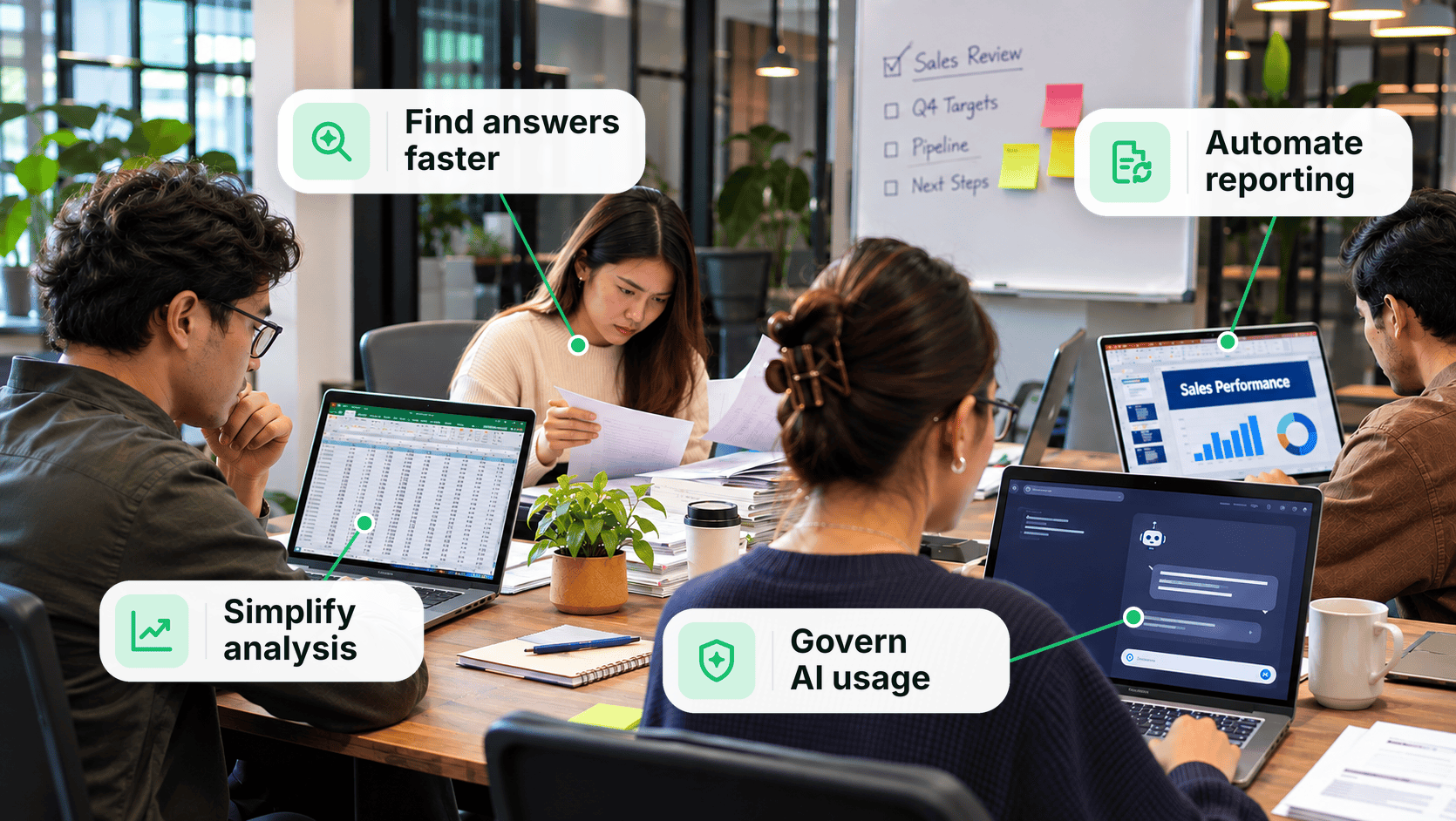
AI-assisted insights excel at examining multiple disparate business metrics simultaneously, intelligently proposing logical explanations, and helping users evaluate potential corrective actions. Consider a scenario where a modern retail organization faces recurring product stockouts despite maintaining adequate overall inventory levels. Artificial intelligence integrated within a modern business intelligence platform can thoroughly analyze historical demand patterns, warehouse-level stock distribution, and vendor supplier lead times to pinpoint likely supply chain bottlenecks and recommend precise inventory replenishment priorities.
Accelerating Business Response
Time-sensitive operational findings frequently go unaddressed when cross-functional teams struggle to communicate their strategic significance or rapidly notify the specific stakeholders who hold the authority to respond.
Artificial intelligence bridges this operational gap by transforming complex analytical findings into cohesive, easily digestible narratives that teams can seamlessly share, discuss, and utilize to coordinate immediate next steps. Furthermore, intelligent systems can proactively flag emerging business anomalies and automatically alert the appropriate personnel. In today’s modern analytics environments, these data stories and automated alerts are frequently embedded directly into executive dashboards, focusing user attention precisely where operational intervention is most urgently required.
Guardrails for Adopting AI in Enterprise BI
While artificial intelligence holds extraordinary potential to make business analytics vastly more accessible and actionable, the ultimate reliability of any insight is strictly tethered to the underlying information and contextual business framework supporting it. Incomplete datasets, inconsistent metric definitions, or lax data governance frameworks can quickly undermine trust in AI-driven features, transforming a promising tool into an operational liability.
Modern business intelligence platforms provide a distinct structural advantage in this regard. Their robust, managed data connections, centralized analytical models, enterprise-grade security protocols, and established reporting practices establish a dependable foundation for AI-enabled analytics. Organizations must carefully consider how to leverage that underlying foundation to avoid common implementation pitfalls.
First, enterprises must ensure that artificial intelligence models are consistently grounded in trusted, current business data. An AI-generated answer that appears precise is functionally useless if it relies on incomplete or outdated information. For example, an automated comparison of today’s incoming orders against the previous month’s aggregate sales figures can yield dangerously misleading conclusions if the underlying data extract has not been properly refreshed. Comprehensive business intelligence platforms mitigate this risk by seamlessly integrating disparate operational systems, preparing clean datasets, and actively managing rigorous refresh schedules so that artificial intelligence algorithms operate from a dependable picture of enterprise health.
Second, maintaining reliable information fundamentally requires standardized business definitions across every department. If one corporate division defines revenue strictly as gross sales while another interprets the term as net sales, an AI interface could easily return conflicting answers to structurally similar queries. Centralized, governed metrics and semantic models embedded within modern BI platforms help anchor AI responses to the exact same calculations and terminology utilized in official corporate reporting.

Third, natural language access should intentionally make corporate information significantly easier to locate, not dangerously easier to expose. A regional sales representative, for example, must not accidentally gain unauthorized access to restricted financial ledgers or sensitive employee human resources records simply by phrasing a query in a novel way. Established business intelligence platforms already maintain robust user roles and granular data-level permissions, and modern AI interfaces can and must be designed to strictly respect those boundaries. Moreover, organizations are required to carefully audit precisely what internal enterprise data is transmitted to any external artificial intelligence service provider.
Fourth, artificial intelligence-generated explanations are most valuable when their underlying supporting evidence remains fully verifiable by human users. If an AI algorithm suggests that a sudden quarterly sales decline is directly correlated with a specific customer demographic segment, business users must retain the capability to inspect the relevant underlying figures, calculations, and operational assumptions. Standard BI reports, governed metric calculations, and granular drill-down views provide essential reference points for validating any automated finding before leadership commits to strategic action.
Fifth, human oversight and accountability remain utterly indispensable, as corporate environments invariably involve nuanced contextual factors that no automated report can capture entirely. For instance, artificial intelligence might logically suggest drastically reducing warehouse inventory levels immediately prior to a major marketing promotion. By utilizing shared business intelligence dashboards as a common reference framework, cross-functional teams can carefully weigh the automated evidence alongside broader strategic operational plans and collaboratively decide which recommendations align with business goals. The platform effectively supports the analytical discussion, but human professionals remain strictly accountable for the final decision.
Finally, organizations must continuously monitor system accuracy, user adoption rates, and tangible business value. The strongest evidence of artificial intelligence’s ROI stems from daily operational utilization. Are corporate employees successfully finding answers faster? Are fewer routine data requests reaching IT helpdesks? Are departmental teams responding more rapidly to critical performance findings? Established BI usage metrics help organizations baseline and track these outcomes, while specialized AI monitoring systems effectively identify lingering accuracy issues, integration bottlenecks, and overall operational costs.
Bringing AI and Enterprise BI Together
Artificial intelligence unlocks extraordinary possibilities for enterprises striving to extract maximum strategic value from their corporate data assets, yet realizing that full potential requires a rock-solid business intelligence foundation. Modern platforms like LANSA BI successfully consolidate, harmonize, and standardize enterprise data from across disparate operational systems, enabling artificial intelligence to deliver consistently accurate and contextually relevant results.
LANSA BI integrates cleanly with leading enterprise AI model providers to dramatically enhance natural-language querying, deep data analysis, and automated storytelling for everyday business users. Furthermore, the platform allows internal developers to embed advanced AI-powered business intelligence directly into bespoke corporate applications to streamline daily workflows. This architectural approach empowers employees to secure the precise information and strategic insights required to align on critical decisions and act rapidly, all while significantly reducing day-to-day reliance on IT departments. Comprehensive enterprise-grade security and governance controls safeguard sensitive corporate information, maintaining strict oversight as organizational usage naturally expands across departments.