Scraping thousands of web pages can easily consume hours of computational time, presenting a major bottleneck for organizations collecting data for enterprise applications, market research, price monitoring, or large-scale artificial intelligence systems. The fundamental engineering challenge extends far beyond raw scraping speed; developers must ensure that the entire data collection pipeline remains reliable, scalable, and manageable from start to finish. Recently, data scientist and technical writer Abid Ali Awan decided to test the limits of modern web scraping infrastructure by evaluating how quickly he could collect 10,000 web pages using Python and the Olostep Batch API.
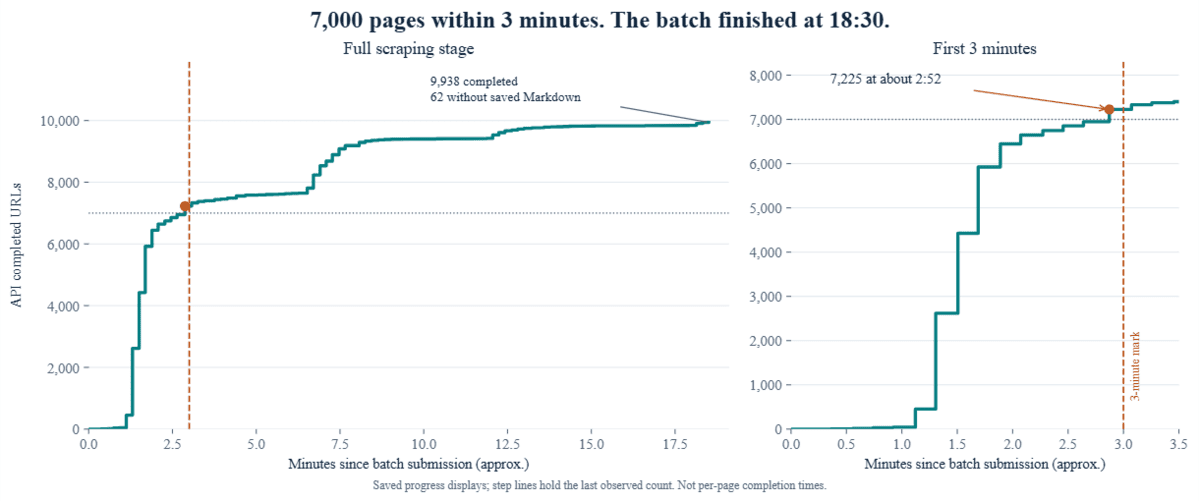
The experiment yielded striking initial performance metrics, with 7,225 pages successfully processed in under three minutes. However, the complete lifecycle of the operation—encompassing the initial scraping phase, data downloading, and rigorous result verification—ultimately took 22 minutes and 26 seconds. Out of the original pool of 10,000 URLs sourced from Mozilla Developer Network documentation, 9,938 were successfully preserved as clean Markdown files. The findings highlight both the immense throughput capabilities of modern batch APIs and the hidden time costs associated with finalizing large-scale data ingestion pipelines.
Understanding How the Olostep Batch API Works
Traditional web scraping often relies on sending thousands of individual HTTP requests sequentially or through concurrent asynchronous scripts, which can lead to IP blocks, rate-limiting issues, and complex error handling. The Olostep Batch API addresses these operational friction points by allowing developers to submit up to 10,000 URLs in a single batch request. Rather than managing thousands of discrete connections, the platform handles the backend processing load while providing programmatic tools to track progress, retrieve completed results, and download extracted content.
As the industry shifts toward automated data collection for artificial intelligence and machine learning models, infrastructure providers are increasingly positioning themselves as enterprise-grade solutions. Olostep is actively expanding its market reach beyond developer-centric tools to offer dedicated web data infrastructure for larger corporate clients. According to company leadership, optimized enterprise workloads can process up to 100,000 pages in under 25 minutes. This level of scale is essential for modern businesses that rely on continuous data streams for competitive intelligence, market trend analysis, and product catalog monitoring.
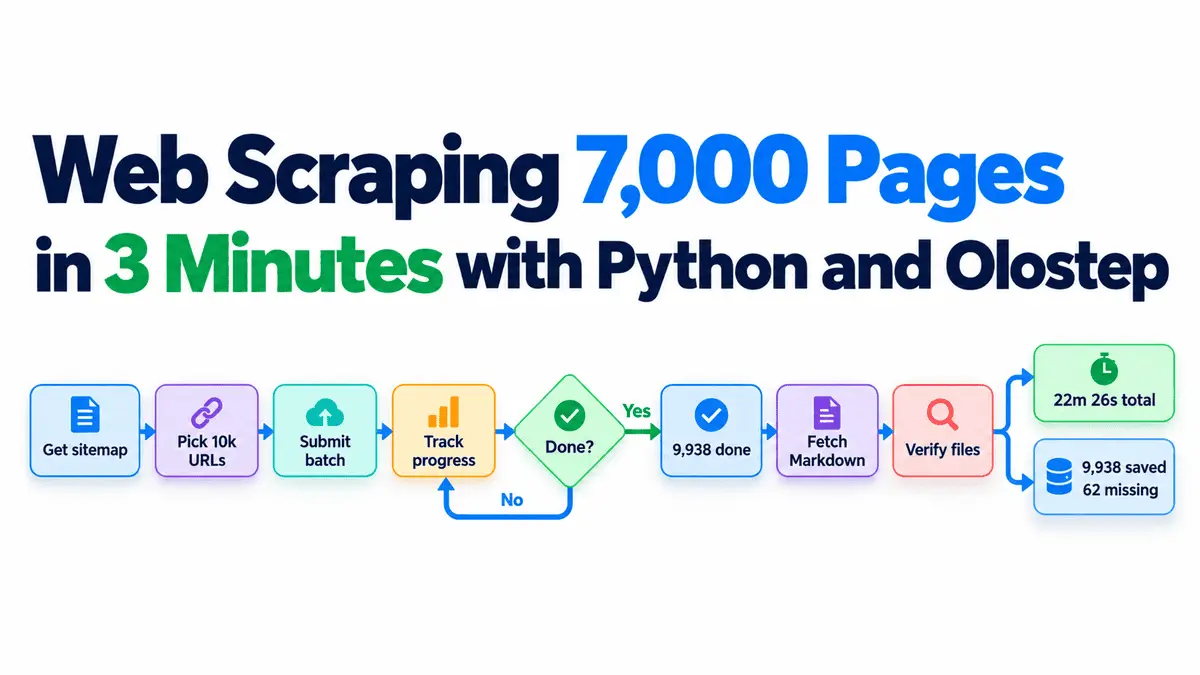
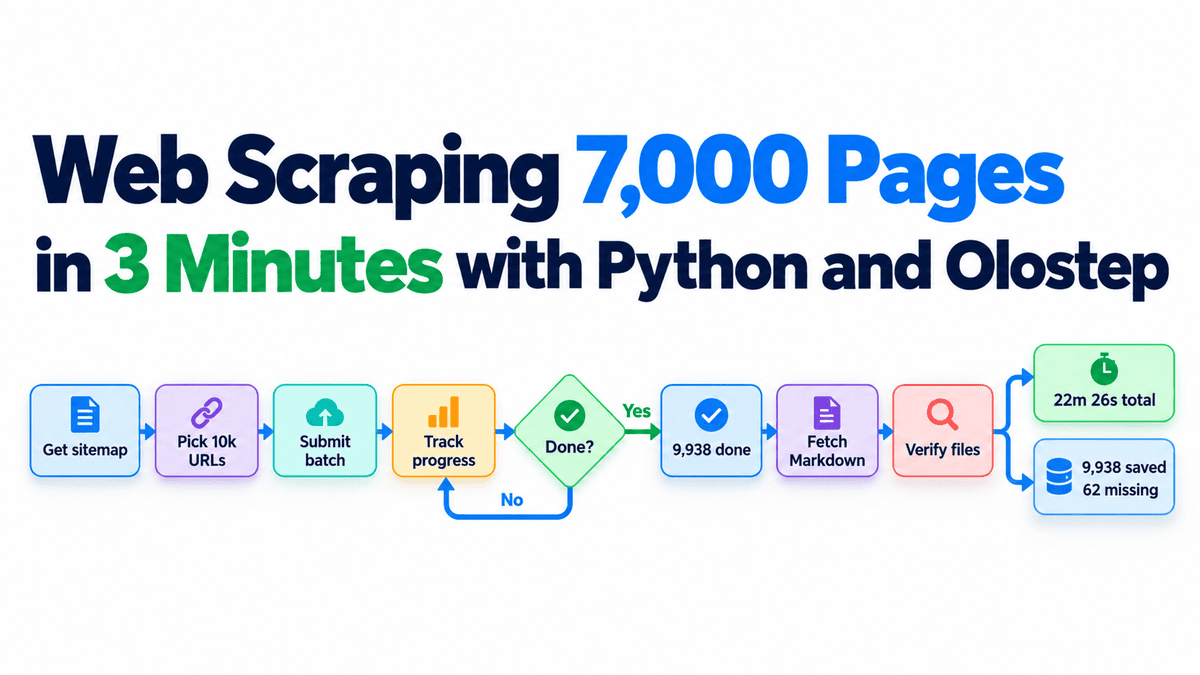
For the purpose of this empirical test, the experiment utilized the Olostep Python Software Development Kit to target 10,000 pages from the Mozilla Developer Network documentation, converting and saving each page directly into Markdown format. The experimental architecture was structured around a multi-stage workflow, moving from initial dataset preparation and batch submission to live progress tracking, parallelized content downloading, and final verification.
A critical observation from the test was that a batch status marking a job as completed does not automatically mean every single target page was successfully captured. In this specific trial, 62 pages out of the 10,000 requested URLs failed to materialize as valid files. This discrepancy underscores the reality that thorough result verification is just as vital as raw scraping velocity when engineering dependable data pipelines for production environments.
Executing the Large-Scale Scraping Experiment
The experimental setup involved a controlled environment utilizing Python 3.13.15 combined with version 1.2.2 of the Olostep SDK. To replicate the test, developers must configure an active Olostep API key, either by establishing an environment variable or entering credentials securely upon execution. Because batch submissions consume API credits, ensuring sufficient account balance is a necessary prerequisite before deploying large-scale scripts.
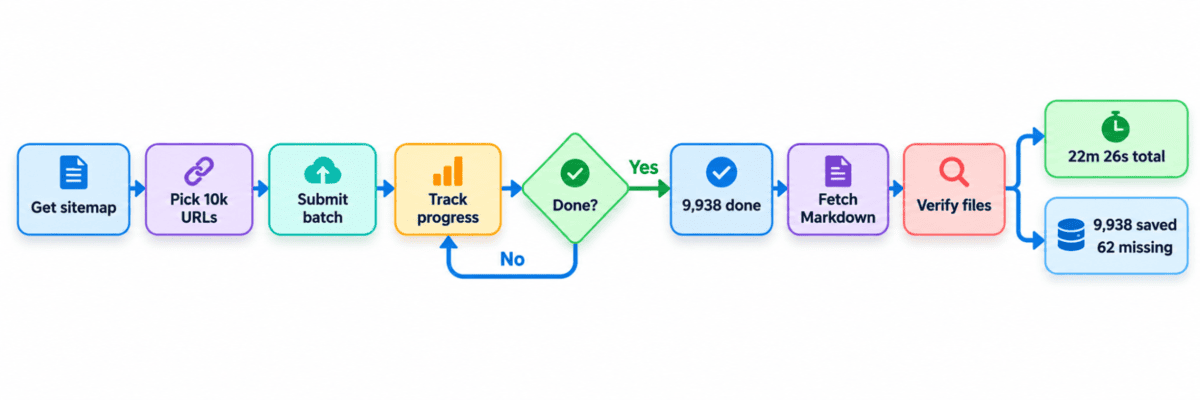
The operational workflow began with the installation of necessary dependencies, including the core Olostep SDK, the requests library for retrieving the MDN sitemap, and tqdm for monitoring execution progress. Following environment configuration, the script targeted the official Mozilla Developer Network sitemap, downloading and decompressing the XML payload to extract available documentation links. From this pool, exactly 10,000 unique URLs were randomly selected using a fixed seed to ensure reproducibility, and the resulting dataset was logged into a local CSV file for reference.
Once the dataset was secured, the URLs were submitted to the Olostep platform in a single batch payload. The script implemented a checkpointing mechanism, saving the batch identifier to a local JSON file so that the job could be safely monitored or resumed if interrupted. During the execution phase, a polling loop tracked the server-side progress, recording elapsed time and completed URLs at regular intervals.
The performance monitoring revealed a fascinating dynamic in processing speeds. During the opening minutes of the run, the platform exhibited blistering performance, clearing more than 7,000 pages in less than three minutes. However, as the batch progressed toward the 10,000-URL threshold, the rate of completion slowed noticeably, with the final batch taking approximately 18 minutes and 30 seconds to reach terminal status.
Retrieving and Verifying the Extracted Data
Once the platform finished processing the batch, the next phase involved downloading the extracted content and translating it into usable local files. To maximize efficiency, the download script utilized asynchronous semaphore controls to manage up to 96 concurrent retrieval operations. It also featured built-in safeguards to skip files that had already been successfully written to disk, preventing redundant network requests in the event of a script restart.
The download phase proved remarkably efficient, securing the majority of the completed items in roughly two minutes and 25 seconds following the conclusion of the scraping stage. Each item was retrieved via its unique identifier, checked for valid textual content, and written to a dedicated Markdown file within a local directory structure.
The final stage of the experiment focused on comprehensive data validation. By cross-referencing the saved files against the original 10,000 target URLs, the verification script generated detailed manifest files and failure logs. Out of the 10,000 requested links, 9,938 files were successfully verified and stored, representing a 99.38 percent success rate, while 62 items encountered issues or failed to return usable content. Factoring in scraping, downloading, and the final verification audit, the total wall-clock time for the entire operation came out to 22 minutes and 26 seconds.
Reflecting on the practical implications of the test, the varying processing speeds across different batch sizes—ranging from smaller runs to the full 10,000-URL workload—suggest that backend resource allocation and dynamic worker scaling play significant roles in handling massive request volumes. While initial throughput figures can be deceptively fast, engineers building enterprise data pipelines must evaluate the complete end-to-end duration of their workflows. Ultimately, the high success rate and detailed visibility provided by the batch architecture demonstrate that modern scraping APIs can effectively support large-scale data collection when paired with robust verification practices.