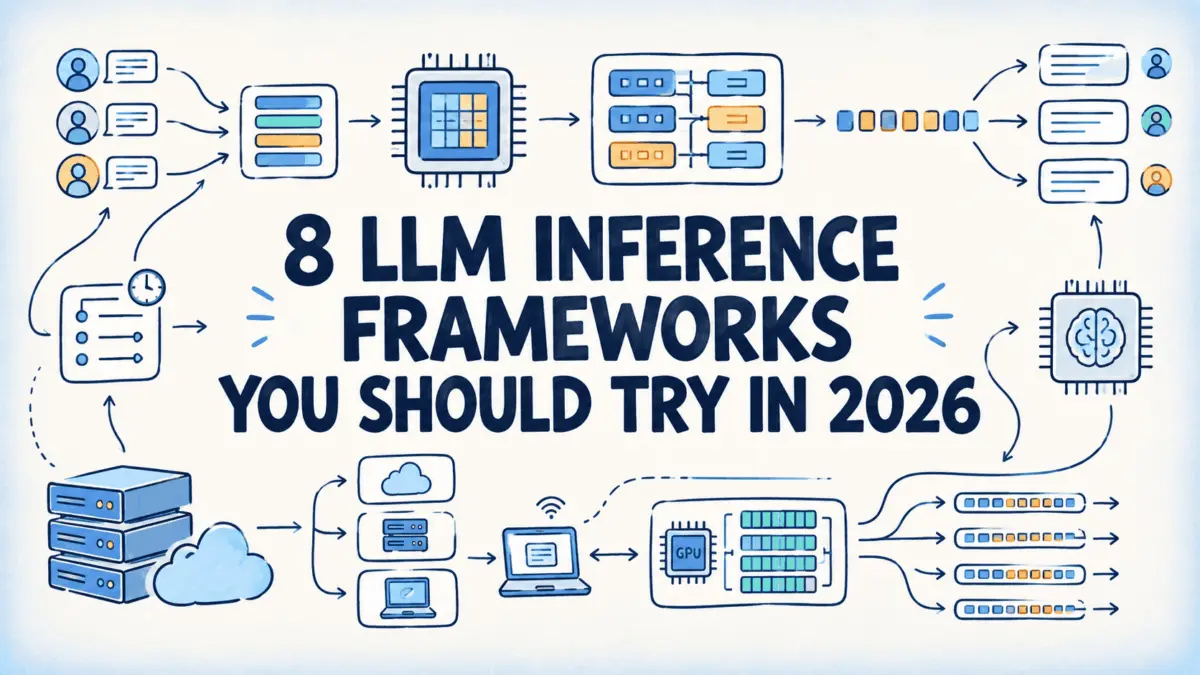
endpoint changes the operational paradigm entirely. A live enterprise application must ingest a multitude of concurrent requests simultaneously, allocating vital GPU memory for every individual request’s key-value cache, assigning a dedicated slot within a dynamic batch, and streaming responses back to clients in real time.
While foundational libraries like PyTorch and Hugging Face Transformers provide the fundamental building blocks necessary to load and execute models, they do not inherently offer out-of-the-box infrastructure for complex request scheduling, cache management, or scalable API layers. Historically, engineering teams had to construct this intricate supporting machinery themselves for every new model they brought to production. Today, however, specialized inference frameworks have emerged to bridge the critical gap between raw machine learning models and robust enterprise applications. These engines sit strategically between the model architecture and the application layer, managing token generation, memory optimization, request batching, and API surfaces. By adopting the right framework, organizations can empower a single GPU to serve significantly more concurrent requests while simultaneously reducing latency—all without altering the underlying model weights.
The landscape of inference frameworks spans diverse operational requirements, ranging from high-throughput, data-center-scale serving solutions designed for massive cloud infrastructure to lightweight tools optimized for local experimentation, edge computing, and low-resource environments.
Among the prominent engines adopted for large-scale deployment is vLLM, which has quickly become a standard starting point for engineering teams transitioning away from plain Transformers architectures. Known for its widespread adoption in production environments, vLLM addresses the core memory bottlenecks of generative AI by optimizing how GPU memory is allocated during token generation. For organizations seeking to scale models across multiple hardware accelerators, the platform offers robust support for tensor parallelism, allowing massive models to be split seamlessly across a cluster of GPUs.
Complementing this approach is SGLang, a framework that pairs a high-performance backend runtime with an expressive frontend language specifically designed for describing complex model interactions. This dual architecture proves particularly valuable for sophisticated workloads that require intricate prompting logic, multi-step reasoning, or structured generation patterns, enabling developers to maintain high execution speeds while orchestrating complex control flows.
For engineering teams requiring absolute optimization down to the hardware kernel level, Modular’s MAX serving framework offers deep control over execution parameters. Designed to extract maximum efficiency from underlying compute resources, MAX allows developers to map serving configurations directly to their specific hardware architecture, ensuring that both CPU and GPU deployments operate at peak performance.
Meanwhile, organizations operating exclusively within an NVIDIA hardware ecosystem frequently turn to TensorRT-LLM. As NVIDIA’s native inference library, its deep integration with the company’s proprietary hardware yields substantial performance dividends. The investment in setup and compilation required by TensorRT-LLM often pays off through maximum execution speed and optimized memory utilization on NVIDIA GPUs.
Another significant contender in enterprise-grade deployment is LMDeploy, a comprehensive toolkit focused heavily on decoding throughput and model quantization. By compressing models without sacrificing performance, LMDeploy enables efficient, concurrent serving across modern GPU architectures, making it a favored choice for large-scale production environments seeking to minimize operational costs.
At the opposite end of the deployment spectrum are tools tailored for local, edge, and resource-constrained environments. Among these, llama.cpp stands out as a lightweight runtime written entirely in plain C and C++ with virtually zero external dependencies. Supporting an extensive array of popular model families including Llama, Qwen, DeepSeek, and Mistral, the framework allows developers to deploy sophisticated language models locally within minutes. Through features like llama-server slots, it even accommodates lightweight concurrent request handling on consumer-grade hardware.
Similarly, Ollama has transformed local experimentation by packaging model downloading, version management, and local serving behind a streamlined command-line interface and API. By abstracting the complexities of local model execution, Ollama serves as an accessible entry point for developers looking to prototype AI applications on laptops and local workstations.
For multi-platform edge deployments and unusual hardware targets, MLC-LLM provides a compiler-based engine built upon Apache TVM. By transforming model weights through specialized compilation pipelines, MLC-LLM enables seamless execution across diverse platforms, spanning AMD, NVIDIA, Apple, and Intel architectures, as well as mobile operating systems and web browsers.
Ultimately, selecting the appropriate inference framework requires careful evaluation of specific traffic patterns, available hardware infrastructure, and target deployment environments. As the generative AI ecosystem continues to mature, benchmarking latency and operational costs directly on production models remains the most reliable path for engineering teams building scalable AI systems.