The amount of public funding pledged by developed countries to help developing nations tackle climate change has plummeted by more than 70% in 2026, according to a new analysis by Carbon Brief.
Under UN climate treaties, wealthy nations are required to provide financial assistance to help developing countries cut their greenhouse gas emissions and adapt to the escalating impacts of climate disasters. Traditionally, these obligations have been fulfilled through multi-year funding announcements that feed into broader global commitments. However, with most of these historical pledges expiring at the end of 2025, the international landscape of climate finance has shifted dramatically.
The sharp decline is driven by a combination of major geopolitical and domestic factors. The United States has once again withdrawn from international climate efforts following a change in administration, while numerous European nations have slashed their foreign aid budgets to accommodate rising domestic fiscal pressures and increased defense spending. Furthermore, civil-society trackers reveal that only five developed nations have stepped forward with new multi-year pledges, with the United Kingdom standing alone as the only major donor among them.
Key historical contributors—including Germany, France, and Japan—have thus far failed to outline concrete plans for new climate finance commitments, and no official public funding is expected from the United States. Consequently, the total amount of public climate finance pledged over the coming years amounts to just $11.7 billion annually, a steep drop from recent spending levels of around $40 billion a year.
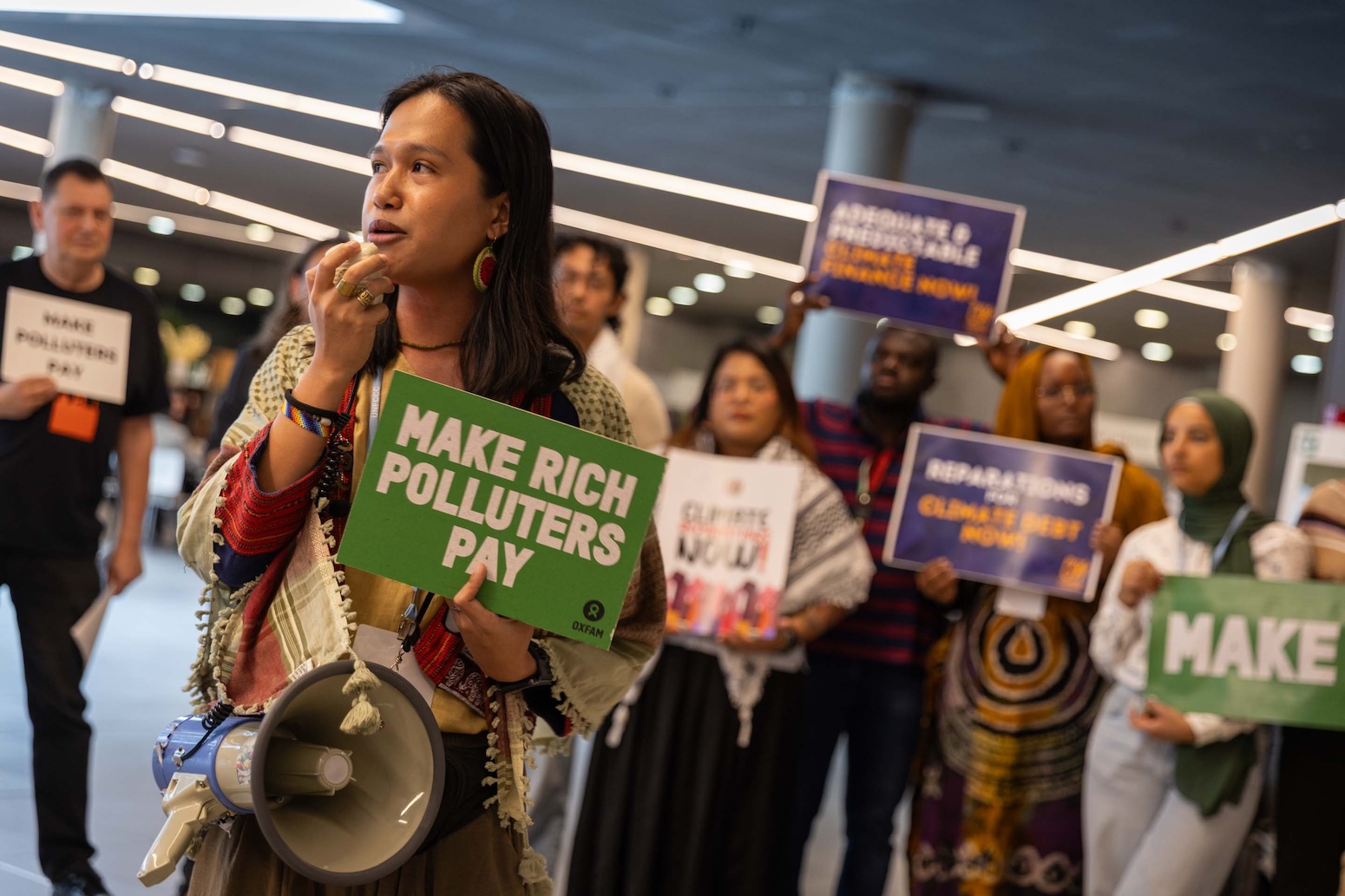
Experts note that compounding global conflicts, tight fiscal constraints, and the rising political influence of far-right movements across the developed world are making it increasingly difficult for governments to allocate new funds for international assistance. As the COP31 climate summit gets underway in Turkey, developing nations are forcefully voicing their urgent need for predictable finance, particularly following the agreement on a new global financial target just two years ago.
Missing Pledges and Shifting Priorities
Under the framework of the Paris Agreement, developed nations carry a formal obligation to mobilize and provide financial support to the Global South. This assistance is channeled through various avenues, including multilateral development banks, dedicated UN climate funds, and private-sector investments that are mobilized by public seed money.
A significant portion of this support, however, is expected to come directly from the public treasuries of developed countries, primarily drawn from foreign aid budgets. In recent years, direct public spending has accounted for roughly one-third of all climate finance flowing to developing nations. Just two years ago, the European Union, the United States, and other wealthy nations agreed to "take the lead" in scaling up annual climate finance from $100 billion in the early 2020s to $300 billion annually by 2035.
Donor countries have historically signaled their intent to meet these targets by announcing multi-year financial goals. With nearly all of those previous pledges expiring in 2025, a severe policy vacuum has emerged. Nearly three decades of established donor frameworks are failing to be replaced by new commitments covering the period out to 2030.
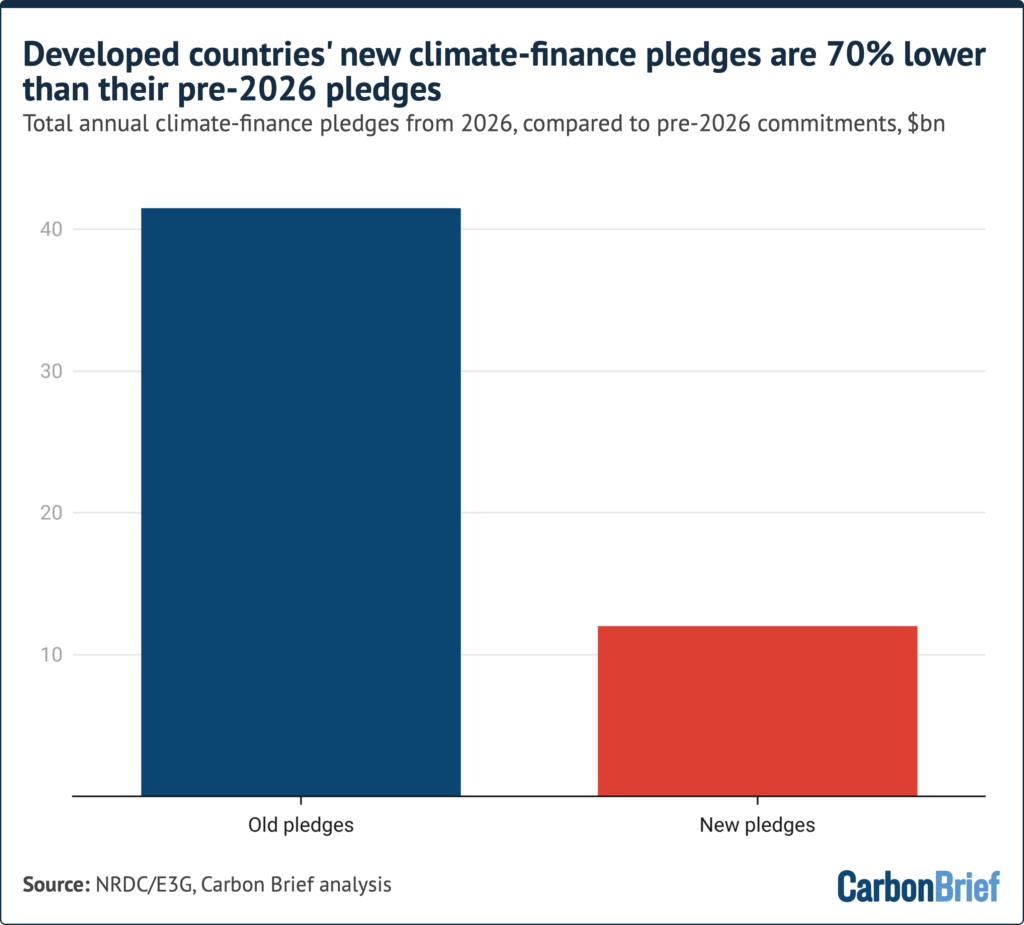
This shortfall is documented in a comprehensive tracking tool maintained by climate NGOs NRDC and E3G. Carbon Brief’s analysis of this data, which utilizes an annualized breakdown of targets, shows that developed countries had previously pledged approximately £42 billion a year in public finance. Based on the new pledges currently on the table, that figure has fallen by roughly 71% to an average of £11.8 billion for the remainder of the 2020s.
While official, finalized data for 2025 is not yet fully available, bilateral public finance reached £43.9 billion in 2024, aligning closely with historical projections. However, the lack of forward-looking commitments leaves a glaring void for the years ahead.
Major Contributors Step Back
International climate finance has historically been dominated by five primary actors: Japan, Germany, France, the United States, and the UK. Together with the European Union, these entities have historically provided roughly 90% of all bilateral public climate finance directed toward developing countries.
Among these heavyweights, only the United Kingdom has put forward a new multi-year pledge, committing £6 billion ($8 billion) in traditional aid between the 2026-29 period, supplemented by £6.7 billion ($8.9 billion) drawn from outside its traditional aid budget. This UK pledge accounts for half of all annual public funds promised from 2026 onward, averaging $5.7 billion per year.
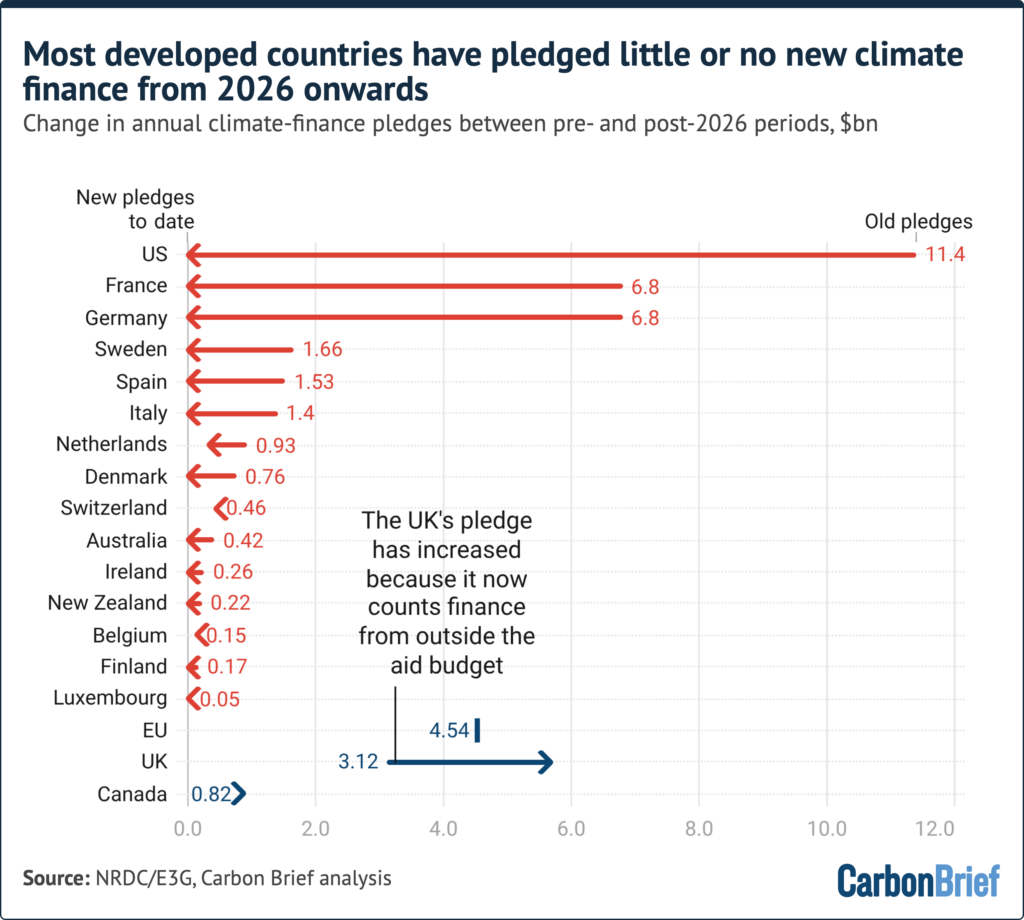
The European Commission makes up the majority of the remaining committed funds, promising an average annual contribution of $4.5 billion out to 2027. Rather than representing a fresh post-2025 pledge, this funding stems from the commission’s pre-existing commitment to spend €28 billion ($31.8 billion) over its broader 2021-2027 budget cycle. Post-2027 contributions remain tangled in ongoing EU budget negotiations.
Canada has pledged to spend 5.3 billion Canadian dollars ($4.1 billion) by 2030, translating to an average of $860 million annually, while the Netherlands, Switzerland, and Belgium have committed relatively modest sums.
Despite wealthy nations formally committing to scale up climate finance under international agreements, these new pledges are generally less ambitious—or only marginally more ambitious—than their predecessors. The UK’s pledge appears robust on paper, but analysts point out that the government has altered its accounting methodology to include $8.9 billion in "additional" public finance tools, such as equity, debt, guarantees, and export credits designed to mobilize private capital. When comparing like-for-like aid components, the UK’s core commitment actually represents a reduction in direct public aid ambition.
The most conspicuous absence is the United States. Under the previous administration, the US had committed to reaching $11.4 billion in annual support by 2024. Following the return of Donald Trump to the presidency, the US has once again withdrawn from the Paris Agreement and drastically reduced its foreign aid allocations, ensuring it will provide no official climate finance in the coming years.

Australia, which is jointly hosting the COP31 summit alongside Turkey, has also failed to table a financial commitment. Josie Lee, policy and advocacy lead at Oxfam Australia, warned that Australia’s failure to announce a climate finance pledge while presiding over the negotiations sends a damaging signal that could embolden governments resisting climate action.
Japan remains the largest overall historical contributor of public climate finance, but it has not traditionally announced standalone targets for this spending, instead bundling public funds with private-sector mobilization goals. As a result, its public finance ambitions were excluded from the baseline comparisons, and Tokyo has not yet announced any new multi-year funding packages.
European Cuts and Political Turmoil
While Europe has long provided the lion’s share of international climate finance, European governments have enacted sweeping cuts to foreign aid budgets in recent years, pointing to severe economic strains and competing demands for increased domestic defense spending.
Germany and France, Europe’s two largest bilateral climate finance contributors, had previously pledged to reach €6 billion ($6.8 billion) per year by 2025. Neither nation has made commitments extending beyond that milestone. Both countries have deeply curtailed their development assistance budgets, causing Germany to miss its 2025 climate finance targets.
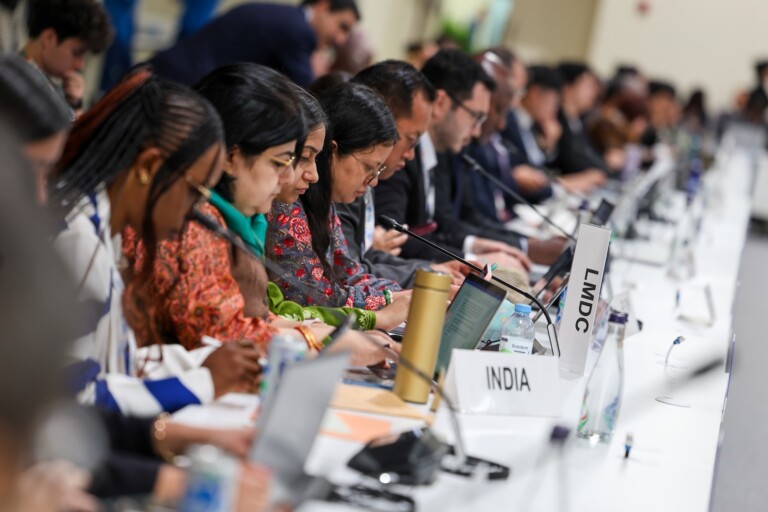
Dr. Anja Carolin Gebel, a senior policy advisor at Germanwatch, noted that climate finance has lost political ground following political shifts and the formation of a new coalition government led by the center-right Christian Democratic Union. Similar political headwinds are evident in France, where Gaïa Febvre of Réseau Action Climat highlights that the rising influence of the far right has made new international financial commitments politically perilous.
Other key European donors are similarly absorbed in domestic political instability. Spain’s center-left government triggered a snap election for late November, making a substantive COP31 pledge unlikely, while Sweden remains locked in coalition negotiations following a tight national vote.
Some nations have offered verbal assurances that funding will continue despite the lack of formal multi-year pledges. The Dutch government, for instance, has stated it will provide "at least" €300 million ($334 million) in dedicated climate funding annually through 2031, with totals likely to run significantly higher in the immediate term.
To address the shortfall, developing nations are championing a dedicated "climate-finance work programme" at COP31 to force discussions on how wealthy nations plan to scale up public support. Conversely, EU officials have emphasized that their member states remain the world’s largest providers of public climate finance—having delivered a record €32.3 billion ($40 billion) in 2025—while urging developing countries to submit overdue domestic emissions-reduction plans.
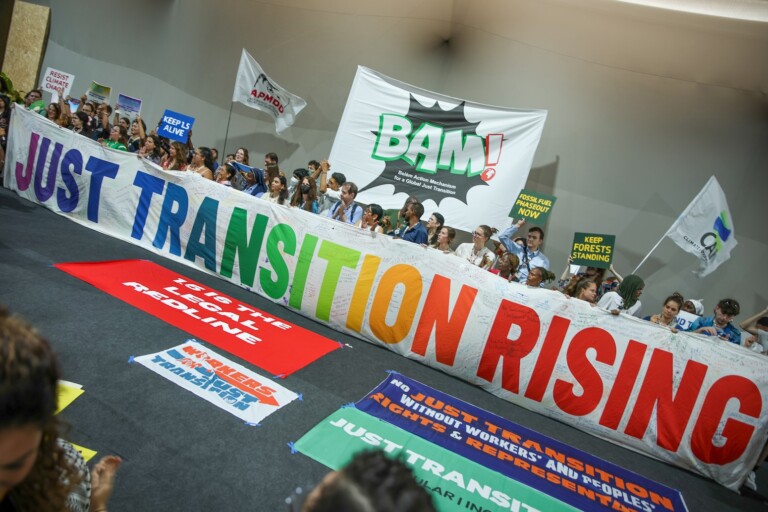
Weighing in on the impasse, EU climate chief Wopke Hoekstra recently remarked that discussions regarding fresh public money are currently "dead in the water."
Joe Thwaites, international climate finance director at the NRDC and co-manager of the commitment tracker, stressed that wealthy nations would benefit from demonstrating clear leadership.
"The lack of new announcements is making the finance negotiations tougher than they need to be," Thwaites said. "The debate around the climate-finance work programme is arising because developing countries have little clarity about how much public climate finance there will be in coming years."