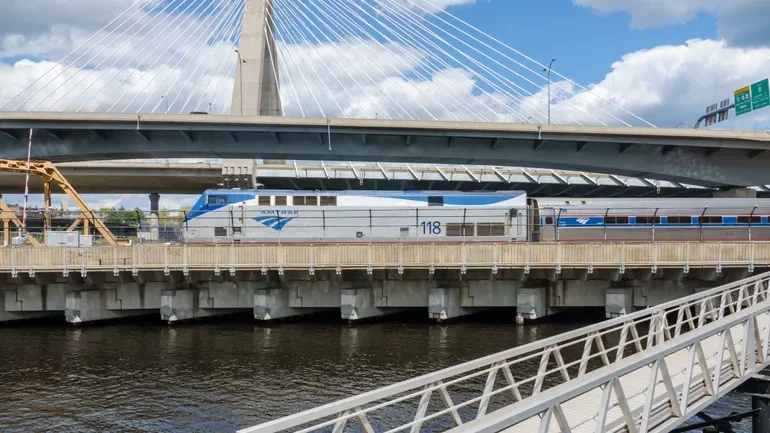
The Commonwealth of Massachusetts has secured a major federal investment aimed at fundamentally transforming passenger rail transit across the state, with a specific focus on modernizing infrastructure in Springfield. The funding marks a critical milestone in a multi-administration effort to bridge geographic divides and integrate western and central Massachusetts more closely with the broader regional economy.
The announcement centers on a substantial $130 million grant awarded by the Federal Railroad Administration to the Massachusetts Department of Transportation. This financial backing is designated for comprehensive upgrades to the tracks and interlockings leading directly to the platform tracks at Springfield Union Station.
State leaders have long championed the expansion and modernization of passenger rail service, viewing it as an essential driver of economic development, environmental sustainability, and social mobility. Current Governor Maura Healey, a Democrat, and her predecessor, former Governor Charlie Baker, a Republican, both prioritized pushing for expanded passenger rail service to western and central Massachusetts during their respective tenures. This rare bipartisan continuity reflects a deep, sustained recognition of the region’s transportation needs.
The concerted push to upgrade the corridor has enjoyed broad-based backing from local political figures throughout the region, major national carrier Amtrak, and freight rail operator CSX Transportation, which owns a portion of the crucial route. Meanwhile, MassDOT maintains ownership of the corridor stretching northward from Springfield to East Northfield, Massachusetts.
Elaborating on the long-term benefits of the project, Governor Healey emphasized the transformative potential of the federal injection in a formal statement. This $130 million investment in Springfield will help the state improve transportation infrastructure, reduce highway and urban congestion, and connect a greater number of communities to vital employment opportunities, housing developments, and broader economic prospects, according to the governor.
Technical upgrades and logistical improvements will form the backbone of the upcoming construction work. The Federal Railroad Administration notes that the funding will specifically upgrade critical interlockings and tracks leading into Springfield Union Station’s platform tracks. In railway operations, interlockings are complex systems of signal apparatus and track switches that allow trains to cross paths and move safely from one track to another without the risk of collision. Upgrading these systems is widely considered essential for increasing train frequency, enhancing schedule reliability, and preventing costly bottlenecks.
Furthermore, Springfield Union Station serves as a vital multi-modal transportation hub for the region. Beyond accommodating intercity passenger trains, the facility routinely hosts intercity bus services, making it a critical nexus for travelers relying on diverse public transit options across western Massachusetts.
The infusion of federal capital into Springfield’s rail infrastructure is viewed by transportation officials as an indispensable step forward for the commonwealth’s transit ambitions. Weighing in on the award, Massachusetts Interim Transportation Secretary Phil Eng highlighted the regional significance of the project in a statement, noting that the funding serves as an important step toward building a more reliable, connected, and efficient passenger rail network for the entire state.
The substantial grant awarded to MassDOT does not exist in a vacuum; rather, it is part of a much broader national funding initiative. The Federal Railroad Administration allocation is drawn directly from a massive $2.3 billion pool distributed through the Consolidated Rail Infrastructure and Safety Improvements program, which was announced on October 19. Under this sweeping federal funding cycle, the FRA carefully evaluated and selected 105 distinct transportation and infrastructure projects spread across 45 states and the District of Columbia.
As engineering planning and project development move forward, state officials anticipate that the modernization of Springfield Union Station’s approaches will lay a solid foundation for future expansions in passenger rail service. By eliminating legacy chokepoints and upgrading physical assets to meet modern standards, Massachusetts moves closer to realizing a fully integrated transit network designed to serve commuters, tourists, and businesses for decades to come.