China’s surging exports of clean-energy technologies—including solar panels, wind turbines, batteries, and electric vehicles—are projected to reduce carbon dioxide emissions outside the country’s borders by roughly 2% by the end of 2026, according to a comprehensive new energy analysis.
The findings, authored by Lauri Myllyvirta, lead analyst at the Centre for Research on Energy and Clean Air and senior fellow at the Asia Society Policy Institute, highlight the massive global footprint of China’s green manufacturing sector. The research indicates that the mitigation impact of these Chinese clean-tech exports grew by 26% year-on-year in the first three quarters of 2026, following a substantial 36% jump in overall impact during 2025.
The analysis, prepared for Carbon Brief, evaluates detailed trade data for clean-tech products, the evolving carbon intensity of electricity systems in destination countries, and the embedded emissions generated during the manufacturing process within China. Should current deployment trends persist through the remainder of the year, Chinese clean-tech exports delivered in 2026 alone will avoid approximately 450 million tonnes of carbon dioxide ($MtCO_2$). This avoided volume is roughly equivalent to the entire annual fossil fuel emissions of Brazil.
The Balancing Act of Manufacturing Emissions
While the long-term climate benefits of these technologies are vast, the analysis also accounts for the initial carbon footprint required to produce them. Looking at full-year data for 2025, manufacturing clean-energy equipment resulted in approximately $170MtCO_2$ of emissions inside China. However, this production successfully avoided $370MtCO_2$ in importing nations over the same timeframe.
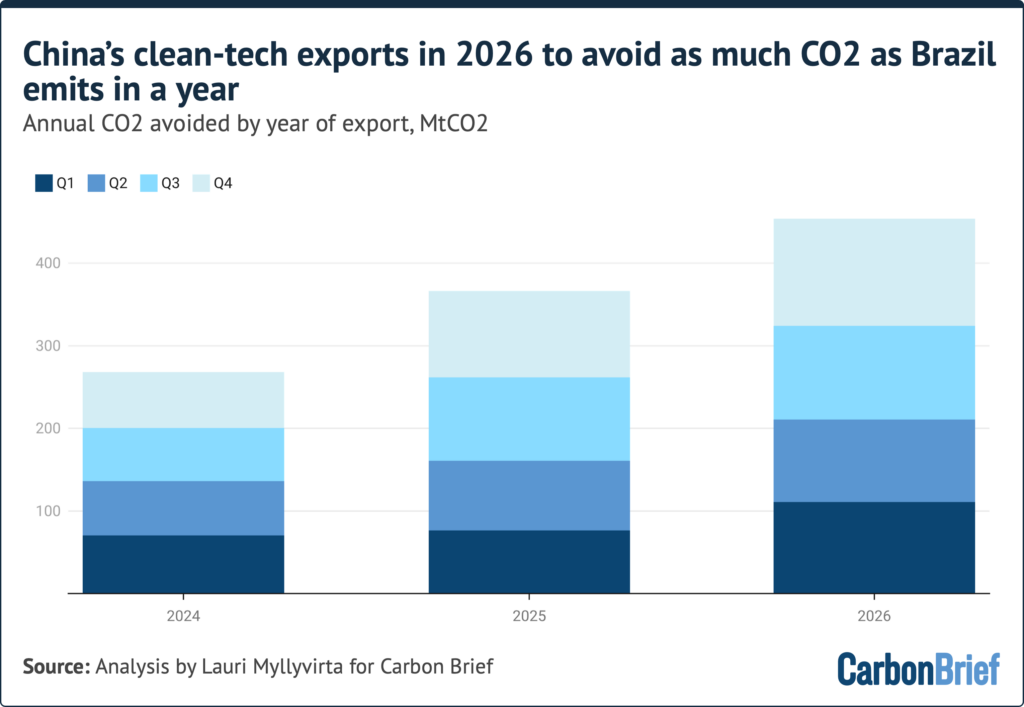
These figures indicate that, on an aggregate global scale, the exported green goods take an average of just six months to completely "pay back" the carbon cost incurred during their manufacturing cycle in China. Once that brief payback window closes, the technology continues to displace fossil fuel generation and consumption for decades, driving down global emissions exponentially.
Solar Exports Remain the Biggest Enabler of Global Decarbonization
China’s solar-equipment exports continue to serve as the single largest catalyst for decarbonization across international markets. Full-year data from 2025 shows that China exported finished solar panels and crucial intermediate products corresponding to a massive 436 gigawatts of total potential generating capacity once assembled and installed abroad.
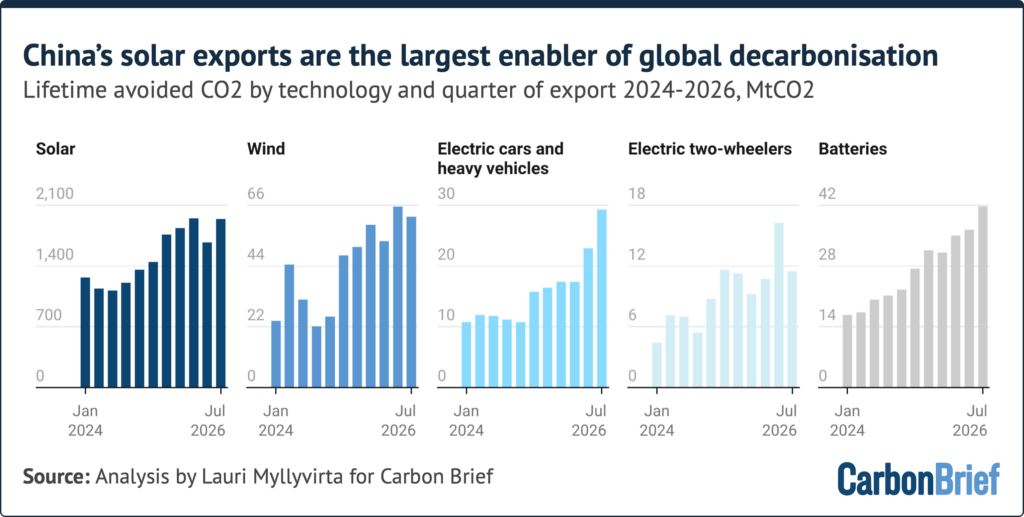
When combined with the export of 8 gigawatts of wind turbines over the same period, these renewable energy components generate approximately 720 terawatt-hours of electricity annually, depending on the average output capacity in each respective destination country. Projections for 2026 suggest that wind and solar equipment exports will scale up to generate approximately 800 terawatt-hours annually—an output equivalent to the generation capacity of roughly 100 traditional coal-fired power plants.
Over their projected 20-year operational lifetimes, the solar equipment exported in 2025 alone is expected to avoid an estimated 6,400 million tonnes of carbon dioxide. This makes solar technology by far the dominant source of lifetime avoided emissions, with wind turbine exports following in second place, displacing a net 180 million tonnes of carbon dioxide.
In the realm of electric transport, China exported 39 million electric vehicles in 2025. This total comprised 36 million two-wheelers, 2.2 million battery-electric cars, 160,000 plug-in hybrid cars, 15,000 buses, and 30,000 heavy-duty trucks. Additionally, the country exported batteries totaling 305 gigawatt-hours of storage capacity, sufficient to power another 5 million battery-electric cars. Factoring in typical driving behaviors, internal-combustion fuel consumption benchmarks, and local grid carbon intensities, these exported electric vehicles and batteries will avoid an estimated $170MtCO_2$ over their lifetimes.
For electric two-wheelers, real-world studies support the conservative assumption that roughly half of e-bike travel directly displaces conventional motor vehicles. Consequently, China’s e-bike exports from 2025 are projected to avoid approximately $40MtCO_2$ over their operational life spans.
The Global South Dominates Avoided Emissions
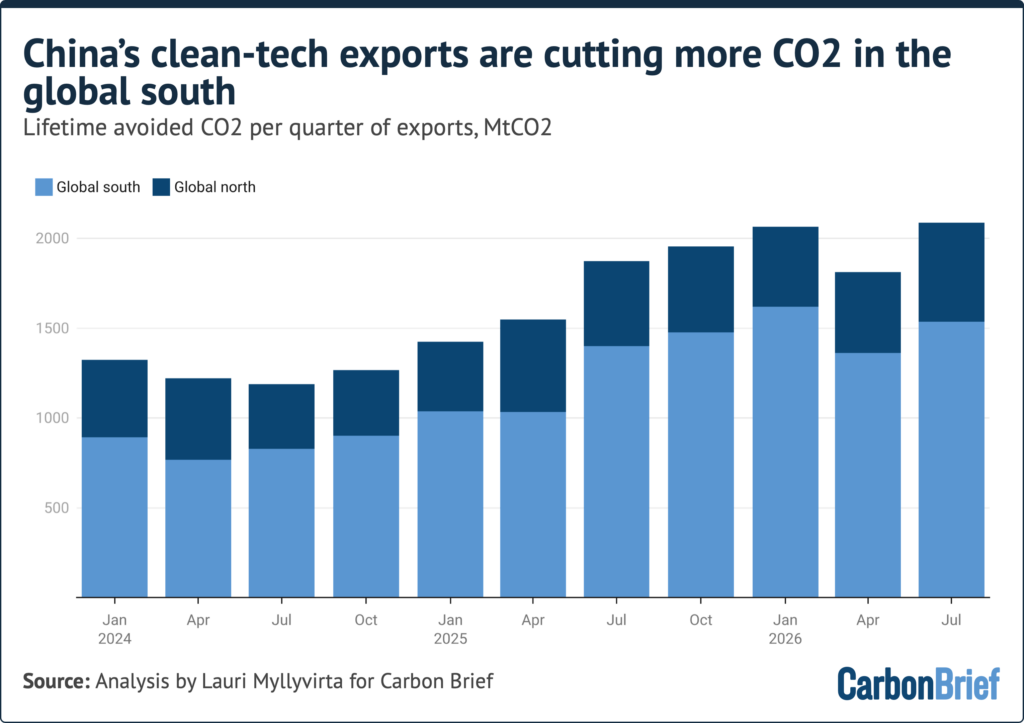
The distribution of these climate benefits is heavily concentrated in developing nations. In 2025, approximately 73% of the lifetime emissions avoided by China’s clean-tech exports were located in Global South countries, which also accounted for 87% of the year-on-year growth in avoided emissions. This trend intensified during the first three quarters of 2026, during which developing nations accounted for nearly the entirety of the increase in global avoided emissions.
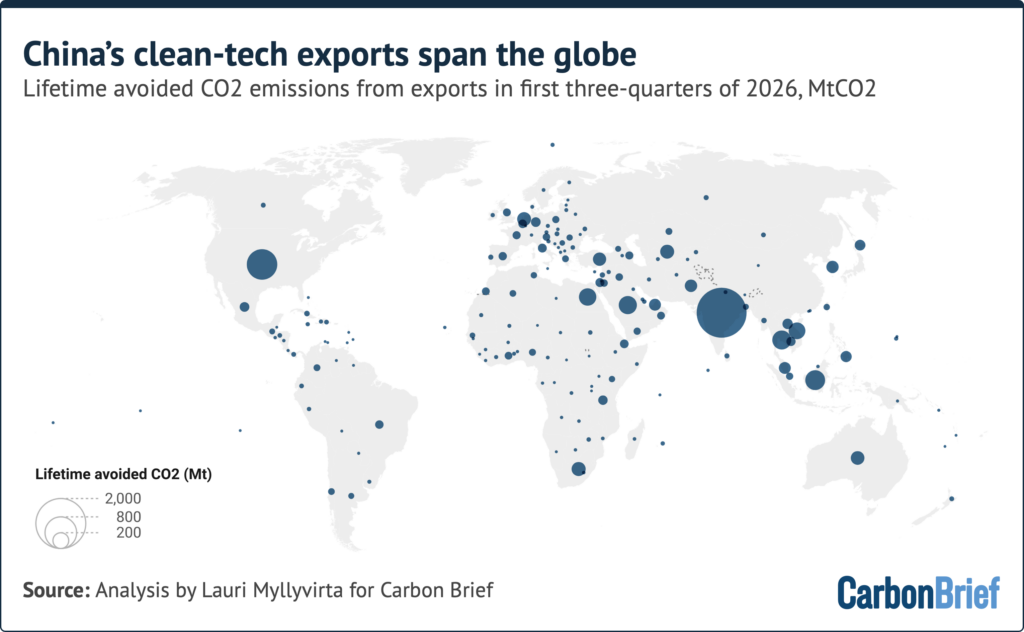
This high proportion is driven by large import volumes, power grids that remain heavily reliant on fossil fuels, and favorable solar irradiation conditions that maximize the output of every gigawatt of installed capacity. Regionally, South Asia leads the world in avoided emissions due to clean-tech imports, backed by robust year-on-year growth. Other top regional destinations include Southeast Asia, North America, Europe, and the Middle East, though the commercial reach spans nearly every country and continent.
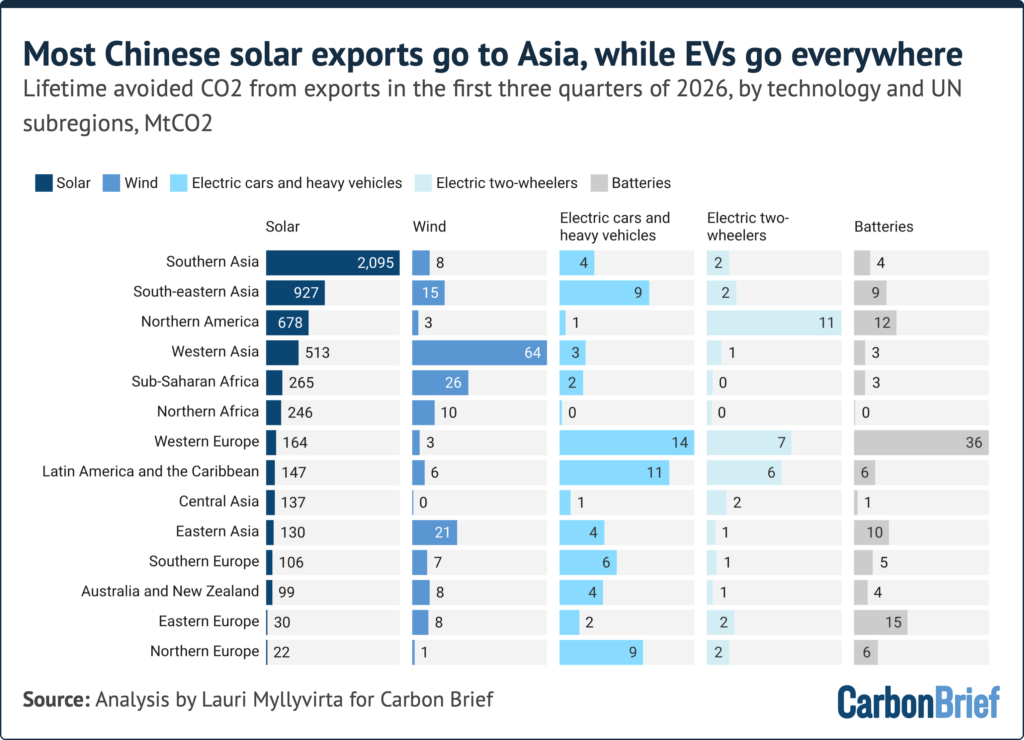
Among individual nations, India holds the largest share of avoided emissions, followed closely by the United States. Despite the introduction of tighter trade restrictions and tariffs by Washington, U.S. avoided emissions rose by another 12% in 2026, surpassing the European Union as a collective bloc. Analysts attribute this to the higher average capacity factor of U.S. solar installations and a more carbon-intensive domestic power grid, meaning every gigawatt of solar installed in the U.S. yields roughly three times more avoided emissions than the same installation in Europe.
Direct Overseas Energy Projects and Evolving Industrial Realities
Beyond equipment exports, China has steadily expanded its direct involvement in overseas clean-energy infrastructure development. This shift follows President Xi Jinping’s 2021 pledge that China would scale up support for green energy in developing countries while halting the construction of new overseas coal power projects.
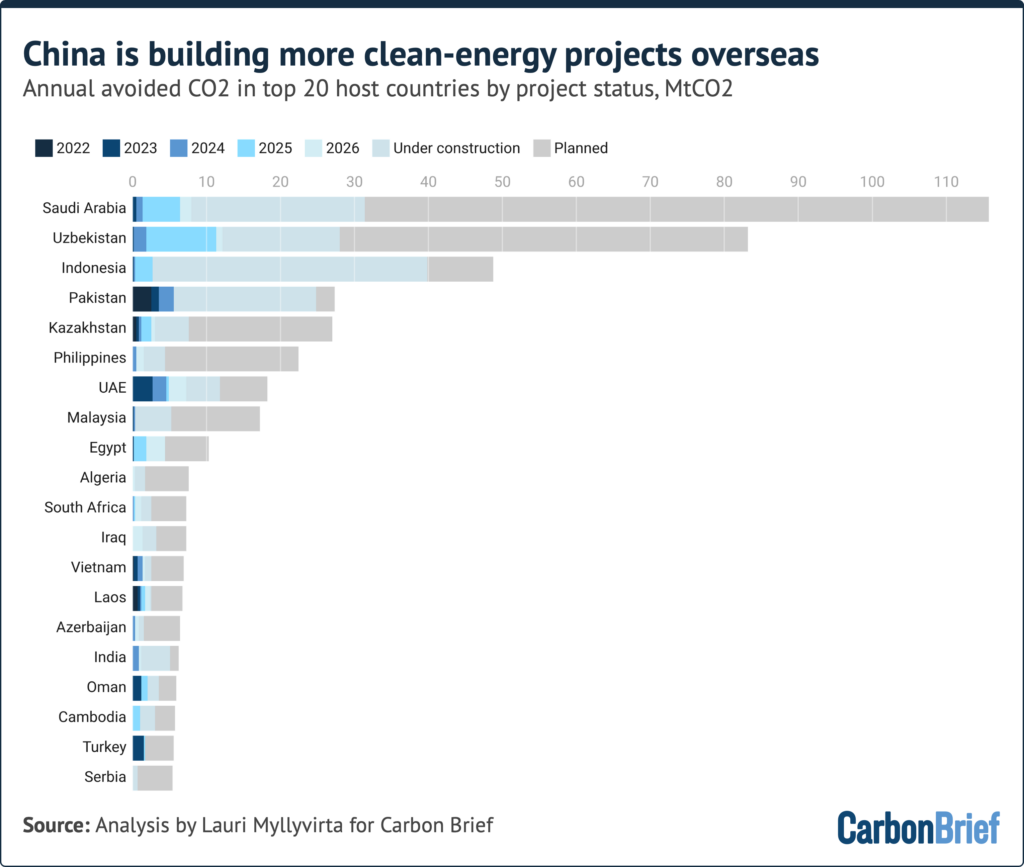
By July 2026, approximately 69 gigawatts of China-linked renewable energy projects were operational abroad, with an additional 100 gigawatts under construction and 280 gigawatts in the planning stages. This renewable pipeline is reinforced by 3.5 gigawatts of operational energy storage projects and another 21.4 gigawatts in development. Furthermore, China has financed and constructed six nuclear reactors totaling 3.3 gigawatts in Pakistan, with construction on an additional 1.2-gigawatt reactor underway.
While these direct investments have transformed China into a major driver of clean power in emerging economies, the scale of direct project development remains small compared to its massive equipment export volume. For instance, while China exported hundreds of gigawatts of solar modules in 2025, only 8.4 gigawatts of solar projects with direct Chinese financing or involvement became operational that year. This indicates that project execution, financing, and infrastructure development using Chinese hardware are predominantly driven by local and international actors.
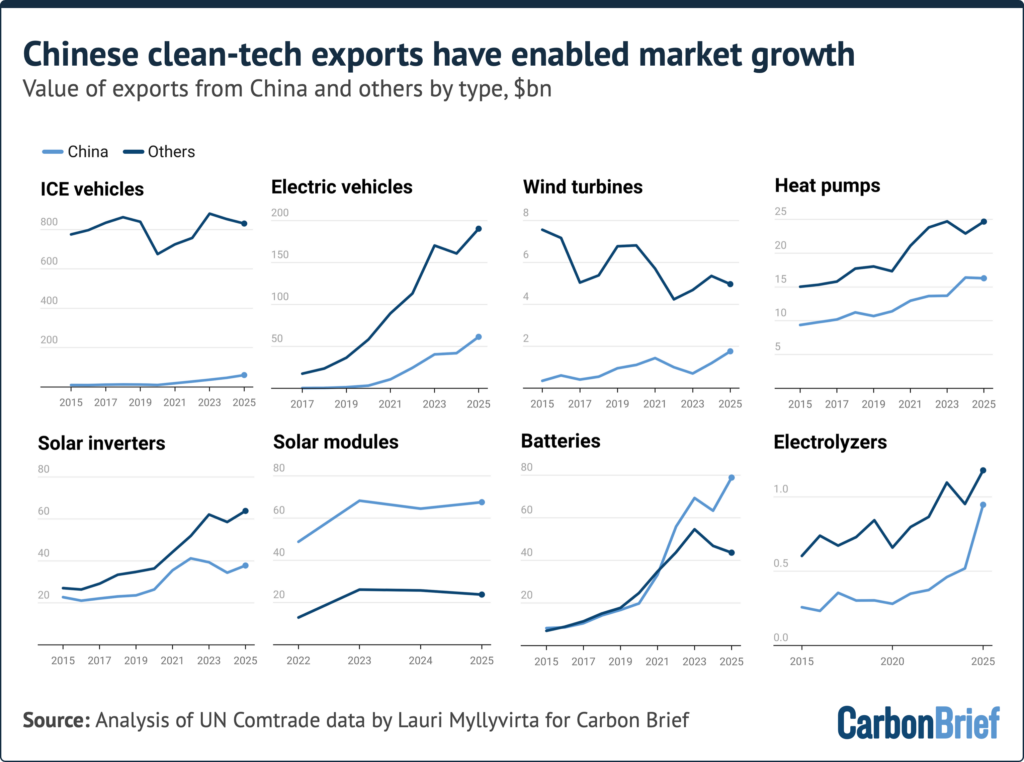
Economic debates continue regarding whether Chinese industrial overcapacity crowds out foreign competitors. However, trade analysis indicates that China’s clean-tech exports have largely captured or enabled broader market growth rather than outright displacing incumbent manufacturing in absolute terms. While traditional vehicle exports from foreign suppliers have faced severe pressure from low-cost Chinese alternatives, markets for heat pumps, solar inverters, and electric vehicles have experienced simultaneous growth in exports from regions like Europe and Latin America.
With clean energy sectors contributing a substantial share of China’s recent GDP growth and accounting for a significant portion of its net export expansion, the nation maintains a profound economic self-interest in the continued success of the global energy transition. As domestic markets for solar and batteries fluctuate following record-breaking deployment highs, maintaining robust export channels remains essential for both global climate targets and Chinese industrial manufacturers.