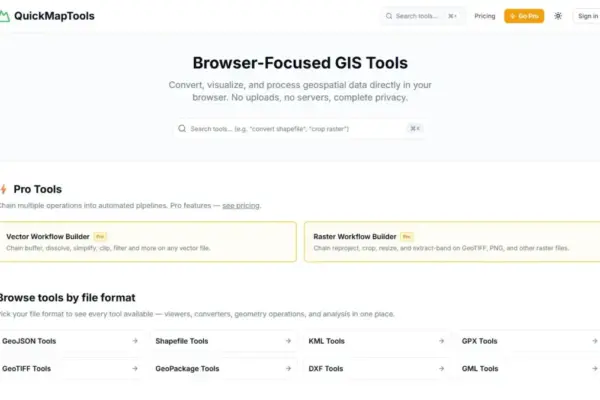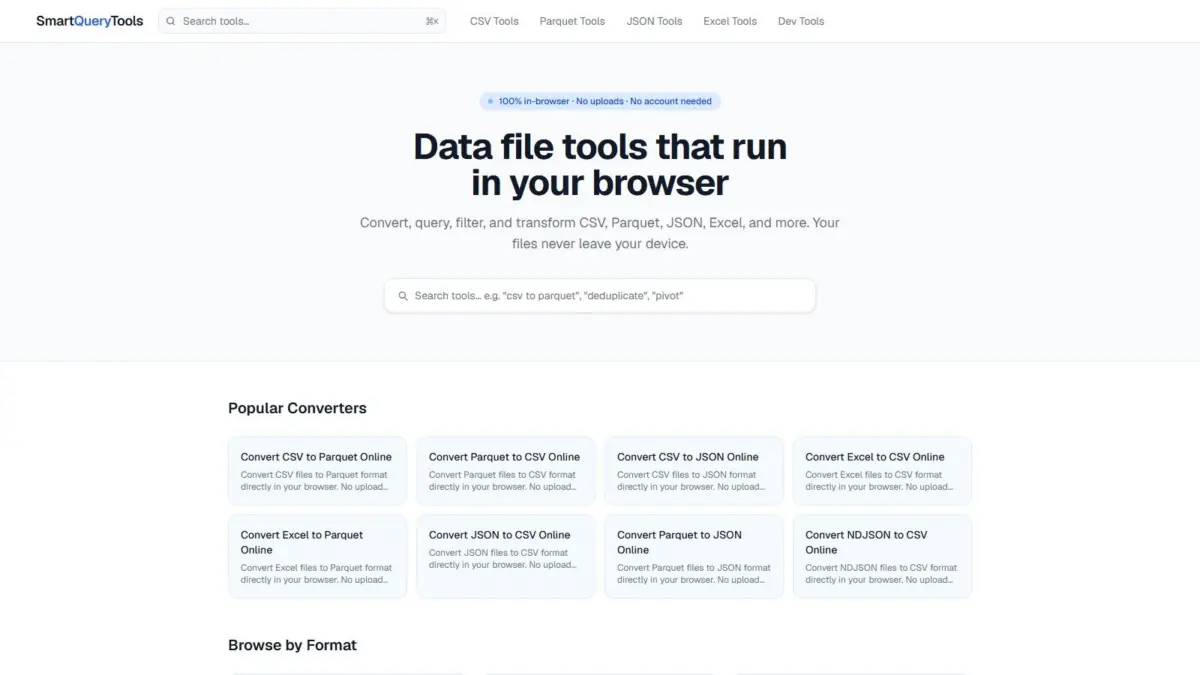
Geospatial specialist and creator of The MapScaping Podcast, Daniel O’Donohue, has introduced SmartQueryTools, a broad collection of web-based data utilities designed to execute directly within standard modern web browsers. The newly launched platform offers data practitioners, spatial analysts, software engineers, and general users the ability to perform an array of data manipulation tasks—including running Structured Query Language (SQL) queries directly on Comma-Separated Values (CSV) files—without installing local software packages, setting up database instances, or registering for user accounts.
At the core of the SmartQueryTools platform is WebAssembly, a low-level binary instruction format that allows modern web browsers to execute high-performance code at near-native speeds. By leveraging WebAssembly technology, the platform shifts computational workloads entirely from remote cloud servers to the end user’s local browser environment. This client-side architecture allows users to upload, query, profile, transform, and export datasets using their own hardware resources, eliminating the performance delays associated with network latency and remote server queues.
Modern data management across enterprise, academic, and technical environments frequently requires converting datasets across inconsistent file formats. SmartQueryTools addresses this technical fragmentation by offering cross-conversion capabilities between a comprehensive selection of file structures. Supported formats include standard Comma-Separated Values (CSV), Apache Parquet, JavaScript Object Notation (JSON), Newline Delimited JSON (NDJSON), Microsoft Excel spreadsheets, Tab-Separated Values (TSV), Apache Arrow, and YAML. The inclusion of modern columnar data storage and in-memory analytical formats alongside conventional text-based spreadsheets provides wide operational utility across varying data engineering pipelines.
The integration of advanced data formats such as Apache Parquet and Apache Arrow represents a notable feature for data engineers and spatial analysts. Apache Parquet has established itself as an industry standard for columnar storage in cloud data warehouses and data lakes due to its high compression ratios and efficient query performance on large datasets. Similarly, Apache Arrow provides a standardized, language-independent in-memory columnar format optimized for analytical operations. Transforming these specialized formats into human-readable text files like CSV or Excel—or converting standard spreadsheets into columnar formats—typically requires local programming environments with custom libraries installed in Python, R, or Rust. SmartQueryTools removes these technical installation barriers by enabling instant format transformations directly inside a standard web browser interface.
The platform also provides dedicated support for structural formats such as JSON, NDJSON, and YAML, which are widely utilized by developers, system administrators, and API integration specialists. NDJSON, which organizes individual JSON objects onto discrete lines, is frequently used for handling event streaming, real-time logging, and large-scale web scraping outputs. By enabling direct transformations between NDJSON streams, traditional JSON arrays, standard YAML configuration structures, and tabular formats such as CSV or Excel, SmartQueryTools simplifies the extraction and inspection of semi-structured data without requiring complex custom scripting.
Beyond data format conversion, SmartQueryTools incorporates several built-in analytical utilities intended for rapid data exploration and transformation. A central feature of the utility suite is its browser-native SQL query tool. This engine enables users to write and execute standard SQL queries directly against flat tabular files loaded into the browser interface. Analysts can run complex filtering, aggregation, grouping, and schema selection tasks using familiar database syntax, operating on raw files like CSVs or TSVs without needing to import them into local or cloud database management systems such as PostgreSQL, MySQL, or SQLite.
Alongside its SQL execution engine, the platform incorporates automated data profilers, multi-file joining tools, and pivot table generators. The data profiling feature allows users to inspect dataset characteristics, analyze schema types, evaluate statistical distribution patterns, and spot missing or malformed values prior to downstream processing. The file joining capabilities allow users to merge separate datasets based on shared key columns directly within the browser window, while the pivot table generator facilitates multi-dimensional aggregation and summary reporting without requiring traditional desktop spreadsheet software.
A critical design choice of SmartQueryTools is its strict local-only execution model and user data privacy framework. In many enterprise, legal, health, and research environments, strict data governance policies prohibit employees from uploading proprietary, confidential, or personally identifiable information to external third-party web tools. Many online file conversion services process incoming files on remote cloud servers, which presents potential security risks, data governance policy breaches, or exposure points for sensitive corporate information.
SmartQueryTools eliminates these privacy risks by ensuring that input files never leave the user’s local computer. Because all computational logic, format parsing, and query execution are processed locally through WebAssembly, no network data transmission takes place, no remote servers receive or process file contents, and no user tracking or account authentication is required. This zero-upload architecture renders the platform suitable for handling confidential internal spreadsheets, protected datasets, and sensitive enterprise records that professionals cannot safely paste or upload into conventional cloud-hosted web utilities.
This browser-bound processing model also resolves technical friction related to corporate IT restrictions and system permissions. Setting up traditional data engineering tools often requires administrative installation rights, dependency management, binary compilation, and command-line configuration. By providing these capabilities directly within a browser interface, SmartQueryTools allows analysts operating on restricted corporate machines or locked-down hardware environments to execute necessary data transformations independently while remaining fully compliant with internal data security protocols.
The platform was created by Daniel O’Donohue, a geospatial specialist who serves as the voice and creator of The MapScaping Podcast, a widely recognized media outlet focused on the geospatial community, geographic information systems (GIS), spatial analysis, and earth observation technologies. Through his work in the spatial technology sector and his podcast interviews with industry leaders, O’Donohue has spent years exploring the practical challenges of handling complex spatial and multi-layered data.
In spatial data workflows, practitioners frequently deal with disparate datasets originating from remote sensing imagery, Internet of Things (IoT) sensors, spatial databases, vector feature layers, and tabular field records. Spatial analysts regularly encounter scenarios where non-spatial tabular data, such as CSV files containing spatial coordinates or tabular attributes stored in Parquet and JSON files, must be cleaned, transformed, queried, or joined before being imported into desktop GIS platforms such as QGIS or ArcGIS. O’Donohue’s practical background in geographic information management informed the development of a lightweight, private utility capable of streamlining preliminary data preparation tasks.
The launch of SmartQueryTools highlights a growing shift toward client-side compute architecture in web software design. As web browser engines continue to advance and support low-level technologies like WebAssembly, complex analytical and data engineering operations that once required dedicated local infrastructure or cloud server compute are increasingly moving to client-side environments. By combining browser-native computation, broad format support, and absolute data privacy, SmartQueryTools provides a practical, secure resource for data practitioners seeking fast, local file manipulation without operational overhead.