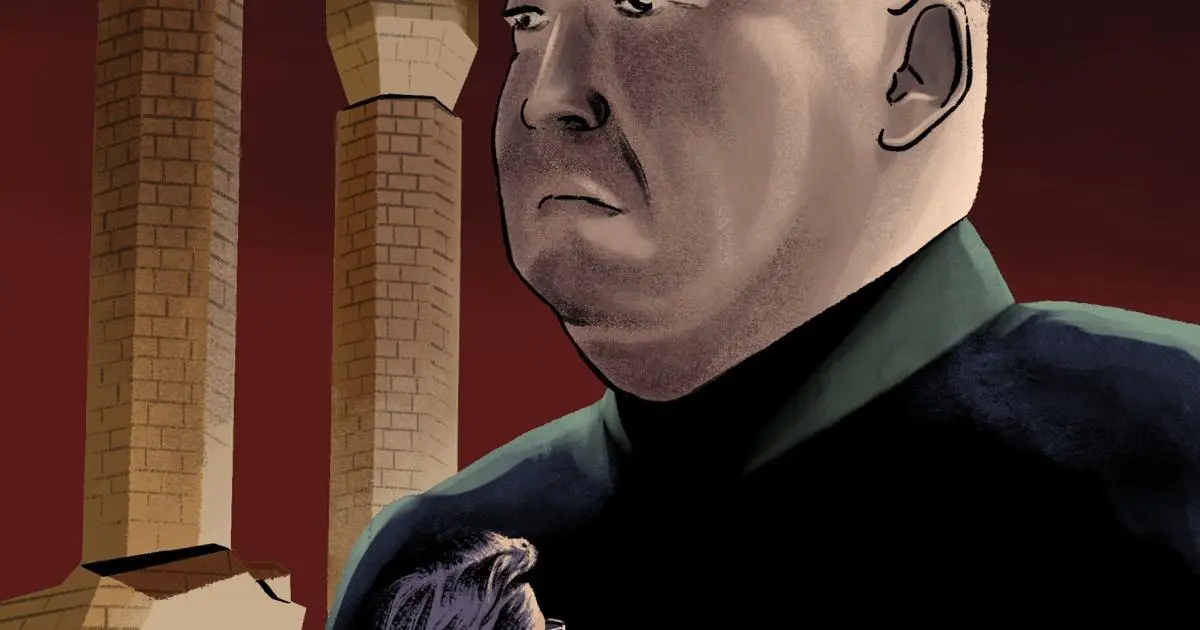
In 2015, North Korean diplomat Thae Yong Ho received a high-profile assignment while stationed in London. Kim Jong Chol, the older brother of North Korean leader Kim Jong Un, was scheduled to travel to the British capital to attend an Eric Clapton concert, and Thae was tasked with looking after him. In the rigid hierarchy of North Korea, providing direct service to the ruling Kim family is considered an immense honor that reflects well on officials and their households. Naturally, Thae expected his two teenage sons to be deeply impressed by the assignment.
To Thae’s profound surprise, his sons reacted with outrage. Ordinary North Koreans could face expulsion from university or even harsher punishments simply for listening to Western music, they reminded their father. Yet here was the ruling family spending thousands of dollars in a single evening to enjoy entertainment that was strictly forbidden to all other citizens. In the eyes of his children, Thae later wrote in his memoir, Password to the Third Floor, he was essentially a prisoner forced to wait on a prison warden. Their sharp reaction left him overcome with shame.
The following year, Thae, his wife, and their sons made a stunning break, escaping to South Korea. His defection caught the international community off guard. Only weeks earlier, Thae had been publicly defending the North Korean regime with fierce conviction. Yet this seemingly incongruous behavior is entirely familiar to those who understand the complex reality of life among North Korea’s ruling class. Officials are often forced to profess absolute devotion to the Kim family right up until the day they run.
The vast chasm between public conduct and private belief remains exceptionally difficult to observe from the outside. For over a decade, researchers have interviewed dozens of former diplomats, Korean Workers’ Party cadres, military officers, businesspeople, and technicians who previously lived, studied, or worked in Pyongyang. These individuals formed the backbone of the system, running the party apparatus, military units, embassies, foreign-currency ventures, and technical programs upon which the survival of the state depends. They enjoyed the best education, housing, food, and social networks their country could provide. While some once believed sincerely in the ideological framework of the system, others learned early on that loyalty was merely a mandatory role they had to perform throughout their lives—a nationwide theatrical production now directed by Kim Jong Un. Nearly all of them described an elite class currently laboring under unprecedented strain.
Since Kim Jong Un assumed power in December 2011, he has systematically tightened his grip on the nation’s elites through sweeping purges of senior party officials and military officers, executing others for minor political missteps. Many members of North Korea’s upper class live with the persistent fear that they or their families can be destroyed at a moment’s notice. At the same time, their escape routes have steadily narrowed. Since Kim sealed off the country’s borders during the COVID-19 pandemic, the number of North Korean defectors reaching South Korea has plummeted dramatically.
Those North Koreans who still manage to slip away increasingly originate from the elite. According to data from South Korea’s National Intelligence Service, the number of defections from North Korea’s upper class recorded under Kim Jong Un’s rule has reached two and a half times the combined total observed during the reigns of his grandfather, Kim Il Sung (1948 to 1994), and his father, Kim Jong Il (1994 to 2011). While the absolute number remains relatively small—totaling in the hundreds—analysts warn it would be a mistake to interpret this trend as a harbinger of imminent regime collapse. North Korea remains remarkably effective at preventing private grievances from crystallizing into organized opposition. The regime does not require every official to genuinely believe in its ideology; rather, it requires doubters to feel utterly isolated and alone in their skepticism.
North Korea has long been branded the “Hermit Kingdom,” but that descriptor paints a misleading picture of total isolation. In reality, it is a nuclear-armed state with diplomatic ties to more than 160 countries, boasting the world’s fourth-largest standing army and highly sophisticated cyber-operations. While the vast majority of the population is fed a relentless diet of state propaganda, most elites are regularly exposed to the outside world. They possess a realistic understanding of global affairs and their country’s actual standing, forcing them to live with intense cognitive dissonance. They must comprehend the real world while simultaneously enforcing and trumpeting official state narratives to their fellow citizens and foreigners alike.
Many high-ranking North Koreans are finding this balancing act increasingly unsustainable. While access to privilege can successfully purchase compliance—and state terror can enforce it—the regime cannot provide what elites increasingly desire: guaranteed security for their families and a viable future for their children. While Kim can alleviate some frustrations by distributing luxury apartments, promotions, and access to extravagant lifestyles, he cannot address the fundamental drivers of discontent without dismantling the strict controls that protect his family’s monopoly on power. Although the state remains fully capable of suppressing open resistance, the growing disaffection of the elite threatens to erode the system from within, leaving a political environment marked by mounting doubt, suspicion, and pervasive anxiety.
TOO CLOSE TO THE SUN
Most of the more than 34,000 North Koreans currently living in South Korea originated from the impoverished northern provinces along the Chinese border, fleeing primarily to escape famine and economic hardship. These individuals typically had little insight into the regime’s inner workings, despite experiencing its cruelty firsthand. Elite escapees, by contrast, emerge from an entirely different environment. They are products of Pyongyang, a capital city of roughly three million people that remains entirely closed off to the vast majority of the country’s 25 million citizens.
Growing up with relatively reliable electricity, running water, and elite educational institutions designed to train future regime operators, these citizens benefited directly from new construction projects, resort developments, and sustained economic growth. Their ranks extend far beyond traditional party cadres and military officers to include artists, software engineers, and restaurant managers groomed from birth to serve the party and the Kim family.
Consider the family of Ri Jong Ho and his son Hyunseung Lee. Ri spent three decades working within Office 39, the secretive agency responsible for earning and managing foreign currency for the leadership. Appointed by Kim Jong Il to senior trade and economic posts, Ri received a Hero of Labor medal and a prestigious Kim Il Sung watch in 2002 as recognition of his loyalty. His son Hyunseung attended elite institutions like the Kumsong Academy and the Pyongyang Foreign Language Institute, and was later permitted to study abroad in China. By his mid-20s, Hyunseung was a trusted party member managing millions of dollars in trade between Chinese companies and North Korea. Despite enjoying the highest echelons of societal comfort, their privileged status offered no protection when the political winds shifted.
The shocking 2013 execution of Jang Song Thaek, Kim Jong Un’s uncle and a veteran official who had served all three Kims, deeply unnerved Ri and other elites. If the regime could eliminate such a decorated family member and attempt to erase him from history, no one was truly untouchable. Ri’s family fled to South Korea from China in 2014, eventually earning master’s degrees from Columbia University, driven by the realization that proximity to power bred profound vulnerability.
Every facet of North Korean society is deliberately structured to prevent independent organization. Party committees operate inside every school, embassy, farm, military unit, office, and factory, while neighborhood units monitor every household. For the elite, this closeness to power invites suffocating scrutiny rather than freedom, drawing them deeper into the grasp of a relentless state security apparatus.
A SPECK OF DUST
Nothing imprinted the dangers of elite life more forcefully than the downfall of Jang Song Thaek. His sudden arrest and public execution sent shockwaves through Pyongyang, serving as an unmistakable warning to all high-ranking officials. Prior to his death, Jang had repeatedly undergone "revolutionization"—a distinct North Korean punishment that strips officials of their titles and sends them to perform grueling physical labor and political reeducation in the countryside, only to sometimes be temporarily rehabilitated.
When Kim Jong Un took power in his late 20s, he moved aggressively to purge senior cadres and military officers from his predecessors’ eras, a consolidation of power external observers viewed as an attempt to compensate for his youth and lack of military experience. When the COVID-19 pandemic struck, the regime further tightened its borders and passed draconian laws criminalizing the consumption of foreign media in an effort to "repurify" socialist culture.
Loyalty in North Korea is evaluated from childhood based on school conduct, political participation, and songbun—a hereditary loyalty classification system divided into "core," "wavering," and "hostile" groups. Adults must regularly attend public self-criticism sessions where they confess minor transgressions and critique colleagues, often coordinating their confessions beforehand to satisfy ideological requirements without triggering real danger. Furthermore, households must maintain spotless portraits of the Kims at the highest point of their walls, with habitation inspectors making regular white-gloved visits to check for dust.
Scholars describe this widespread behavior as preference falsification, where individuals publicly misrepresent their beliefs because honesty carries fatal consequences. Elites constantly calibrate their speech, allowing genuine belief and deep cynicism to coexist within the same offices and minds.
WHAT THE ELITE WANT
Despite these pressures, giving up a lofty social position is difficult. Kim Jong Un has made deliberate efforts to appease the ruling class by constructing gleaming new housing in Pyongyang and distributing foreign vehicles, luxury watches, and steady employment. An elite title provides tangible status, societal deference, and a strong sense of personal relevance that ordinary citizens cannot access.
However, this social contract has a clear expiration date. Retired senior officers and cadres do not receive pensions; the government routinely reclaims state-provided cars, homes, and appliances, often reducing elderly veterans to working as guards or market vendors. Younger elites, witnessing this cycle, are increasingly motivated to accumulate private wealth and secure futures in business and technology rather than enduring decades of military conscription or rigid party careers.
The rapid growth of unofficial markets—sparked by the collapse of the public distribution system during the famine years of the 1990s—has profoundly altered daily life. Although the state officially condemns capitalism, it now taxes regulated markets and allows selected officials to engage in business ventures, provided they continue performing their duties and paying mandatory loyalty funds. Money has become a powerful secondary currency of influence, often rivaling traditional political rank.
ALONE, TOGETHER
While elite disaffection is undeniably growing, it has not translated into an imminent uprising. The regime’s pervasive surveillance network, collective punishment policies, and strict prohibition of unapproved gatherings effectively atomize the population, leaving potential dissidents unsure of whom they can trust. For most aggrieved officials, organizing reform is far too dangerous, leaving defection as the primary alternative for those willing to abandon their homeland and face the permanent loss of family ties.
Ultimately, the vulnerability of the Kim family regime lies not in a sudden mass revolt from below, but in the slow erosion of genuine ideological conviction at the top. As the loyalty of the elites becomes increasingly performative and driven entirely by self-preservation, the foundational pillars of the totalitarian state grow steadily more precarious.