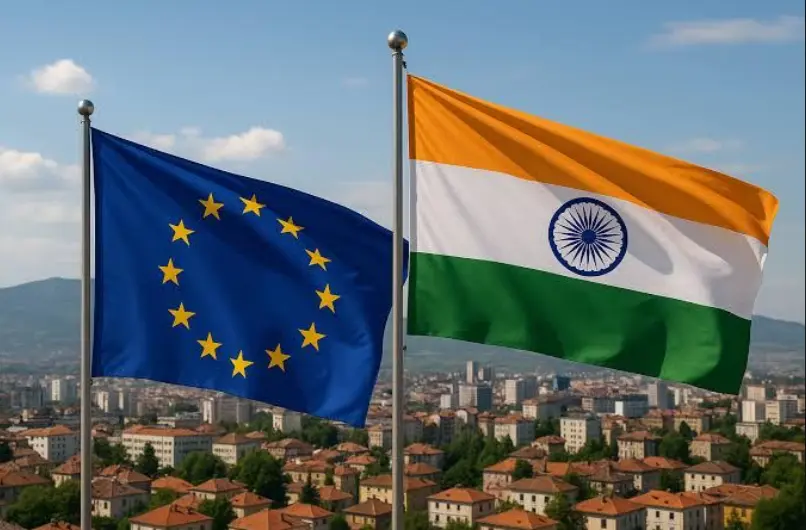
The maritime partnership between India and the European Union has undergone a profound transformation, evolving from a modest framework of anti-piracy coordination in the Gulf of Aden into a comprehensive security and strategic relationship. This structural evolution mirrors sweeping shifts in the global geopolitical environment, marked by heightened Indo-Pacific competition, frequent disruptions to vital shipping and supply chains, an escalating reliance on digital maritime infrastructure, and mounting international apprehension over the vulnerability of ports, undersea cables, and other critical maritime assets.
As the institutional architecture binding New Delhi and Brussels grows increasingly robust—underpinned by high-level dialogues, frequent naval interactions, and the formalization of the India-EU Security and Defence Partnership—the defining hurdle for both actors no longer lies in establishing diplomatic consensus. Instead, the primary challenge is to successfully convert these expansive political frameworks into sustained, practical operational cooperation across shared maritime domains.
While India and the European Union approach the global maritime commons from distinct strategic traditions and foreign policy standpoints, their fundamental security and economic interests are witnessing a steady, undeniable convergence. Consequently, the future trajectory of India-EU maritime cooperation will not be measured by the sheer breadth of its written commitments, but rather by its proven ability to translate shared interests into collective, real-world maritime action. The ultimate test facing both powers is whether they can seamlessly transition from being strategic partners on paper to becoming truly effective partners in securing the seas.
From Anti-Piracy Coordination to a Broader Maritime Relationship
The formal foundation of the India-EU relationship was laid with the establishment of their Strategic Partnership in 2004. However, initial maritime cooperation remained narrowly focused. The proliferation of Somali piracy off the Horn of Africa provided the first genuine context for sustained operational coordination. In 2008, the European Union launched Operation Atalanta to combat piracy, while the Indian Navy concurrently deployed warships independently to the Gulf of Aden. Operating without a unified command structure, the two sides nevertheless managed to coordinate merchant vessel escorts, exchange vital intelligence, and gain critical operational experience against a shared maritime menace.
This early practical cooperation established a reliable baseline for broader engagement. A decade later, the EU-India Strategic Partnership: A Roadmap to 2025, adopted in 2020, formally proposed expanding the scope of interaction by replacing the limited counter-piracy dialogue with a comprehensive maritime security dialogue. This ambition was further reinforced by complementary policy frameworks, notably the European Union’s 2021 Indo-Pacific strategy and India’s overarching SAGAR vision—Security and Growth for All in the Region—alongside the Indo-Pacific Oceans Initiative.
Momentum quickly translated into operational milestones. The first-ever joint naval exercise between the Indian Navy and EU naval forces took place in the Gulf of Aden in June 2021. This was followed by a subsequent joint exercise in the Gulf of Guinea in October 2023, and an advanced counter-piracy drill staged in the wider Indian Ocean in June 2025. Complementing these exercises, the fourth EU-India Maritime Security Dialogue, convened in March 2025, tackled critical agenda items including the protection of vital maritime infrastructure, enhancements in maritime domain awareness, and regional capacity-building initiatives.
The institutional momentum reached a significant milestone with the first EU-India Security and Defence Dialogue, held in New Delhi on March 6, 2026. This meeting served to operationalize the broader Security and Defence Partnership signed earlier that year on January 27, 2026. The agreement successfully consolidated existing security ties within an overarching political framework, explicitly highlighting joint naval activities, maritime domain awareness, safeguarding critical submarine infrastructure, and regional capacity-building as core pillars for deeper bilateral collaboration.
This rapid institutional maturation is a direct response to a radically altered threat environment. The contemporary maritime domain is plagued by an expanding Chinese naval footprint, persistent attacks on commercial shipping in the Red Sea, severe supply-chain vulnerabilities, and heightened exposure risks facing coastal ports and undersea fiber-optic cables. Consequently, the bilateral security agenda has expanded far beyond traditional naval defense to encompass the long-term resilience of global trade routes, the protection of critical infrastructure, and the sustainable governance of shared maritime resources in an era of escalating climate-related risks.
Converging Interests, Different Strategic Motivations
The compelling case for closer cooperation does not rely on India and the European Union possessing identical strategic priorities or foreign policy outlooks. Rather, their partnership is driven by complementary needs and distinct domestic incentives that naturally align at sea.
For India, deepening maritime cooperation with European capitals supports the broader diplomatic goal of diversifying its strategic partnerships, gaining access to advanced marine technologies, and securing a prominent role in shaping the security architecture spanning the Indian Ocean and the wider Indo-Pacific. This engagement serves as a natural extension of New Delhi’s national emphasis on regional stability, maritime security, and collaborative capacity-building with neighboring littoral states.
For the European Union, the maritime relationship is deeply anchored in economic survival and trade security. European prosperity relies heavily on uninterrupted sea lanes passing through the Indian Ocean and the vital choke points of the Indo-Pacific. Ensuring the security of these maritime routes, maintaining resilient supply chains, and safeguarding reliable digital and physical infrastructure are matters of profound economic and strategic urgency for the bloc.
These divergent motivations find their clearest point of intersection in maritime security and situational awareness. India’s Information Fusion Centre for the Indian Ocean Region provides an established, highly effective hub for monitoring vessel traffic and improving regional domain awareness. Conversely, European partners bring advanced satellite surveillance, specialized naval capabilities, and robust regulatory frameworks to the table. Enhancing the interoperability of these distinct technological systems offers far greater practical value to both sides than the creation of yet another diplomatic dialogue mechanism.
The underlying economic stakes are massive. International shipping data indicates that more than 80 percent of global trade by volume moves across the oceans. Furthermore, the Indian Ocean connects some of the world’s most critical energy transit corridors, including the Strait of Hormuz and the Strait of Malacca, rendering any disruption to these geographical chokepoints an immediate threat to global energy security and macroeconomic stability.
Constraints on Deeper Cooperation
Despite the clear convergence of economic and security interests, significant structural constraints continue to influence the depth and speed of India-EU alignment. Different strategic cultures and policymaking traditions mean that total alignment is neither expected nor necessarily required.
India’s steadfast commitment to strategic autonomy can occasionally place boundaries on institutional alignment with external partners, particularly during acute geopolitical crises. However, this foundational policy also provides New Delhi with the flexibility to deepen practical maritime cooperation without necessitating formal alliance commitments. On the other side, the European Union faces its own unique institutional hurdles. The formulation and execution of EU foreign and security policy depend heavily on achieving internal consensus among diverse member states, a dynamic that can frequently limit both the speed and the overall scope of collective external action.
Institutional fragmentation poses another ongoing challenge. While the Security and Defence Partnership signed in 2026 provides an overarching political umbrella, day-to-day maritime activities remain dispersed across a wide array of specialized dialogues, bureaucratic agencies, and operational mechanisms. The primary obstacle is rarely a shortage of institutions, but rather the pressing need to better connect existing bodies to tangible, practical outcomes on the water.
Operational ambitions are further checked by physical capacity limits. European naval assets are routinely stretched thin across multiple global theaters, while the Indian Navy maintains extensive, primary responsibilities across the vast expanses of the Indian Ocean Region. These realities naturally favor selective joint exercises, targeted information sharing, and cooperative regional capacity-building over unrealistic expectations of continuous, permanent joint deployments.
Defense-industrial cooperation remains a major test of the partnership’s strategic depth. Strict export controls, complex procurement regulations, and long-standing technology-transfer restrictions frequently impede efforts to transition the relationship from simple equipment acquisition toward genuine co-development and co-production of advanced maritime capabilities.
Finally, contemporary maritime threats increasingly transcend traditional institutional boundaries. Complex challenges such as cyberattacks targeting port infrastructure, physical sabotage of submarine communication cables, rampant illegal fishing, and climate-induced humanitarian disasters cannot be resolved by navies alone. They demand coordinated responses spanning navies, coast guards, civil regulators, technology agencies, and commercial maritime operators alike.
Priorities for the Next Phase of Partnership
To overcome these structural limitations and maximize the potential of their relationship, India and the European Union are focusing their efforts on several key operational priorities designed to bridge the gap between policy and practice.
First, both partners are working to operationalize maritime domain awareness by making information sharing a central priority. By improving the interoperability of existing surveillance, satellite tracking, and white-shipping monitoring systems, New Delhi and Brussels aim to establish clear protocols for exchanging intelligence regarding piracy, suspicious vessel movements, and threats to critical underwater infrastructure. The shared objective is to achieve faster, more reliable common situational awareness without adding unnecessary bureaucratic layers.
Second, the protection of maritime critical infrastructure—including commercial ports, submarine data cables, and offshore energy installations—has emerged as a distinct and urgent area of collaboration. Conducting joint risk assessments, synchronized cyber exercises, and developing coordinated crisis-response protocols involving both government authorities and private infrastructure operators are viewed as essential defenses against modern hybrid and cyber threats.
Third, naval and coast-guard exercises are gradually evolving beyond basic anti-piracy drills and humanitarian assistance scenarios. Future engagements are slated to tackle more demanding operational environments, such as maritime infrastructure protection and complex mine countermeasures, where operational success relies entirely on rigorously tested joint procedures rather than mere political messaging.
Fourth, sustainable maritime connectivity received a significant boost with the advancement of the India-EU Green Shipping Corridor initiative. Building upon initial pre-feasibility studies, a dedicated industry coalition was formally launched at the Sagarmanthan event in New Delhi. This coalition seeks to connect expanding Indian green-fuel production capabilities with surging European maritime demand, with a particular focus on green ammonia and methanol. The current focus centers on commercial viability, port readiness, targeted investments, and practical deployment across the supply chain.
Finally, joint support for smaller Indian Ocean island states and littoral nations provides an effective avenue for converting bilateral goodwill into regional public goods. By coordinating coast guard training programs, offering hydrographic assistance, bolstering maritime law enforcement capabilities, and improving disaster preparedness, India and the European Union can meaningfully contribute to long-term stability across the broader region.
The evolution of India-EU maritime relations from parallel anti-piracy efforts into a comprehensive security partnership reflects a mature understanding of shared global vulnerabilities. The defining task ahead is to ensure that the existing institutional framework translates into durable, tested mechanisms for situational awareness, infrastructure protection, and operational interoperability, marking a new chapter defined by implementation rather than ambition alone.