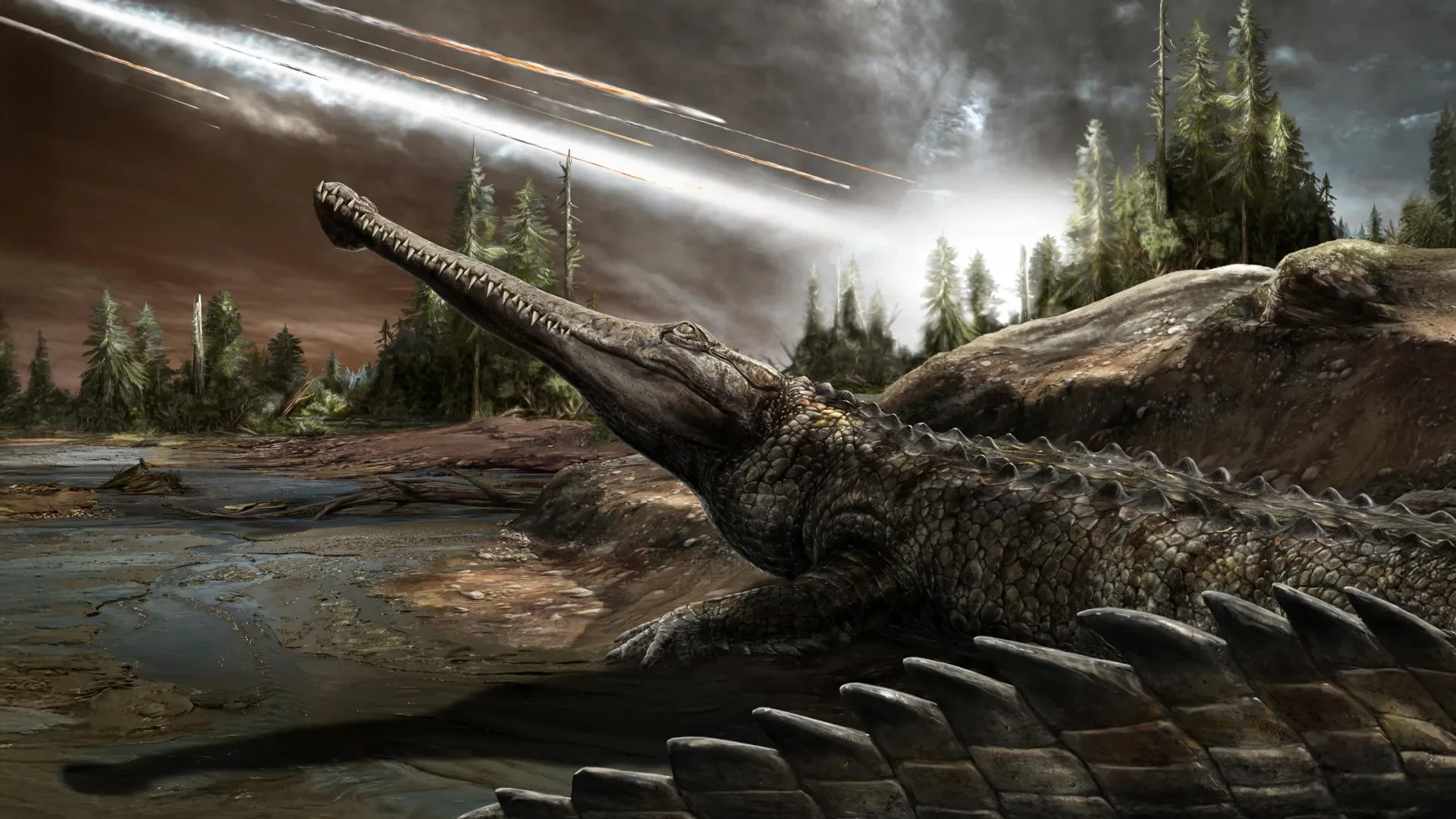
Sixty-six million years ago, a catastrophic asteroid impact triggered one of Earth’s greatest mass extinctions, wiping out the non-avian dinosaurs and reshaping the trajectory of life on the planet. Yet, among the carnage, crocodiles and their ancient relatives managed to endure. New research suggests that a lifelong preference for warm environments may have given these resilient reptiles a crucial survival advantage during Earth’s darkest hour.
Scientists led by University College London (UCL) discovered that crocodiles and their ancient predecessors spent much of their 250-million-year evolutionary history tethered to warm climates, rather than adapting to dramatically shifting temperatures. When the Earth grew hotter, these creatures expanded their geographic ranges into new, higher-latitude regions, occasionally reaching as far as Antarctica. Conversely, as global temperatures fell, they retreated back toward the safety of the tropics.
Published in the journal Science Advances, the comprehensive study analyzed more than 7,000 fossils and records representing over 400 living and extinct species. To understand how these animals interacted with their environments over deep time, researchers combined this vast fossil database with sophisticated computer models that reconstructed Earth’s ancient climate and geography across a staggering span of 245 million years.
The resulting data indicates that tropical and subtropical regions remained remarkably suitable for crocodile relatives after the asteroid struck. Even as environmental conditions deteriorated severely for many other groups of animals, including dinosaurs, the habitats near the equator offered stable conditions. According to the study’s climate simulations, only the most extreme scenarios eliminated these potential refuges entirely.
Why Crocodiles Survived the Dinosaur Extinction
To piece together the puzzle of prehistoric survival, the research team closely examined how global conditions shifted immediately following the Chicxulub asteroid impact 66 million years ago. Their simulations revealed that equatorial zones would have remained warm enough to continuously support crocodile relatives. These stable patches acted as ecological arks, providing safe havens where surviving populations could persist through the initial environmental crisis and eventually recover.
This dynamic stands in stark contrast to the fate of non-avian dinosaurs. Previous modeling conducted by members of the same research team demonstrated that suitable habitats for those ill-fated dinosaurs contracted far more severely and rapidly after the impact, leaving them with virtually nowhere to hide from the cascading environmental collapse.
Lead author Dr. Alfio Alessandro Chiarenza, based at UCL Earth Sciences, pointed out that the cataclysmic event did not impact every corner of the globe in the exact same way.
"The asteroid did not make the whole planet equally hostile to every group," Dr. Chiarenza explained. "Crocodiles’ long-standing preference for warm environments may have placed survivors exactly where suitable climates held up best, like around the equator. These refuges could have sheltered populations that later recovered and radiated out."
This critical insight offers a plausible explanation for how a lineage of animals that emerged around the same time as the earliest dinosaurs managed to survive not just one, but two of Earth’s five major mass extinction events.
Ancient Crocodiles Were Far More Diverse
While modern crocodiles share a remarkably consistent, recognizable body plan, their deep evolutionary history reveals a startling array of shapes, sizes, and ecological niches. The broader crocodile lineage, scientifically known as pseudosuchians, once boasted a dizzying variety of forms that challenge the modern perception of these reptiles.
At various points in their history, pseudosuchians included heavily armored plant-eaters, terrestrial predators that hunted exclusively on land, and colossal aquatic beasts weighing well over a metric ton. Among the most remarkable prehistoric members of this family was Sarcosuchus, a terrifying giant predator often dubbed the "super croc" that could reach lengths of up to 12 meters. Another fascinating relative, Postosuchus, was a formidable land-dwelling hunter capable of walking on either two legs or all four.
Dr. Chiarenza noted the dramatic physical evolution of the lineage, contrasting it with their rigid climate preferences. "Crocodiles are often called living fossils, but their ancestors and relatives changed enormously throughout their history, ranging from giants the size of a bus that could have devoured a T. rex, to small, cute animals with the face of a pug," he said. "Our study shows that, despite all this diversity, what stayed surprisingly consistent was their relationship with climate."
Fossils Reveal 245 Million Years of Climate History
To uncover this consistent relationship, the scientists reconstructed the historical temperature and rainfall preferences of 400 distinct crocodile species and their ancient relatives. They achieved this by drawing upon a rich archive of fossil evidence, established evolutionary family trees, and detailed geographic mapping of where living crocodile species reside today.
The team then cross-referenced these ecological preferences with detailed computer reconstructions of ancient geography and shifting climates to map out where habitable zones must have existed across different geological epochs.
A clear and persistent behavioral pattern emerged from the data. As global climates fluctuated over millions of years, crocodile relatives consistently tracked warmer conditions. They pushed their geographic ranges outward during exceptionally hot periods and pulled them inward toward the equator when global temperatures dipped.
A striking example of this occurred approximately 50 million years ago during the early Eocene, a period of intense global warmth. Global temperatures at the time were roughly 10 degrees Celsius higher than they are today, and the polar regions were entirely free of permanent ice. During this greenhouse world, crocodile relatives thrived at remarkably high latitudes across North America, Europe, and even Antarctica.
However, as a prolonged phase of global cooling set in over the subsequent millions of years, the geographic regions capable of supporting them shrank, forcing their populations back toward warmer tropical latitudes.
Two Surprising Exceptions
Although this loyalty to warm environments remained remarkably stable across deep time, the researchers uncovered two notable exceptions that demonstrate a degree of evolutionary flexibility within the wider lineage.
The first exception occurred during the Cretaceous Thermal Maximum, roughly 94 million years ago, when global temperatures soared as high as 14 degrees Celsius above modern levels. During this hyper-warm interval, one specific branch of the crocodile family tree evolved an unprecedented physiological tolerance for conditions far hotter than the broader lineage could handle at other times.
A separate evolutionary adaptation unfolded around 34 million years ago in Australia. As a protracted global cooling trend reduced rainfall and dried out the Australian continent, an extinct group of crocodiles adapted to survive in increasingly arid, desert-like environments.
These rare divergences prove that while most crocodile relatives faithfully tracked their preferred warm climates, certain branches retained the capacity to evolve novel tolerances when pushed by extreme environmental shifts.
What Happened After the Dinosaur-Killing Asteroid?
To better understand the immediate aftermath of the Chicxulub impact, the researchers deployed climate simulations to test how the decades and centuries following the asteroid strike would have affected surviving habitats.
The team modeled several catastrophic environmental consequences, such as massive clouds of dust and ash blocking out sunlight, alongside surging carbon dioxide levels driven by intense global volcanic activity.
When the simulations factored in a 50% to 10% reduction in sunlight, the warm regions clustered near the equator still managed to remain suitable for crocodile relatives. These pockets of stability could easily have served as vital ecological safe zones during the peak of the post-impact disruption.
However, the simulations also tested a more severe nuclear winter scenario involving a 15% reduction in sunlight. Under those extreme conditions, even the equatorial regions became completely unsuitable. The researchers noted, however, that this level of prolonged solar obscuration is generally considered unlikely by modern paleoclimatologists.
Other simulated environmental shocks, including elevated atmospheric carbon dioxide, did not significantly alter the availability of suitable thermal zones for crocodiles. Taken together, the findings reinforce the idea that crocodiles survived primarily because they happened to reside in regions where temperatures stayed within their comfort zone, even as the rest of the planet plunged into chaos.
The Survival Strategy That Could Now Become a Weakness
While climate stability near the equator played a major role in their survival, the researchers emphasize that it was likely only one piece of the puzzle. Several intrinsic biological traits undoubtedly improved the chances of crocodile relatives during the mass extinction.
Their relatively small body sizes, semi-aquatic lifestyles, flexible diets, and modest energy requirements all contributed to their resilience. As ectothermic, or cold-blooded, animals, crocodiles require significantly less food to sustain their bodies than endothermic creatures that must constantly generate their own internal body heat.
At the same time, the study’s findings raise pressing questions about how modern crocodiles will fare amid contemporary anthropogenic climate change.
For hundreds of millions of years, migrating toward regions with suitable temperatures was the primary mechanism by which these animals coped with a shifting planet. Today, however, human development has drastically fragmented natural landscapes. Expanding cities, widespread agricultural land, and dense networks of roads now severely restrict where wildlife can freely roam.
Professor Philip Mannion, also based at UCL Earth Sciences, highlighted the modern conservation implications of the research. "These findings have implications for species today," Professor Mannion said. "If crocodiles mostly coped with past climate change by moving towards suitable habitats, today’s species will need room to move as the planet warms, and the loss of suitable areas to roads, farms and cities is making that harder."
The research was funded by major scientific organizations, including The Royal Society, the Leverhulme Trust, and the National Environment Research Council (NERC).