In May 2024, an extraordinary solar storm painted the night skies with brilliant auroras across latitudes where the northern and southern lights are rarely visible. Yet, while these vivid displays captivated millions on the ground, they were merely the most visible symptoms of a massive, unseen disturbance unfolding high above the planet. Deep within Earth’s magnetosphere—the vast, protective magnetic bubble surrounding our world—scientists were quietly witnessing an unprecedented event that they had never directly measured before.
The historic disturbance originated when a notably large sunspot unleashed several powerful solar eruptions in rapid, violent succession. As enormous clouds of magnetized plasma raced through the vacuum of space, they merged together before violently slamming into Earth’s magnetosphere. The resulting collision generated the strongest magnetic disturbance ever recorded in Earth’s ring current, a colossal torus of electrically charged particles circulating thousands of kilometers above the equator.
For decades, space physicists have debated the precise origins of the particles that populate this vital ring current. Researchers have long understood that there are two primary contributors: the solar wind, a continuous stream of charged particles flowing outward from the Sun, and Earth’s ionosphere, an electrically charged layer sitting in the upper atmosphere. Both sources typically supply particles during standard geomagnetic storms, and many scientists logically expected the solar wind to dominate during an extreme event driven by particularly dense solar flows.
Instead, the first direct compositional measurements taken during a storm of this magnitude revealed a striking and unexpected reality. Particles originating directly from the solar wind contributed only a minuscule fraction of the ring current, while ions surging upward from Earth’s own atmosphere dominated the region to an extent never previously documented by science.
The findings, published in the journal Science Advances, suggest that Earth’s atmosphere plays a far more influential role in dictating the severity of extreme geomagnetic storms than previously recognized. Because the dominant ions welling up from Earth are substantially heavier than the lighter particles carried by the solar wind, they likely amplified the magnetic disturbance, causing the ring current to reach its greatest intensity unusually close to the planet. Furthermore, these profound observations strengthen the case for a proposed Japanese satellite mission specifically engineered to investigate how atmospheric particles escape into space and shape intense space weather events.
How the May 2024 Solar Superstorm Disrupted Earth’s Magnetic Field
On May 10 and 11, 2024, enormous clouds of charged solar particles struck Earth’s magnetosphere, triggering one of the most powerful geomagnetic storms in decades. Often referred to by researchers as the "Gannon storm" or the "Mother’s Day storm," the severe event pushed the SYM-H index—a standard scientific measure of global geomagnetic disturbance—to a staggering minimum of −518 nanoteslas. This represented the second-largest recorded disturbance since continuous electronic tracking began in 1981, trailing only the historic storms of November 2004.
Although the vibrant, colorful auroras drew worldwide public attention and filled social media feeds, the practical consequences of such severe space weather extend far beyond a picturesque night sky.
"Some super or extreme geomagnetic storms are not just impressive light shows—they pose radiation risks to spacecraft, disturb GPS signals and communications, and cause power outages. Understanding how a geomagnetic storm develops is not only a scientific question, but also one with real-world consequences," said Naritoshi Kitamura, the lead author of the study and a designated assistant professor at the Institute for Space-Earth Environmental Research (ISEE) at Nagoya University.
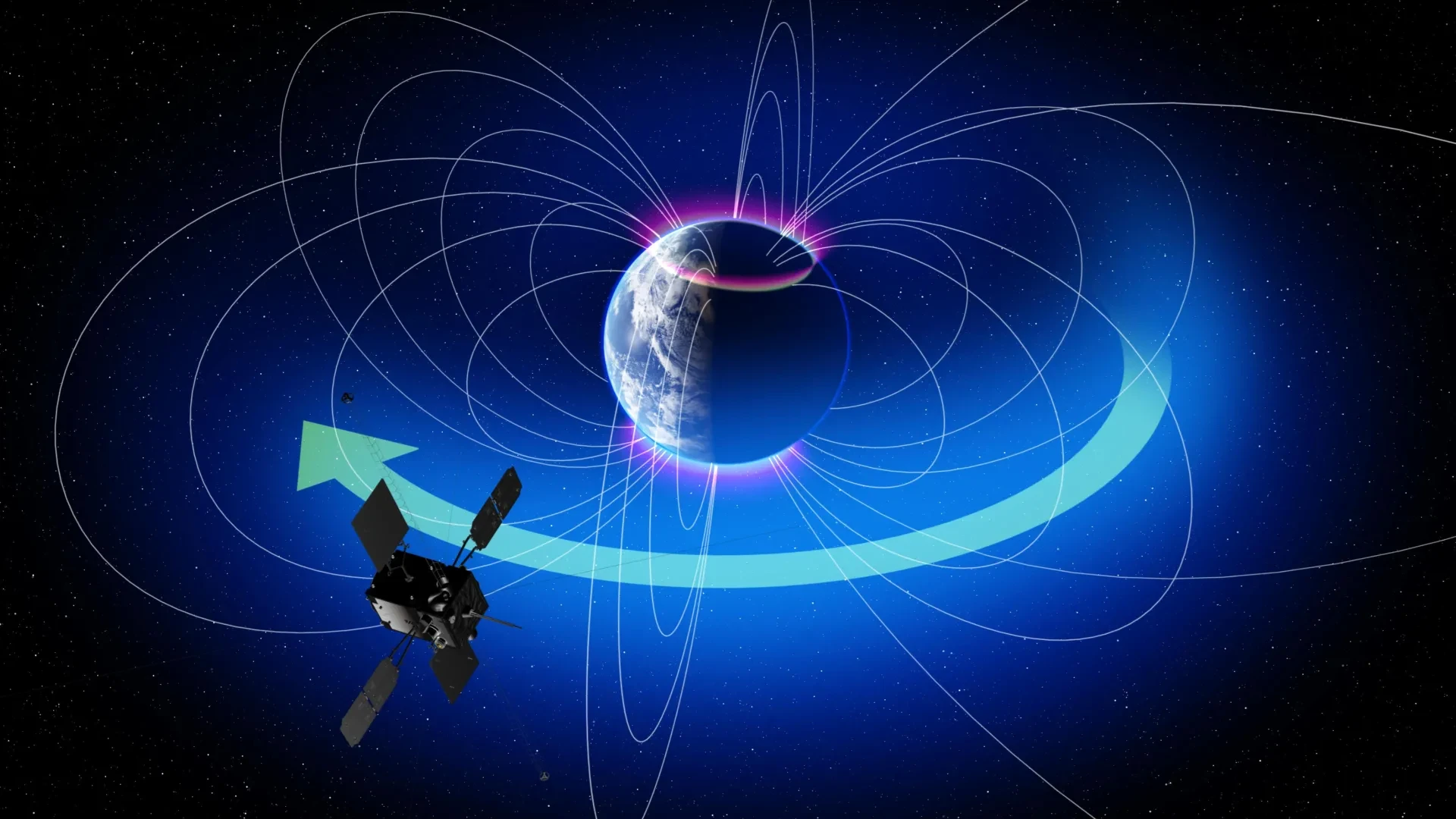
A major driver of these magnetic disruptions is Earth’s ring current. This massive belt of energetic charged particles, composed primarily of oxygen and hydrogen ions, slowly and continuously circulates around the planet thousands of kilometers above the equator. As these ions move, they form a massive electrical ring current that generates its own localized magnetic field. This newly generated field partially opposes Earth’s natural internal magnetic field, temporarily weakening the magnetic readings recorded at ground level. The resulting fluctuations are among the primary signals space scientists utilize to monitor and gauge the strength of ongoing geomagnetic storms.
Japanese Satellite Reveals an Unexpected Source of Storm Particles
Scientists were able to investigate the unprecedented May 2024 storm in remarkable detail largely due to Japan’s Arase satellite. Launched in 2016 and operated by the Japan Aerospace Exploration Agency (JAXA), the spacecraft is managed alongside the ERG (Arase) science center, which is jointly run by the Institute of Space and Astronautical Science (ISAS)/JAXA and the Institute for Space-Earth Environmental Research at Nagoya University.
Arase routinely travels directly through the hazardous region of space where Earth’s ring current forms and evolves. Its advanced onboard scientific instruments are capable of measuring both the mass and energy of individual passing ions, allowing researchers to accurately determine the exact types of particles present during any given space weather event.
By sheer good fortune and remarkable timing, the spacecraft passed through the ring current shortly after the May 2024 storm initially erupted and again as the severe disturbance approached its ultimate peak. These fortuitous passes provided researchers with a rare, invaluable opportunity to examine the precise chemical composition of the ring current during an exceptionally powerful geomagnetic event.
"This is the first simultaneous observation of ring current ions and solar wind during a storm this large, and the data was clear—approximately 85% of ions were oxygen from Earth’s own ionosphere," Kitamura explained.
The overwhelming contribution from Earth’s atmosphere was particularly surprising to the research team because the storm had been triggered by unusually dense streams of material arriving directly from the Sun. Rather than acting as the primary supplier of the ring current ions, the solar wind played a surprisingly minor role in the total particle population measured by the spacecraft.
Earth’s Magnetic Field Weakened by 40%
The Arase satellite’s high-precision measurements uncovered yet another extraordinary feature of the May 2024 storm. The planetary magnetic field weakened dramatically, and this severe reduction occurred in a region much closer to Earth than where similarly intense declines had ever been documented in the past.
"Near the peak of the storm, Arase detected a 40% decrease in magnetic field intensity at roughly 16,000 kilometers above Earth, and much closer to Earth than similar large decreases previously documented," the researchers noted.
Concurrently, the satellite detected a sharp decline in the population of energetic electrons that normally circulate smoothly through this specific region of near-Earth space.
Such an extreme weakening of the magnetic field can drastically alter the trajectories followed by these trapped electrons, causing them to drift away from their stable orbits and vanish into outer space or plunge deeper into the atmosphere. However, space physicists have not yet fully determined whether the extreme deformation of the magnetic field directly caused the observed electron loss, indicating that further targeted research will be required to establish a definitive causal connection.
Together, these observations provide vital new insight into how the ring current behaves during especially intense geomagnetic storms. They also strongly suggest that the unusually large population of heavy oxygen ions originating from Earth’s own atmosphere may have acted as a catalyst, helping to produce the severe magnetic disturbance so close to the planet’s surface.
A New Clue to Predicting Dangerous Solar Storms
These groundbreaking findings could carry significant implications for the future of space weather forecasting. Current operational models rely heavily on monitoring conditions within the incoming solar wind to estimate how powerful an approaching geomagnetic storm might become before it strikes Earth.
However, the new measurements strongly imply that conditions within Earth’s own upper atmosphere can drastically influence a storm’s ultimate intensity. Understanding the precise mechanisms that allow massive quantities of atmospheric ions to escape into the magnetosphere, and quantifying how heavily those particles contribute to the ring current, may therefore prove essential for generating more reliable space weather predictions.
The researchers believe that deploying additional specialized satellite missions will be critical to answering these lingering questions. Their published findings directly support FACTORS, a proposed scientific mission currently being prepared for an upcoming JAXA proposal opportunity, which would involve a constellation of two dedicated satellites.
The proposed FACTORS mission would investigate the complex physical processes that allow ions from Earth’s atmosphere to flow upward into the magnetosphere while examining how those escaping particles influence the growth and severity of geomagnetic storms.
By revealing the intricate ways Earth’s atmosphere and incoming solar material interact during extreme events, future missions could eventually improve forecasts of hazardous space weather. Enhanced prediction capabilities would ultimately help scientists and engineers better anticipate and mitigate solar storms capable of disrupting satellites, navigation networks, global communications, and critical ground-based power infrastructure.