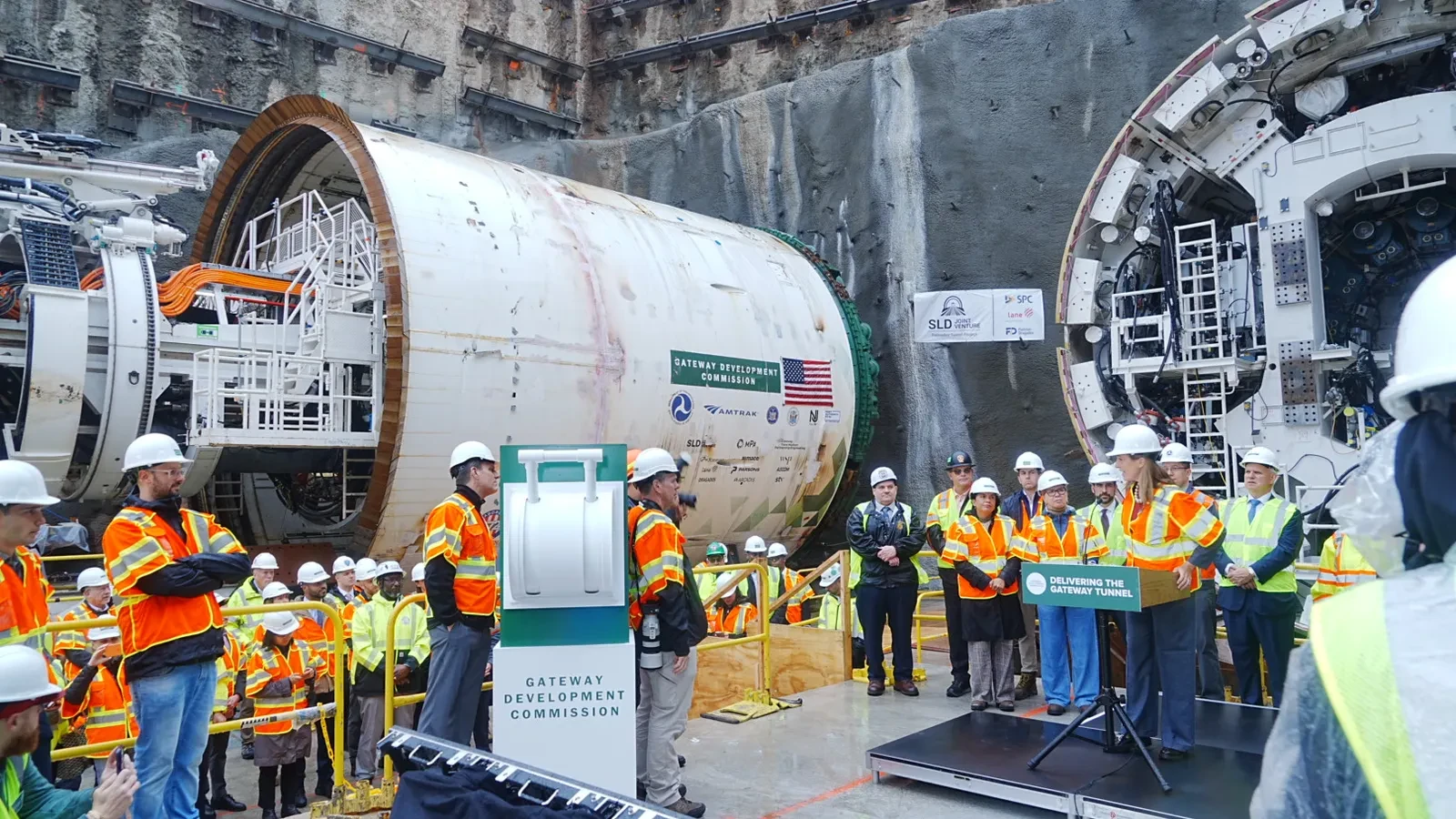
Contractors on the monumental $16 billion Hudson Tunnel project are officially ready to dig in. The first set of custom-engineered tunnel boring machines for the massive interstate rail project will soon start to chew through 5,100 feet of hard rock beneath the Palisades Cliffs in New Jersey, according to a recent news release from the Gateway Development Commission. Project stakeholders, elected officials, and construction leaders gathered for a ceremonial launch event, with the first of the massive machines slated to begin active boring in the coming days, as confirmed by the GDC.
The milestone marks a critical step forward for one of the most vital and complex infrastructure endeavors in modern American history. The Hudson Tunnel project aims to modernize and expand rail capacity between New Jersey and New York, replacing aging infrastructure that carries hundreds of thousands of commuters daily.
"It’s been more than a century since a rail tunnel was last dug through these cliffs," New Jersey Governor Mikie Sherrill said during the launch event, highlighting the historic nature of the undertaking. "I was asked how many of these boring machines are there in the world, and the answer is this is it. Each one is purpose-built for the specific job at hand."
A powerful joint venture comprising Schiavone Construction, Lane Construction, and Dragados has been entrusted with completing this initial phase of tunnel boring. The work forms a core component of the broader Palisades Tunnel construction package, overseen by the Gateway Development Commission in close partnership with the Port Authority of New York and New Jersey, which is managing the delivery of the construction package.
The colossal engineering marvels will soon begin boring parallel tubes starting from the tunnel portal located in North Bergen, New Jersey, and extending all the way to the Hudson County Access Shaft, which sits on the border of Weehawken and Hoboken. The sheer scale of the equipment is staggering. According to project specifications released by the GDC, each machine features a rotating cutterhead measuring 28 feet and 8 inches in diameter. The trailing gantry extends roughly 500 feet behind the main unit, and each complete machine weighs in at more than 1,680 tons.
The mechanical process of carving through the earth is an intricate choreography of heavy industry and precision engineering. As the massive rotating cutterheads, fitted with heavy-duty disc cutters, break the dense Palisades rock into smaller chips, an integrated conveyor belt system carries the excavated material out of the tunnel. Simultaneously, as the machine inches forward, an automated erector arm places precast concrete segments to form the permanent, structural lining of the tunnel. Hydraulic thrust jacks brace securely against the edges of the newly completed tunnel lining, generating the immense pressure required to push the multi-ton machine forward through the rock face.
"These machines are amazing," said U.S. Senate Minority Leader Chuck Schumer, D-N.Y., during the launch event, drawing laughter from the crowd. "They’re certainly not boring."
A Turbulent Year
While the arrival and imminent launch of the boring machines represent a major victory for the project, Schumer and other leaders took time to acknowledge the immense construction and political challenges that have tested the resolve of project stakeholders over the years.
"The rock is so hard it only moves 30 feet a day," Schumer said during the event, emphasizing the slow, grinding nature of subterranean excavation. "That’s why we can’t let anybody stop it. We have to keep going and going and going till these machines reach the other side of the river."
The journey to this launchpad has been anything but smooth. Construction on the broader Hudson Tunnel project resumed earlier this year following a contentious federal funding dispute that had temporarily halted work. The impasse was eventually resolved when a federal judge barred the Department of Transportation from withholding vital federal funds over disputes related to its disadvantaged business enterprise program.
Despite those political hurdles, the Gateway Development Commission has continued to push the project’s various phases forward. In April, the GDC awarded a massive $1.29 billion contract to a joint venture consisting of Traylor Bros., Walsh Construction, and Skanska for the Manhattan Tunnel Project. That significant contract award effectively moved all remaining major construction packages required to bore the new tunnel into active development and execution.
Reflecting on the fierce legal and political battles fought to keep the enterprise alive, Governor Sherrill pointed to the administration’s resilience. "We’ve taken the Trump administration to court five times to keep this project going, and we’ve won five times," Sherrill said. "We’re going to keep fighting, even if it requires a few more trips to court."
Years of Work
Getting the tunnel boring machines to this operational milestone required nearly three years of meticulous, heavy civil construction progress, according to Governor Sherrill.
The groundwork began in late 2023, when contractors initiated construction on a specialized bridge designed to support a heavily traveled section of Tonnelle Avenue in North Bergen. Engineering teams carved out vital space underneath the highway to accommodate the massive gantries of the boring machines. They also excavated the deep launch box from which the tunnel boring machines will officially begin their subterranean journey, as detailed by the GDC.
The custom manufacturing of the tunnel boring machines took place concurrently with these surface-level civil works, a complex process that spanned more than a year. A single machine is made up of nearly 100 intricate and heavy-duty components.
"It’s a mechanical marvel," Sherrill said during the event. "Workers here have spent the past few months reassembling and testing it, so it’s ready for today’s launch."
Once the first pair of tunnel boring machines successfully completes its journey to the Hudson County Access Shaft, specialized crews will dismantle and remove them. They will then be replaced with a second pair of specialized machines designed to construct the complex section of the tunnel running directly underneath the Hudson River, according to the GDC’s long-term schedule. Once the entire initiative is complete, the new two-tube rail tunnel will provide a modern, highly reliable connection between New Jersey and New York, safeguarding the regional economy and easing chronic commuter delays.
As the machines prepare to turn their cutterheads into the rock, federal lawmakers emphasized that eternal vigilance will be required to see the multi-billion-dollar project through to its ultimate completion.
"We still have a lot of work to do, and knowing some of the politicians in Washington, there are still going to be attempts to slow this project down," said U.S. Senator Cory Booker, D-N.J., during the ceremony. "But I know, when all is said and done, generations not yet born will benefit from the work that we have done."