As the skies above urban centers, critical infrastructure installations, and military installations grow increasingly crowded with commercial, public safety, and recreational uncrewed aircraft systems (UAS), defense and security operators face a distinct operational dilemma. The primary challenge in modern airspace security is no longer merely detecting the physical presence of a drone; rather, it is instantaneously understanding who is operating the aircraft, precisely where it is navigating, and whether that specific flight path has been authorized by aviation authorities.
Addressing this mounting security requirement, ANRA Technologies announced significant progress in its counter-uncrewed aircraft systems (C-UAS) capabilities. The operational update follows the company’s extensive participation in prominent international and domestic evaluation programs, including the NATO Counter-UAS Technical Interoperability Exercises and the U.S. Army’s Driving Innovation in Realistic Training (DIRT) Days. These rigorous field experimentation programs are designed to evaluate emerging defense and security technologies within highly realistic military training environments, testing how systems perform under pressure and alongside diverse multi-vendor hardware.
At the core of ANRA’s technological advancement are two primary software and hardware solutions: the Single Integrated Operating Picture (SIOP) software and the Tactical Airspace and C-UAS Operations (TACO) system. Together, these platforms bridge a critical historical gap in the security sector by combining traditional radar and radio frequency drone detection methodologies with real-time operational information regarding authorized commercial and public safety airspace activity. Through continuous software refinement, iterative development, and extensive field testing in demanding defense and security environments, both SIOP and TACO have officially progressed from Technology Readiness Level (TRL) 5 to TRL 7, marking a major milestone toward operational readiness and large-scale deployment.
The advancement comes at a pivotal time for federal funding and security procurement. ANRA is actively inviting U.S.-based sensor makers, defense and homeland security system integrators, public safety technology providers, critical infrastructure operators, and government agencies to explore strategic partnerships, joint demonstrations, and integration opportunities. This outreach coincides with growing federal financial backing aimed at bolstering regional and national counter-drone defenses against illicit or unauthorized aerial incursions.
How ANRA Counter-Drone Software Uses UTM Data
Traditional counter-drone architectures have historically operated in a vacuum, focusing almost exclusively on detecting, tracking, and identifying unknown or unauthorized aircraft through radar, radio frequency analysis, and optical devices. While effective at spotting anomalies, this siloed approach often leaves security personnel overwhelmed by false positives, treating every legitimate commercial delivery drone, utility inspection aircraft, or police surveillance quadcopter as an immediate security threat.
ANRA’s modern approach fundamentally redefines this paradigm by seamlessly pairing traditional sensor detections with available Unmanned Aircraft System Traffic Management (UTM) information concerning authorized flights. By integrating live UTM data feeds with localized detection streams, security operators can instantly assess whether a detected aircraft belongs to a legitimate commercial enterprise, public safety unit, or government agency. This contextual intelligence enables security teams to effectively filter out routine, authorized operations and prioritize genuine anomalies, drastically reducing operator fatigue and lowering the risk of accidental interference with legal commercial aviation.
The foundational software driving this capability is SIOP, ANRA’s sensor-agnostic airspace awareness and command-and-control (C2) software. SIOP is engineered to ingest, process, and correlate multi-source data streams from primary and secondary radars, passive radio frequency sensors, optical cameras, Remote ID broadcasts, and Automatic Dependent Surveillance-Broadcast (ADS-B) transponders. It then overlays these real-time tracks with comprehensive UTM information, including predefined geozones, active flight plans, and scheduled airspace reservations.
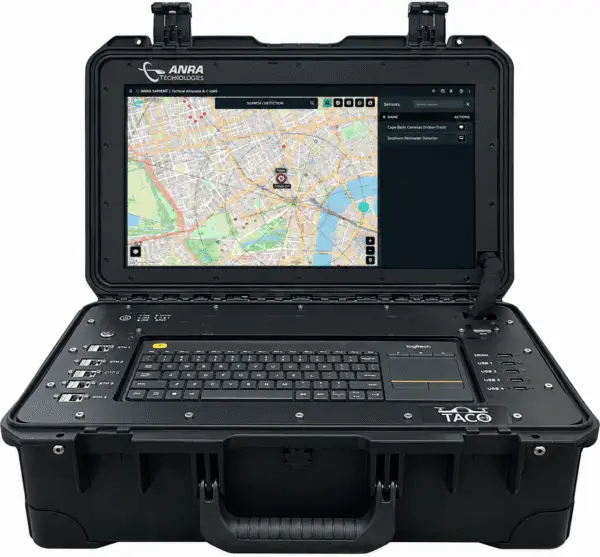
To bring this software capability into the field, ANRA developed TACO, which packages the SIOP software into a rugged, modular, and highly portable hardware system. Housed securely within a ruggedized Pelican iM2500 case, the entire TACO unit weighs approximately 17 kilograms, translating to roughly 37.5 pounds, making it easily transportable by a single operator or deployable from mobile command vehicles. The system is engineered for rapid tactical deployment, capable of being set up and brought fully online in under 15 minutes.
Despite its compact form factor, TACO delivers enterprise-grade performance. Field testing has demonstrated its capacity to simultaneously connect with up to 10 distinct sensors while actively tracking and managing up to 100 simultaneous targets. Furthermore, the system boasts an impressive sensor fusion latency of under one second, ensuring that operators receive near-instantaneous situational awareness updates. Reliability is maintained through robust engineering that allows the system to sustain full functionality during complete communication outages and retain up to 80 percent of its core performance capabilities during partial hardware or network failures. Beyond tactical mobile deployments, TACO is equally equipped to support permanent, fixed-site installations at sensitive locations such as commercial airports, maritime ports, and critical power generation plants.
NATO and U.S. Army Interoperability Testing
ANRA’s technical maturation has been forged through years of rigorous trials in demanding multinational and joint-service environments. The company has actively participated in the NATO C-UAS Technical Interoperability Exercises since 2023, alongside its ongoing involvement in the U.S. Army’s DIRT Days field experimentation events. These high-stakes trials are designed to rigorously test the integration, data-sharing, and information exchange capabilities of emerging technologies with a diverse array of legacy and cutting-edge sensor arrays and command-and-control systems.
A key focus of these exercises is adherence to open architecture standards, specifically SAPIENT, which facilitates seamless communication and data exchange among disparate hardware and software vendors. Both SIOP and TACO natively support the SAPIENT open architecture standard, as well as ASTERIX data protocols and various proprietary data interfaces. This commitment to open standards ensures that defense customers are not locked into a single proprietary ecosystem, allowing them to integrate ANRA’s software with their existing sensor investments. Company representatives emphasize that while these exercises successfully demonstrate advanced technical interoperability in simulated and controlled test environments, they do not constitute formal NATO certification or official military endorsement.
The sophistication of ANRA’s counter-drone software is deeply rooted in the company’s extensive, real-world experience operating commercial UTM platforms. ANRA’s core UTM infrastructure routinely supports major corporate and municipal customers, including logistics pioneers like Amazon Prime Air and large-scale utility providers such as the New York Power Authority. According to operational metrics provided by the company, ANRA’s UTM systems facilitate approximately one beyond visual line of sight flight every ten seconds, while actively supporting more than two dozen municipal police departments across their daily operations.
Expanding this ecosystem further, ANRA recently introduced VISTA, a specialized receive-only application designed to provide operators with a clear, localized view of nearby UTM traffic. However, the company maintains a strict delineation between airspace awareness and kinetic or electronic mitigation. ANRA frequently notes that detection, tracking, and identification alone do not establish the necessary legal authority or regulatory clearance to physically mitigate, jam, or intercept an airborne aircraft, reinforcing the critical role of human oversight and adherence to aviation law in security operations.
U.S. Partnership Opportunities
The push for advanced, interoperable counter-drone technologies is receiving a substantial financial boost from the federal level. On October 16, the Federal Emergency Management Agency announced a significant allocation of $250 million in funding through its fiscal 2027 Counter-Unmanned Aircraft Systems Grant Program. This major grant initiative is specifically designed to assist state, local, and territorial government agencies in strengthening their regional counter-drone defenses, protecting critical infrastructure, and securing public gatherings against potential airborne threats.
In direct response to this influx of federal funding and the growing demand for comprehensive airspace security solutions, ANRA Technologies is actively inviting key stakeholders across the domestic security landscape to explore collaborative ventures. The company is seeking U.S.-based sensor manufacturers, defense and homeland security system integrators, public safety technology providers, critical infrastructure operators, and government agencies to engage in discussions regarding joint technology demonstrations, software integrations, and strategic teaming opportunities. By combining ANRA’s NATO-tested UTM and command-and-control software with best-in-class domestic sensors, industry partners can deliver a unified, highly adaptable airspace defense solution tailored to the evolving needs of modern security forces.