By DRONELIFE Features Editor Jim Magill
As state legislatures and local municipalities increasingly push to impose new regulations aimed at protecting event venues from unwanted unmanned aerial vehicle (UAV) incursions, drone operators and industry
advocates are growing deeply concerned. They warn that the growing wave of new rules is creating a confusing and burdensome patchwork of laws and ordinances across the country—many of which legal experts and industry leaders believe will eventually be challenged or pre-empted entirely by established federal airspace regulations.
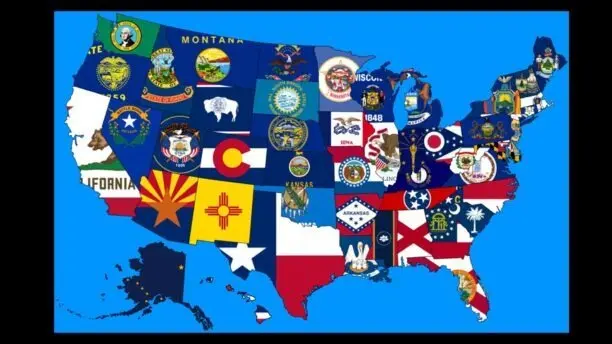
Recent legislative actions in California, Arizona, and Alabama highlight these stark differences in state-level regulations and bring to the forefront long-standing questions regarding federal airspace authority. Each of these states has recently passed laws that seek to limit or outright prohibit drone overflights of major venues during large-scale public events, such as professional concerts, sporting events, and motor sports rallies like monster truck shows.
Marshall White, founder of the airspace intelligence platform UAShield, warns that statutes of this nature could prove to be profoundly problematic both for commercial operators who rely on drones to run their daily business operations and for recreational UAV pilots just looking to fly safely.
“Until fairly recently, following ‘the rules’ generally meant abiding by FAA regulations. In contrast to state and local laws, these are fairly easy to identify and monitor, as federal law is generally standardized in its delivery and availability. That is not at all the case with state and local regulations,” White explained in an email statement.
Although the new laws enacted across the three states—specifically California’s AB 2113, Arizona’s SB 1160, and Alabama’s HB 429—share similar broad objectives of event security and privacy protection, they differ significantly in their operational specifics, definitions, and enforcement mechanisms.
“One notable exception is that California clearly outlines venue capacity, requiring a threshold of 1,000 or more people, while Arizona does not specify a capacity limit. This puts an additional burden on operators who now have to verify precise seat counts at venues prior to conducting a flight,” White pointed out.
Another critical area where the laws diverge sharply is in the geographic scope of the restricted airspace established surrounding an event venue. While the newly enacted California and Alabama laws prohibit drone flights within a 400-foot radius of a venue, the Arizona law sets off a vastly expanded restricted zone that spans an entire one-mile perimeter around the site.
Despite these restrictions, all three new state laws do contain specific exemptions for certain types of drone operators. For example, exemptions are typically granted if an operator obtains explicit written consent from a person possessing legal authority over the ticketed entertainment event, or if the individual is acting as an employee of a regulated utility company performing official business duties.
Furthermore, California’s AB 2113 carves out a specific exemption for commercial operators who hold an FAA certificate and are authorized to conduct beyond visual line of sight (BVLOS) operations, provided they are operating in full compliance with all applicable federal regulations. Similarly, the Alabama law provides exemptions if the operator is authorized by federal regulations to operate an unmanned aircraft system and is conducting the operation in a lawful manner consistent with federal rules.
White noted that the wide variety of exemptions offered by each statute provides a major point of contrast among the different state laws.
“California exempts venue consent, which is often impractical, utility and emergency personnel, who represent a small minority of commercial operators, and FAA-authorized commercial BVLOS flights. However, a routine Part 107 commercial flight isn’t exempt on its own. Arizona, on the other hand, appears to exempt all FAA-compliant flights,” he said. “This difference in the fine print only serves to create additional confusion for otherwise law-abiding operators who are simply trying to do their jobs.”
Beyond operational boundaries and exemptions, the severity of the financial penalties and legal consequences also varies wildly from state to state. Violations of the laws in California and Alabama carry a relatively standard civil or misdemeanor fine of $500. In stark contrast, Arizona’s law enforces much more stringent penalties, which can include up to six months in jail and a maximum fine of $2,500.
White believes that several of the drone laws passed by individual state legislatures will ultimately face serious legal challenges under the federal pre-emption doctrine, a legal principle that explicitly grants the regulation of the national airspace solely to the Federal Aviation Administration (FAA).

“I believe that state regulations like this set a confusing and dangerous precedent. I believe this is true of Arizona’s version of the law in particular,” he said. “While a 400-foot bubble, like California’s version, is one thing, Arizona’s one-mile bubble is another thing entirely.”
He added that by creating an uncoordinated patchwork of rules regarding drone operations, states are placing unnecessary and unfair administrative burdens on operators who already have to juggle complex flight planning tasks, airspace authorizations, and weather conditions.
“This patchwork either needs to be woven into a single, seamless tapestry and standardized across states and venues with a centralized notification system, which sounds a lot like what the FAA already has, or states should stick solely to enforcing the act of launch and recovery from the ground,” White concluded.
Challenging Alabama’s Ticketed-Event Law
Friction between local authorities and the commercial drone community is already mounting, with some of the newly enacted state laws facing immediate pushback from working professionals. In Alabama, Kevin Henderson, the owner of Birmingham-based drone photography company SkyBama, has publicly spoken out against local implementation efforts. Specifically, he criticized a move by the Birmingham City Council to consider adding a $500 first-offense local municipal fine for violations of Alabama’s new state law restricting drone flights over ticketed events, which officially went into effect on October 1.
Henderson, whose commercial enterprise regularly includes capturing newsworthy, drone-acquired imagery for media publication, argues that the combination of the state law and city-imposed fines threatens to directly interfere with his livelihood and ability to gather news.
“I cover a lot for news and events,” Henderson said in an interview. “Let’s say a musical artist is coming to Birmingham and they haven’t been here in 20-something years and it’s a massive concert.” He argued that an experienced operator should be legally permitted to launch a drone, capture a photograph of the public scene, and land safely, provided they are strictly following all underlying FAA regulations.
“What they passed in Alabama, in my opinion, doesn’t hold any weight in court, especially with First Amendment issues,” Henderson said. “But it does give police a reason to hand you a $500 fine, possibly confiscate your equipment, and could cause you to lose your shot even if you’re following all FAA regulations.”
Henderson also pointed out that the state law is drafted with ambiguous language regarding how it delineates the 400-foot boundary within which drone flights are prohibited.
“So, how are they going to define 400 feet? Does it start from the stage? Does it start from a property line, a fence, a road?” he asked. “And once they determine that, how is a police officer going to know if you were 380 feet away from something or 450 feet away from something?”
According to Henderson, these vague statutory definitions put the heavy burden of deciding what constitutes an aviation violation onto local police officers, who typically receive no specialized training in the enforcement of federal aviation rules or airspace management.
“Are they just going to say, ‘Okay, I see you flying a drone. You’re near the event. Here’s your ticket. We’ll see you in court,’ or will they confiscate your equipment or arrest you?” he questioned.
Reflecting on the legislative landscape in his home state, Henderson noted that Alabama’s organized drone industry advocates had previously managed to successfully fend off various legislative attempts to pass restrictive bills over the years.
“The state has tried to create several drone bills over the past, I guess maybe eight years or so, and we’ve pushed back really hard. And I was honestly very surprised that this ticketed event one made it through, but somehow it did,” Henderson said.
While he acknowledges that certain types of state and local regulations—such as targeted restrictions against flying drones above sensitive critical infrastructure sites—make logical sense for public safety, he maintains that sweeping measures like the ticketed-venue law prove far too onerous for the broader drone-flying community.
“You just don’t want to interfere with legal operations of people that are doing their work or enjoying their hobby and not doing anything unsafe and just enjoying the day,” Henderson said. “It’s a big balancing act between state officials and the regular drone operator.”