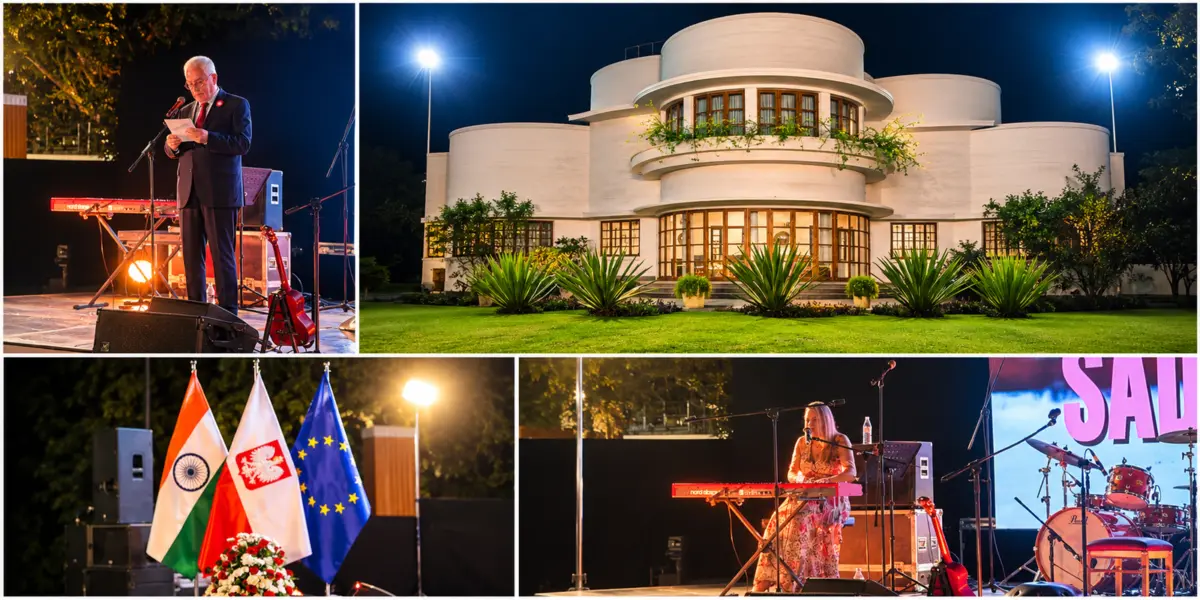
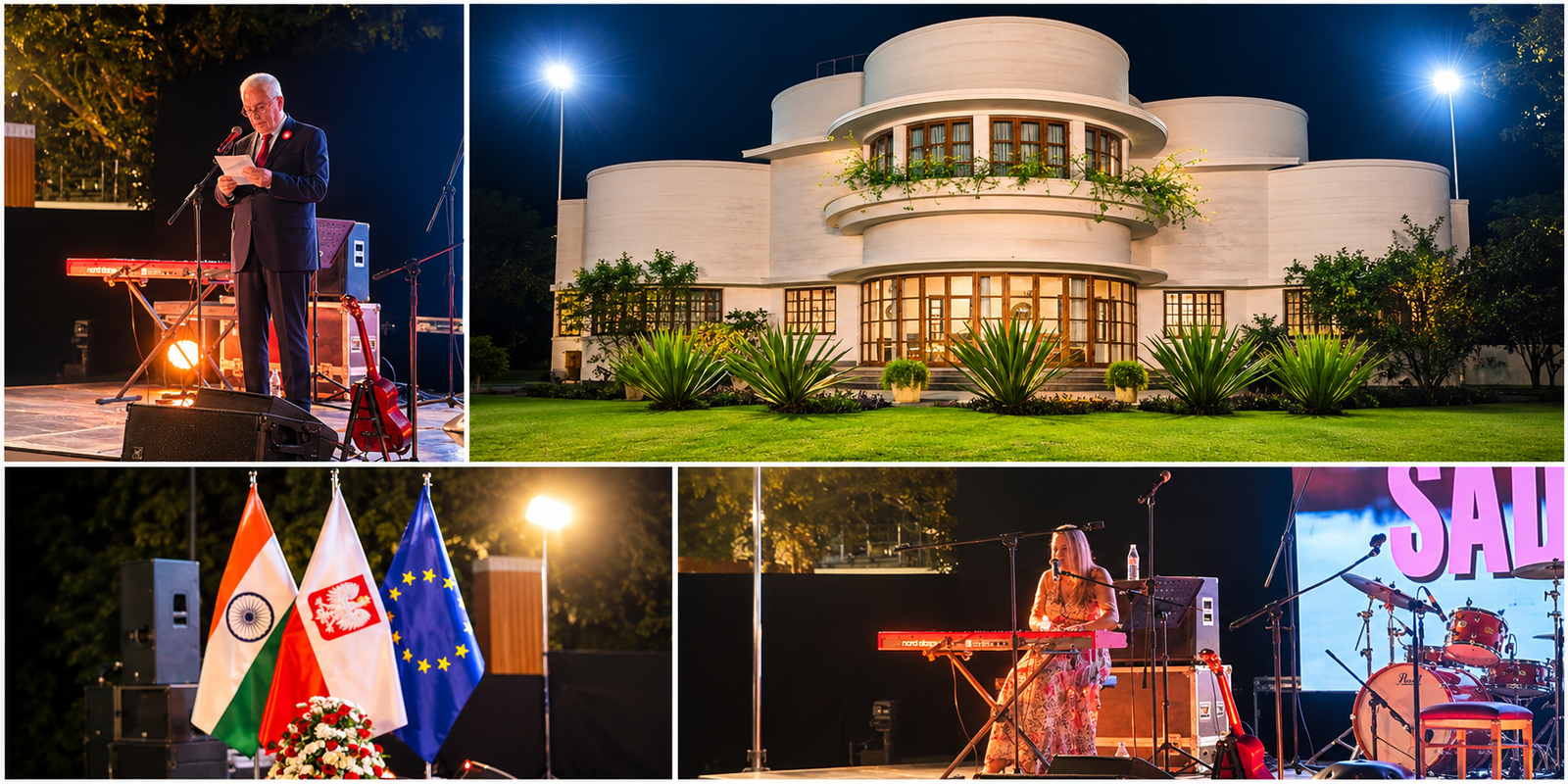
NEW DELHI — In the heart of the Indian capital, diplomacy rarely sounds quite this soulful. Blending historical reflection, cultural storytelling, and the improvisational brilliance of European jazz, the Chargé d’Affaires of the Republic of Poland in India, Dr. Piotr Antoni Świtalski, recently hosted an unforgettable evening at the Polish residence in New Delhi. The gathering, held on November 2, was designed to mark a deeply significant period in the Polish calendar, transforming a traditional diplomatic reception into an intimate cultural exchange that resonated deeply with its international audience.
Setting the tone for the evening, Dr. Świtalski opened his remarks with a poetic observation that immediately captured the imagination of the room. "Every nation has a specific month on the calendar that serves as a mirror to its deepest soul. For Poland, that month is November," he reflected.
What followed departed significantly from the standard, formulaic addresses typical of diplomatic functions. Instead, Dr. Świtalski delivered a captivating narrative tracing Poland’s complex history, enduring traditions, and unyielding passion for freedom. Delivered with a signature warmth and self-effacing humor, his remarks succeeded in making the assembled guests feel less like attendees at a formal state function and more like welcomed friends gathered in a private home.
For Poland and its diaspora, November represents far more than the seasonal transition from the crisp days of autumn to the biting cold of winter. Rather, it is a profoundly symbolic month that brings together the two defining pillars of the Polish national identity: remembrance and independence.
Dr. Świtalski began his historical and cultural exploration by guiding his guests back to the opening days of November. On November 1, Poland observes All Saints’ Day, immediately followed by All Souls’ Day on November 2. Across towns, cities, and rural villages, Polish families make traditional pilgrimages to local cemeteries to honor and remember their departed loved ones. During these solemn yet beautiful observances, millions of candles are lit, transforming graveyards into breathtaking, luminous seas of flickering light that stretch as far as the eye can see.
Drawing a poignant cultural bridge for his Indian audience, the Polish diplomat noted that the luminous, glowing spectacle of Polish cemeteries on All Souls’ Day bears a striking visual and emotional resemblance to India during the festival of Diwali.
However, Dr. Świtalski emphasized that this deeply ingrained tradition carries a weight far beyond personal grief or family remembrance. During the turbulent 123-year period when Poland was systematically partitioned by its imperial neighbors and completely erased from the political map of Europe, the act of remembering ancestors and preserving cultural traditions transformed into a powerful form of national resistance. With the Polish language officially suppressed in schools and public administration, and the national flag strictly outlawed by occupying authorities, collective memory and shared cultural rituals became the primary bulwarks keeping the idea of an independent Poland alive in the hearts of its people.
"For Poles, memory is not a passive act. It is a patriotic duty," Dr. Świtalski remarked, underscoring how history lives on in the daily consciousness of the nation.
When Jazz Became an Expression of Freedom
Transitioning smoothly from the solemn, candlelit atmosphere of historic cemeteries to a surprisingly vibrant cultural phenomenon, the diplomat steered the evening’s conversation toward an unexpected domain: jazz.
Dr. Świtalski introduced his audience to Zaduszki Jazzowe, Poland’s distinctive and culturally significant All Souls’ Day jazz tradition. This unique movement originated in the historic city of Kraków in 1954, during a turbulent era of strict communist governance. In those restrictive decades, jazz music faced intense ideological suspicion, censorship, and official state discouragement, as authorities viewed Western-influenced syncopation and improvisation as politically suspect.
Despite these heavy restrictions, underground and mainstream musicians courageously continued to play, gathering in private apartments, smoke-filled cellars, and informal venues across the country. The inherently improvisational spirit of jazz made it a natural vehicle for individual expression, creative freedom, and subtle cultural resistance against totalitarian control.
At the emotional and historical center of this musical narrative was Krzysztof Komeda, the celebrated Polish jazz pianist and visionary composer widely regarded as one of the true founding fathers of the modern Polish jazz school. Komeda’s hauntingly lyrical compositions left an indelible mark not only on Polish music but also on international cinema, notably through his legendary film scores.
Illustrating his profound personal connection to the country’s musical heritage, Dr. Świtalski shared a charming and evocative sentiment with the audience: "If I had two hearts, one would beat to the rhythm of Chopin, but the other to the rhythm of Komeda."
It was precisely this unique spirit of artistic creativity, historical remembrance, and unyielding musical freedom that the Polish embassy sought to channel and celebrate in the heart of New Delhi.
From Remembering the Past to Celebrating Freedom
As the evening’s narrative progressed, the focus shifted forward to November 11, celebrated annually as Poland’s National Independence Day.
Following more than a century of painful partitions—spanning 123 years of foreign domination—Poland finally regained its sovereign independence in 1918 in the wake of the First World War. For generations leading up to that historic milestone, ordinary Poles had fought tirelessly to preserve their native language, rich culture, and distinct national identity, maintaining their collective sovereignty even when their homeland no longer existed as an independent state on official maps.
Dr. Świtalski spoke with visible passion about the remarkable resilience and determination of the Polish people in their generational quest for liberty. He thoughtfully noted that Poland’s historical struggle for independence had never been solely about securing its own freedom; rather, it was tied to a broader European and universal aspiration for human dignity and self-determination.
Drawing profound parallels with his hosts, the Polish diplomat observed that both Poland and India share a deep, visceral understanding of the painful, arduous journey from colonial subjugation and foreign occupation to sovereign independence. Both nations intimately comprehend the priceless value of cultural identity, historical memory, and the ongoing civic responsibility required to safeguard freedom for future generations.
This resonant historical comparison struck a powerful chord with the Indian dignitaries, diplomats, and cultural figures in attendance, bridging two distinct geographic regions through shared historical resilience.
An Evening of Polish Jazz in Delhi
Turning the spotlight from historical reflection to contemporary artistic expression, Dr. Świtalski introduced the star performer of the evening: Maria Sadowska. He described her to the audience as a true Renaissance woman whose multifaceted career spans roles as a gifted singer, songwriter, composer, screenwriter, fashion designer, and acclaimed film director.
The diplomat also took a moment to highlight Sadowska’s significant cultural contributions to preserving and modernizing Poland’s rich musical heritage, noting her dedication to keeping Krzysztof Komeda’s legendary musical legacy alive through innovative contemporary recordings and fresh interpretations inspired by his pioneering work.
"Tonight, we are incredibly honoured to bring that exact spirit of freedom, nostalgia, and memory here to Delhi," Dr. Świtalski stated, setting the stage for the musical portion of the diplomatic reception.
Seamlessly transitioning from spoken reflections to transcendent performance, the evening came alive as Maria Sadowska took the stage, filling the Polish residence with the sophisticated, evocative sounds of contemporary Polish jazz. The musical performance offered the distinguished gathering an immersive auditory experience, blending melancholy nostalgia with uplifting rhythms.
The successful cultural event received robust support from key corporate sponsors, including Maspex, TZMO, ISI, and WB India. For the guests in attendance, the gathering delivered much more than a standard musical performance or a routine diplomatic cocktail. It served as a comprehensive, multi-sensory introduction to a resilient nation that consistently finds creative, meaningful ways to connect its profound historical past with its vibrant present—communicating its national soul through remembrance, poetry, jazz music, and an enduring, uncompromising love for freedom.