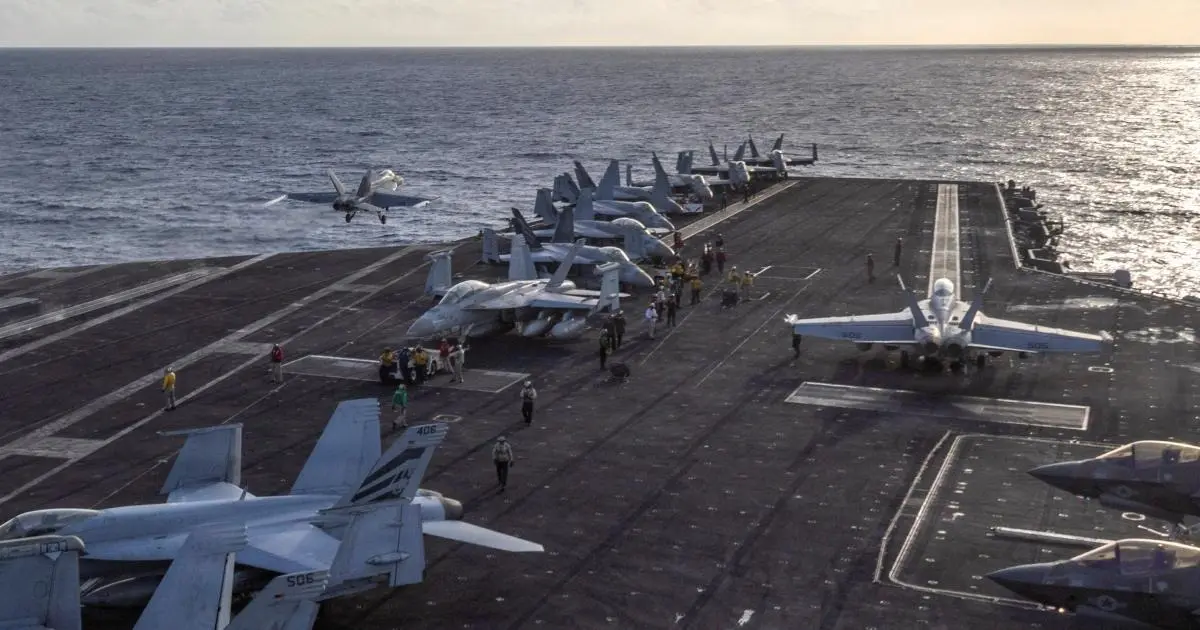
On October 8, the USS Abraham Lincoln and its accompanying carrier strike group finally returned to the United States after spending an astonishing 320 days at sea. This deployment, marking a near-record duration for the modern American military, had long since devolved into a source of acute controversy. As the strike group’s vessels went month after month without a single port call, onboard conditions deteriorated precipitously. Sailors documented alarming supply shortages, chronic plumbing failures, and water contamination issues that severely tested the crew’s endurance.
As living and working conditions worsened, morale plummeted markedly. The psychological toll became so severe that eight sailors attempted to commit suicide over the course of the deployment. By the time the fleet finally cleared the Middle East and headed home, its struggles had spilled over into the public sphere, making front-page headlines across the country and intensifying scrutiny over the operational tempo demanded of U.S. naval forces.
The harrowing travails of the Lincoln are far from an isolated incident. Instead, they form part of a broader, increasingly alarming pattern of military strain that has generated intense concern among defense analysts since the war in Iran began last February. Experts have raised serious questions about the wisdom of similarly lengthy deployments mandated for other carrier strike groups. They have expressed deep concern regarding the Trump administration’s strategic decisions to pull soldiers and advanced military hardware stationed in the Indo-Pacific region out of their theaters and reposition them to the Middle East. Perhaps most troubling to defense planners is the steady depletion of the United States’ elite stockpile of sophisticated munitions, which are being consumed at a rate that far outpaces replenishment.
Beneath all of these mounting operational failures lies a single, systemic root cause: the U.S. armed forces simply are not built for the near-constant state of use and deployment they have experienced for decades. Ever since the conclusion of the Cold War, American defense planners have structured the U.S. military to possess the capacity to fight two major regional conflicts simultaneously. In practice, this doctrine has driven Washington to construct a force explicitly optimized for short, sharp, and decisive wars. Consequently, the defense apparatus does not possess a sufficient number of units, weapons systems, or personnel to sustain endless, protracted conflicts while concurrently projecting power across the globe to coerce adversaries and reassure international partners.
In response to these compounding crises, American officials are now attempting to modestly increase the overall size of the military. More critically, they are pinning their hopes on massive infusions of federal funding designed to drastically enhance the technological capability of existing armed forces. However, executing these sweeping changes will prove exceptionally challenging—and, from a broader strategic perspective, they may ultimately be unnecessary. The United States remains an inherently secure nation flanked by vast oceans and backed by numerous capable, wealthy allies. It does not require a sprawling defense apparatus uniquely engineered to fight everywhere, all at once. Rather, the nation would be far better served by focusing its strategic attention on a narrower, more disciplined set of priorities and scaling down its global commitments accordingly.
STRETCHED THIN
The conventional, nonnuclear forces of the United States, which consistently consume more than 80 percent of the total defense budget, are meticulously structured and sized for specific, high-stakes contingencies—most notably, a prospective clash with China, Russia, or both nearly simultaneously. To prepare for these formidable adversaries, military hardware is explicitly designed for maximum lethality and survivability within what planners anticipate to be an unimaginably hazardous combat environment.
To achieve this, the Pentagon has heavily prioritized the procurement of precise, long-range, and stealthy weaponry. These sophisticated assets are intended to violently pierce enemy air and coastal defenses, paving the way for other exceptionally expensive, advanced platforms—such as F-35 fighter jets or B-2 and B-21 stealth bombers—to deliver large quantities of slightly less sophisticated, yet devastatingly lethal, precision munitions.
Washington has never realistically expected these high-end wars to be protracted affairs. Instead, military doctrine assumes that under the immense pressure generated by such intense conflicts, an adversary will quickly back down, or the war will rapidly escalate to nuclear threats or, worst of all, actual nuclear exchange. During the Cold War, for instance, the United States and its NATO allies based their contingency planning around an extremely intense, roughly 30-day conflict against the Soviet Union.
Today’s military planners have likely adopted a very similar set of assumptions regarding a potential war with Beijing or Moscow. The underlying American philosophy dictates that highly capable conventional forces, combined with the catastrophic risk of nuclear escalation, should serve as a powerful deterrent against attack. Should deterrence ultimately fail, planners hope to halt an enemy in its tracks immediately, creating escalation risks so monumental that the adversary will recognize its miscalculation and desperately seek to reverse course.
However, this strategic mindset carries a profound structural flaw: Washington simply does not possess the resources required to sustain long, great-power conflicts. With a price tag of roughly $100 million per aircraft, the F-35—a vital mainstay of the air force, navy, and Marine Corps—is fundamentally not designed for rapid mass production. The same constraint applies to the long-range stand-off missiles that would serve as the preferred munitions during the opening days of such a war.
While the U.S. military has developed sophisticated theater ballistic missile defenses, their primary institutional purpose is to protect deployed U.S. forces and essential military infrastructure, rather than sprawling towns, civilian cities, and industrial centers. While these defense systems can theoretically be repurposed to shield civilian populations under specific conditions, doing so rapidly exhausts the finite supply of interceptor missiles. In a full-scale conflict with China or Russia, civilians residing in local, allied nations would ultimately need to look after themselves.
These systemic vulnerabilities have been laid bare by Washington’s ongoing war against Iran. The United States likely calculated that it could swiftly overpower the Islamic Republic—at best a middle power, albeit one harboring significant regional ambitions. Under optimal circumstances, the U.S. military routinely overmatches adversaries of this caliber, much as it decisively dismantled Iraqi forces during the 1990–91 Gulf War.
Yet, America’s adversaries have actively adapted over the decades. They no longer merely produce scaled-down, less capable iterations of the advanced great-power militaries that U.S. forces are specifically trained to deter and defeat. Instead, modern regional powers have heavily fortified themselves, preparing to absorb punishing blows and continue fighting, even if operating at reduced levels of overall combat effectiveness.
OVERPROMISE AND UNDERDELIVER
Overly ambitious war plans and flawed grand strategies are not the sole drivers of the U.S. military’s current struggles; domestic and international politics have compounded these difficulties significantly. Because the American public remains deeply hesitant to support prolonged foreign interventions and costly casualties, U.S. politicians will go to extraordinary lengths to avoid service member deaths.
As a result, leaders routinely take the high-end weaponry that the military has painstakingly stockpiled to break through great-power defenses and instead spend it profligately on low-end regional conflicts. Similarly, political pressures compel Washington to deploy scarce, sophisticated air defense batteries to shield allied towns and cities, driven by the fear that unprotected partners might otherwise seek out new alliances or unilaterally settle conflicts by compromising with their adversaries.
Furthermore, U.S. policymakers suffer from a persistent tendency to overuse the armed forces as a default instrument of statecraft. Elected officials frequently prefer to accompany diplomatic messaging with overt military action—partly due to a fading faith in traditional diplomacy—which pushes them to parade, position, or deploy military assets far more frequently than operational prudence warrants. When commanded to act, military commanders routinely salute and comply, driven by professional ethos or the simple reality that career military leaders naturally gravitate toward active command.
The cumulative result is a visibly worn-down military apparatus. The defense press is consistently populated by reports detailing naval vessels and military aircraft that fall short of operational standards because they have been kept at sea far too long, leading to severely deferred maintenance schedules. This backlog creates cascading repair bottlenecks across the entire force. When a warship must remain in dry dock significantly longer than planned to undergo comprehensive repairs, subsequent ships in the rotation are forced to wait even longer for necessary servicing, compounding their eventual maintenance needs.
Ultimately, the U.S. Navy finds itself with fewer fully ready combat ships available to respond to an unexpected great-power challenge. The U.S. Army faces strikingly parallel hurdles, with combat and support vehicles returning from operations to maintenance depots in unexpectedly poor, degraded condition. Within the air force, the "full mission capable rate" of the F-35 fleet—which was never particularly robust—has plummeted from 38 percent down to 25 percent since 2021. Overall aircraft readiness rates across the broader air force have also steadily declined in recent years, largely driven by unrelenting operational overwork.
Meanwhile, American soldiers, sailors, pilots, and marines remain on a perpetual wartime footing, tasked with constantly coercing adversaries, deterring hostile states, and reassuring anxious allies. This relentless tempo generates extreme operational activity levels that directly undermine personnel retention.
Although the military has historically enjoyed strong retention rates among senior enlisted personnel in recent years, those trends may soon reverse. Since 2024, navy warships have repeatedly deployed undercrewed, pushing remaining personnel to exhaustion. The ultimate consequence of this perpetual overuse is clear: the sharp operational edge of the American military is being steadily dulled, and its steel blade weakened.
FIT FOR PURPOSE
U.S. defense officials are acutely aware of these mounting systemic challenges. Presently, they are attempting to engineer a solution by building a somewhat larger and far more technologically advanced military. For instance, Congress appears poised to increase the Pentagon’s baseline budget—encompassing the enduring costs of manning, training, and equipping the force—by more than 25 percent, pushing it to an unprecedented $1.1 trillion for the 2027 fiscal year.
Beyond that, the Pentagon hopes to secure an additional $350 billion in supplementary funding through subsequent legislation. Defense leadership also aims to recruit more than 40,000 new service members.
However, this proposed influx represents a personnel increase of roughly three percent at best—a figure far too small to adequately staff the additional units required to resolve existing readiness deficits. Moreover, the increasingly complex, high-tech weaponry that lawmakers hope to purchase cannot compensate for the crushing strain of constant deployments and endless overlapping wars. The domestic defense industrial base is already struggling to keep pace with current baseline demands, and recruiting massive numbers of new service members would likely require offering significantly higher financial compensation, which would ultimately need to be extended across the entire force. Personnel costs would rapidly consume an even greater share of the defense budget. Alternatively, Washington could resort to conscription, but such a move would trigger severe domestic political backlash.
A viable alternative exists, however: scaling down. Instead of clinging to the fiction that the United States must retain the capacity to fight two major great-power wars simultaneously, Washington should tailor its strategic ambitions to fit its available resources.
The nation should continue to maintain forces capable of addressing major contingencies, such as deterring territorial expansion or aggression by China. However, policymakers must willingly slow down or deprioritize secondary commitments. Congress should explicitly task the Pentagon with conducting a comprehensive internal review of the armed forces to establish a formal "activity budget." This budget would be derived from a realistic assessment of how much actual military activity—measured in flying hours, ship days at sea, and field training days—can be safely undertaken without degrading the readiness of the total force.
Once established, military leadership would allocate operational activity accordingly. Grounded in the lessons learned from three decades of debilitating hyperactivity, senior commanders must determine what precise level of training exercises, forward deployments, and regional interventions the military can genuinely support without eroding the capabilities required to deter a peer competitor and, if necessary, wage war effectively. The U.S. Navy already possesses a framework for this through its Optimized Fleet Response Plan, which outlines sustainable fleet activity levels. Yet, successive American presidents and defense secretaries have routinely bypassed and ignored this plan whenever political expediency dictated higher deployment tempos.
Crucially, this proposed activity budget should not be classified; it ought to be published openly alongside the annual dollar budget released by the Pentagon, detailed on the Department of Defense comptroller’s website. Whenever elected officials wish to exceed the pre-approved operational activity levels, they should be legally and politically mandated to explain precisely why, and to present a credible plan for repairing the force afterward.
Military commanders should also view this through an ethical lens, recognizing that senior leaders should be prepared to resign when systemic overuse inflicts severe, systemic damage on the personnel and equipment under their command.
To successfully lighten its crushing strategic load, Washington will need to devolve certain responsibilities onto capable international partners. This transition should be entirely feasible, even when accounting for the necessity of managing Moscow’s aggressive posture, which serves as the primary European contingency driving U.S. defense planning. Principal European nations possess more than sufficient economic, industrial, and technological resources to handle Russia independently, provided they choose to make the necessary investments. The foundational transatlantic bargain should therefore be renegotiated to reflect the genuine, limited liability that the United States is prepared to assume for the defense of the European continent.
While the National Defense Strategy of the Trump administration acknowledges this reality in theory, actual U.S. military activity levels and troop deployments across Europe demonstrate that Washington has not genuinely reduced its role in the region’s defense. The Supreme Allied Commander of NATO remains an American officer, a position that should logically be filled by a European counterpart.
Tens of thousands of U.S. service members remain garrisoned across Europe, many of whom should be brought home. Furthermore, official Pentagon and regional command websites continue to feature exhaustive inventories of exercises and maneuvers spanning the continent, involving both permanently stationed forces and rotating units deployed directly from the United States. These footprints, too, must be systematically reduced.
American policymakers may naturally harbor the instinct that global security challenges can be resolved simply by purchasing a larger military. Yet a far superior solution requires the United States to recalibrate its grand strategy and embrace a posture of greater strategic restraint. Washington simply lacks both the national will and the infinite resources required to simultaneously underwrite the defense of Asia and Europe while fighting protracted, open-ended conflicts in secondary theaters like the Middle East.
Nor, fundamentally, does the nation require such overextension. The United States remains inherently secure: geographically wealthy, endowed with bountiful natural resources, safely insulated by vast oceans, and bordered by relatively weak and compliant neighbors. Only radical, seismic shifts in the political constellation of power across Asia, Europe, or the broader Middle East could genuinely threaten core American security interests.
Washington should certainly maintain sufficient military power and stockpile adequate strategic reserves to insure against such unlikely shifts. In general, however, the nation can well afford to be far less proactive. Adopting a more restrained grand strategy could ultimately enable meaningful reductions in the overall defense budget, providing essential fiscal relief at a time when ballooning national deficits demand severe financial discipline from the Pentagon.