
Autonomous drone delivery pioneer Zipline has successfully secured a massive $1.5 billion in new funding, propelling its corporate valuation to an impressive $21.5 billion. The capital infusion is earmarked to accelerate the company’s ambitious plans to scale its operations across the United States, driving heavy investments in advanced manufacturing, strategic hiring, and robust delivery infrastructure.
The blockbuster funding round was jointly led by prominent investment firms Paradigm, WCM Investment Management, and Layer Global. They were joined by a powerhouse consortium of returning and new financial backers, including ride-sharing giant Uber, Fidelity, Valor Equity Partners, Tiger Global, J.P. Morgan, ARK Invest, and Salesforce Ventures.
This latest financial milestone marks a meteoric rise for the logistics innovator. Just months prior, in January 2026, Zipline announced a funding round exceeding $600 million at a valuation of $7.6 billion. The jump to a $21.5 billion valuation in less than a year underscores surging investor confidence in the commercial viability of autonomous aerial logistics and the company’s trajectory toward mainstream adoption.
Walmart and Uber Support National Expansion
Armed with fresh capital, Zipline is aggressively pursuing national scale through high-profile partnerships with retail and transportation heavyweights. Walmart and Zipline have finalized a significant multiyear agreement to launch 300 additional delivery sites across the country, with potential for further expansion beyond those initial locations as demand dictates.
At the same time, Uber’s strategic investment cements a shared vision between the two companies: reaching an astonishing milestone of one million drone deliveries per day by the end of 2029. Under this partnership, Zipline’s autonomous delivery service will be seamlessly integrated into the Uber Eats application. The rollout will begin in markets where Zipline already maintains an operational footprint before scaling into new metropolitan areas.
These sweeping commercial agreements provide Zipline with immediate access to an established base of retail and restaurant customers. Industry analysts note that this integration is critical for generating the massive, consistent order volume required to sustain a nationwide aerial delivery network. By plugging directly into existing consumer habits through familiar platforms like Uber Eats and Walmart, Zipline bypasses the friction of building a consumer-facing ordering app from scratch.
Delivery Volume and Business Results
Beyond its partnerships, Zipline shared compelling business metrics demonstrating the economic value its service brings to local merchants. Hundreds of businesses now generate recurring revenue through the drone delivery network, with dozens of new merchants coming on board every single week.
Highlighting the impact on the food service sector, Zipline released operational results from restaurants that have utilized its delivery infrastructure over an extended period. Between March and October 2026, Zipline’s share of total delivery revenue at those established partner restaurants surged from 10.8% to 34.9%. Furthermore, those merchants reported a 26% overall increase in gross merchandise value (GMV) derived from deliveries, with Zipline-fulfilled orders accounting for a striking 80% of that total growth.
Crucially, internal merchant data indicates that these drone orders largely represented entirely new business rather than sales cannibalized or diverted from traditional third-party delivery platforms. While these encouraging figures reflect the performance of a carefully selected group of established early-adopter partners rather than the entire sprawling network, they suggest that aerial fulfillment can unlock untapped customer demand for local eateries.
Faster, Quieter Deliveries
Zipline’s operational momentum is perhaps best illustrated by its performance in Texas. The company reported executing more than one million commercial deliveries in the Dallas-Fort Worth area throughout 2026 alone, proving that high-frequency autonomous logistics is already a daily reality for hundreds of thousands of suburban residents.
Speed remains one of the most compelling selling points of the technology. In October, Zipline’s median delivery time clocked in at just 19 minutes from the moment a customer completed their checkout. For specialized items like bakery goods that require minimal kitchen preparation time, the median delivery window dropped to an astonishing 10 minutes.
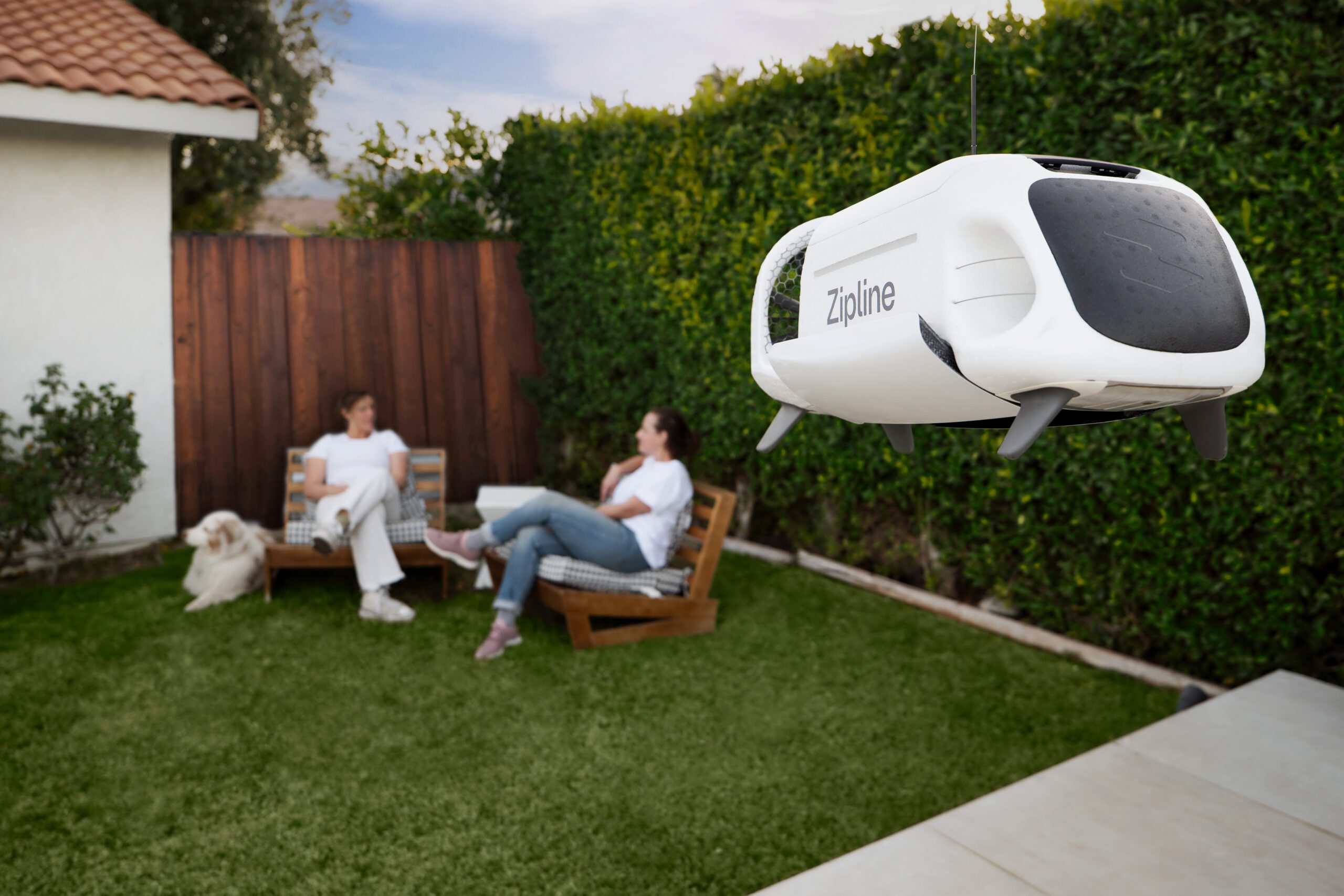
To support this rapid scaling while mitigating the challenges of urban and suburban integration, Zipline has introduced sophisticated acoustic technology that actively adjusts aircraft operations to reduce noise emissions. The company’s next-generation aircraft are specifically engineered to carry heavier payloads across longer distances while flying at higher altitudes and operating much more quietly than earlier models.
These technological refinements address mounting public scrutiny regarding noise and privacy as commercial drone delivery expands into densely populated neighborhoods. Public sensitivity to low-flying aircraft has occasionally sparked friction between tech firms and local municipalities.
A stark example unfolded in Westborough, Massachusetts, where residents and local officials fiercely challenged Amazon’s proposed drone delivery facility over mounting concerns regarding noise, public safety, local zoning laws, and environmental impact. Local residents successfully approved a municipal bylaw explicitly restricting commercial drone operations within town limits, while federal lawmakers formally requested a site-specific environmental assessment. Facing significant local pushback, Amazon withdrew its facility application on October 30, though the retail giant indicated plans to submit a revised proposal in the future.
This high-profile dispute illuminates a complex regulatory and social hurdle facing the entire drone delivery sector: securing certification and operational approval from the Federal Aviation Administration (FAA) does not automatically guarantee community acceptance. Local land-use regulations, municipal zoning rules, grassroots community sentiment, and environmental oversight will likely dictate the geographic boundaries where delivery companies can successfully deploy and expand.
From Regional Operations to a National Network
Zipline’s journey to becoming a domestic delivery titan began far differently. The company originally launched its commercial operations by transporting critical medical supplies, blood products, and vaccines to remote and underserved communities in Africa, later pivoting to consumer retail delivery in the United States and international markets. Over the course of its corporate history, Zipline has accumulated an impressive safety record, reporting 150 million commercial autonomous miles flown without a single safety incident.
Reflecting on the monumental funding round and the road ahead, Anton Levy, Founder and Managing Partner of lead investor Layer Global, emphasized the transformative nature of the company’s mission. "Zipline has already brought the future of delivery to the communities it serves. Now, the opportunity is to reach millions more," Levy said. "With partners like Uber and Walmart and a repeatable model for entering new markets, Zipline is well positioned to make drone delivery a mainstream part of everyday life."
For the broader commercial drone industry, Zipline’s aggressive national expansion serves as the ultimate test of large-scale commercial viability. The company has already demonstrated that it can successfully execute high-volume, reliable delivery operations within select regional markets. Its next great frontier is extending that operational model across the entire United States while tightly managing logistics costs, maintaining flawless safety and reliability standards, and proactively navigating the complex landscape of local community relations.