Solar power generation across Great Britain reached an unprecedented all-time high over the summer of 2026, propelled by a potent combination of intense, prolonged heatwaves, clear skies, and a rapidly expanding national deployment of both commercial solar farms and residential rooftop installations. New data and comprehensive analysis published by Carbon Brief reveal that the summer months of June, July, and August yielded a staggering 8.8 terawatt-hours (TWh) of electricity, marking a dramatic milestone in the nation’s ongoing transition toward renewable energy.
The remarkable surge in clean energy production did not happen in a vacuum. It unfolded against the backdrop of what the Met Office officially provisionally recorded as the hottest summer in the history of the United Kingdom, featuring five distinct and punishing heatwaves between May and August. According to meteorological records, the season also ranked as the sixth sunniest on record, bathing the country in more than 620 hours of sunshine.
England and Wales, which bore the brunt of the most extreme temperatures, experienced their second-sunniest summers in recorded history. June 2026 shattered previous benchmarks to become the hottest June in England since temperature records first began in 1884, while Wales and the wider UK witnessed their second-warmest Junes on record. The relentless heat was swiftly followed by exceptional dryness. July earned the dubious distinction of being the driest July for England and Wales since 1836. Pockets of the capital experienced an entirely rainless month, while meteorological stations such as Wisley in Surrey recorded an astonishing 62 consecutive days without a single drop of rain. Peak temperatures climbed to a blistering 38.1 degrees Celsius at Kew Gardens in southwest London on August 13.
Attribution science compiled by the Met Office underscored the extraordinary nature of the season, concluding that the record mean temperatures observed across the summer were made approximately 130 times more likely by human-driven climate change.
Despite persistent concerns that extreme heat can occasionally degrade the operational efficiency of photovoltaic panels, the sheer volume of daylight hours and exceptionally high levels of solar irradiation comprehensively overwhelmed any minor thermal efficiency losses. Consequently, solar generation surged by a remarkable 23% compared to the exact same three-month window in 2025. When viewed against a broader historical canvas, the summer output of 2026 is double the level of solar generation recorded during the summer of 2021, illustrating the exponential acceleration of the technology’s footprint in the British energy landscape.
Every individual month of the season broke previous boundaries, with June, July, and August each establishing new monthly records for solar generation. July emerged as the most prolific calendar month for solar energy in British history, delivering 3.3 TWh of electricity and successfully satisfying 15% of the total national electricity demand for the entire month.
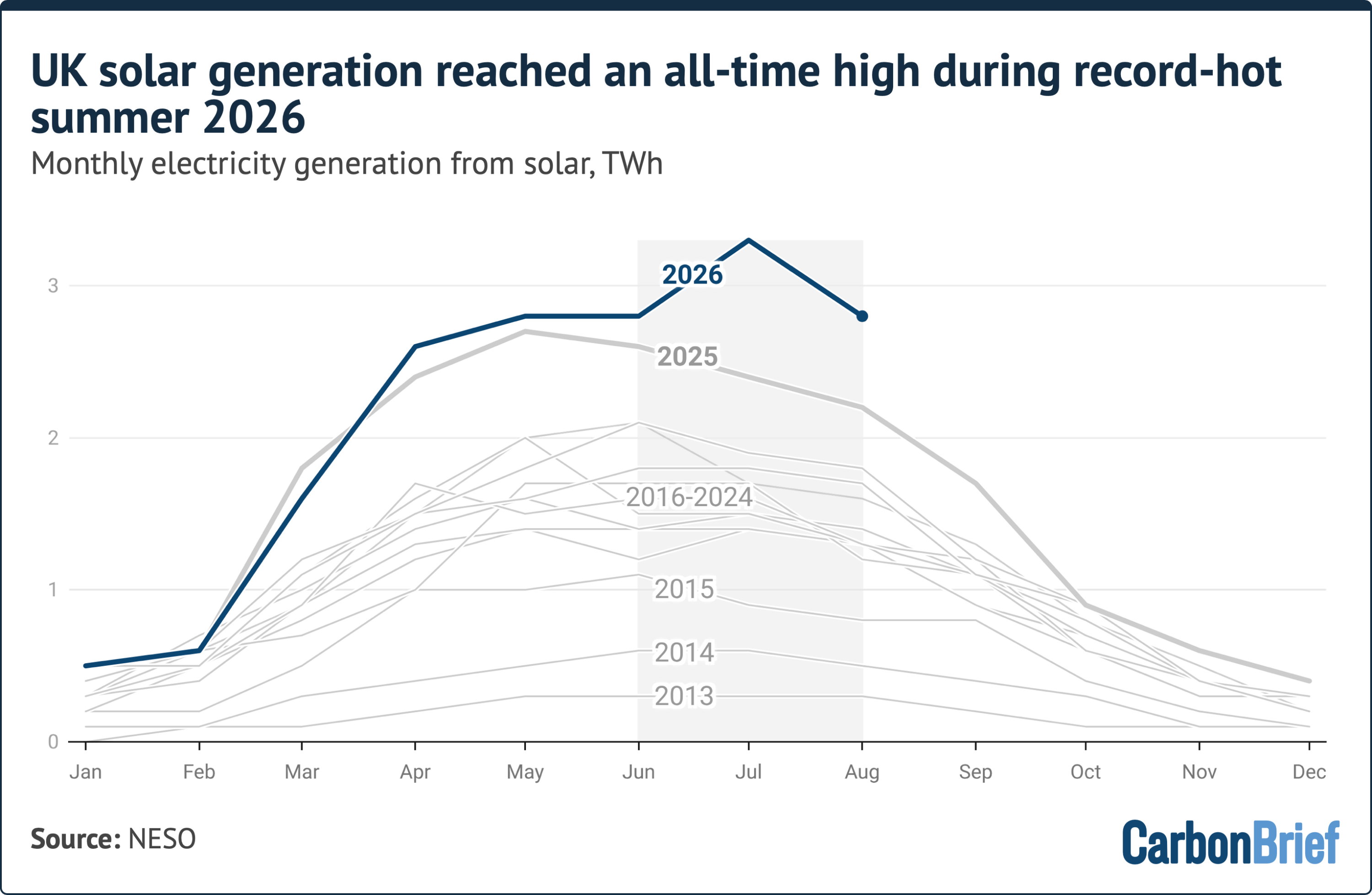
By the close of August, cumulative UK solar generation for the year 2026 had already reached 17 TWh, outperforming the figures from the corresponding point in 2025 by 13%. This sustained upward trajectory is underpinned by a continuous, nationwide expansion of solar infrastructure. Domestic rooftop solar arrays alone now account for approximately 29% of the nation’s total cumulative solar capacity.
Government energy statistics indicate that UK solar capacity stood at 21 gigawatts (GW) by the third quarter of 2025, representing a year-on-year surge of 3 GW, or 18%. Updated figures from the University of Sheffield’s PV_Live monitoring project show that total installed solar capacity has since climbed to nearly 24 GW.
This infrastructure expansion is mirrored at the grass-roots level, driven by households and businesses eager to hedge against volatile fossil fuel markets. Government figures highlight that nearly 172,000 separate solar installations have been fitted across the UK since the beginning of 2026 alone. The momentum reached a fever pitch in July, during which more than 19,800 rooftop solar systems were installed—the mathematical equivalent of a new system being mounted onto a British roof every two minutes. In total, nearly 1.7 million households across the UK are now equipped with operational solar panels.

The financial dividends of this solar boom have provided tangible relief to consumers grappling with broader economic pressures. According to an independent analysis conducted by Utility Bidder, British households equipped with rooftop solar panels and home battery storage systems managed to bypass an estimated £86.7 million in electricity costs across the 26 official heatwave days recorded throughout the summer.
Chris Hewett, chief executive of the trade association Solar Energy UK, welcomed the milestone generation figures in a statement to Carbon Brief. He emphasized that the record-breaking output was fueled by a combination of clear skies and the relentless, continued growth in national deployment.
"The surge in solar generation this summer not only kept bills down for people with solar and batteries in their homes, but helped keep overall power prices much lower than they would have been if Britain had been relying on more gas generation during the day," Hewett noted.

Even though the season as a whole smashed cumulative production records, it is worth noting that no new half-hourly solar power output record was established over the summer of 2026. The peak instantaneous generation record remains safely held at 15.2 megawatts (MW), a threshold that was achieved earlier in the year on April 23, 2026.
- Note: While this reporting references the United Kingdom throughout, the underlying electricity generation data strictly relates to the interconnected island of Great Britain, comprising England, Scotland, and Wales. Northern Ireland operates under a separate, all-Ireland electricity market framework.