A comprehensive new analysis has revealed that soaring wholesale costs, driven primarily by expensive natural gas, are responsible for nearly 90% of the increase in United Kingdom household electricity bills since 2020.
The figures, shared with climate and energy publication Carbon Brief by the prominent thinktank Nesta, directly challenge a widespread political and media narrative that the UK’s legally binding net-zero targets are to blame for crippling household energy costs. Instead, the data demonstrates that fossil fuel volatility remains the primary culprit behind the ongoing cost-of-living squeeze.
According to the research, wholesale gas costs are also behind the vast majority—77%—of the increase in household gas bills over the same period.
Andrew Sissons, director for a sustainable future at Nesta, told Carbon Brief that the transition toward net-zero is actually acting as a vital shield for British consumers. "Rising gas prices, not net-zero, have driven most of the recent surge in Britain’s energy bills," Sissons said. "Britain is particularly exposed, with over 80% of households connected to gas mains, while our electricity system still relies too much on gas as the marginal unit."

The release of this analysis coincides with the UK government’s recent controversial approval for the Jackdaw gas field to be developed in the North Sea, a decision pushed forward despite official acknowledgments that the project would not materially affect consumer prices.
Another Gas Crisis
The findings arrive against a backdrop of renewed turbulence in international energy markets. In January 2026, analysts reported that two-thirds of the rise in electricity bills since the onset of the 2022 global energy crisis was directly attributable to high gas prices.
Now, amid ongoing military conflict in the Middle East, wholesale gas prices have climbed back to their highest levels since Russia’s 2022 invasion of Ukraine. As of October 19, UK wholesale natural gas prices stood at 220 pence per therm—equivalent to roughly £75 per megawatt-hour (MWh)—surpassing the average seen during the acute crisis year of 2022, which sat at 210 pence per therm or £72/MWh.
When accounting for inflation, typical UK annual household electricity bills rose by £180 by the fourth quarter of 2026, relative to the same period in 2020. The Nesta analysis shows that an overwhelming 90% of this increase—amounting to £161—is directly tied to wholesale costs dictated by the global price of gas.
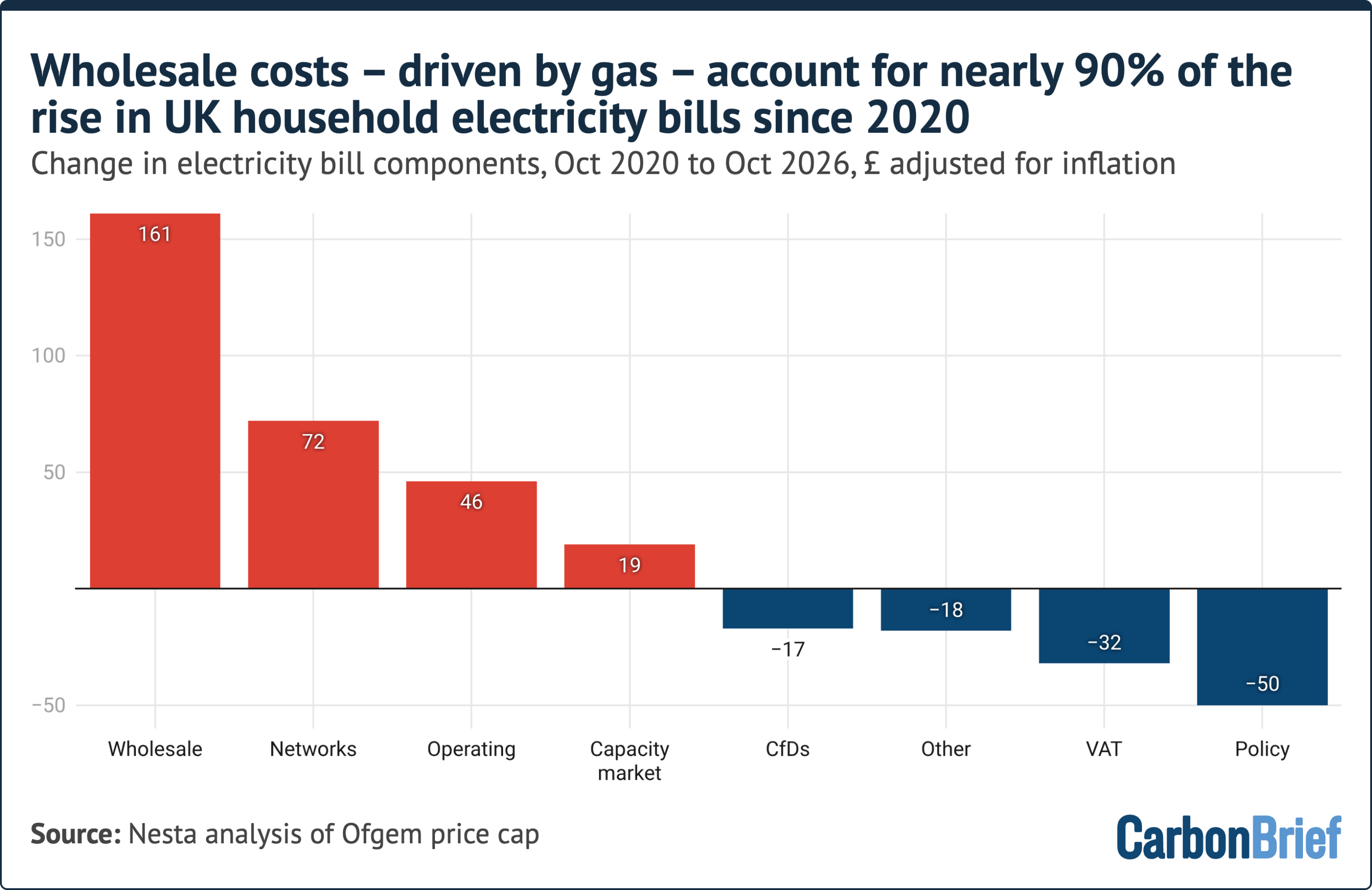
In stark contrast to prevailing public perceptions, government-backed renewable energy schemes known as Contracts for Difference (CfDs) are actually helping to reduce electricity bills by £17 under the current price cap system. Furthermore, the government has actively cut policy-related costs for electricity by shifting 75% of legacy renewable support onto general taxation, terminating the Energy Company Obligation (ECO) efficiency scheme, and temporarily removing value-added tax (VAT) from domestic energy supplies.
Network costs have added £72 to typical bills since 2020, according to the thinktank. The vast majority of this increase—some £46—represents necessary investments in the high-voltage electricity transmission network, often described colloquially as the motorways of the national power grid.
By contrast, only £21 of the rise in network costs relates to balancing the system, which includes constraint payments made to wind farm operators to temporarily power down during periods of localized grid congestion, while simultaneously turning on backup gas plants due to insufficient transmission capacity.
While wind constraint payments frequently attract extensive coverage across national newspapers and broadcast media, total system balancing costs make up a relatively minor slice of the overall financial burden, accounting for just £35, or roughly 4%, of a typical £858 annual household electricity bill.
Meanwhile, energy supplier operating costs have risen by £46 since 2020. Although underlying figures from industry regulator Ofgem do not break down these operational increases in granular detail, analysts believe the surge is heavily driven by the mounting burden of household energy debt across the country. By law, retail supplier profit margins remain strictly capped at 2.5% of overall bills.
Breaking the Link
Despite the severe pressures on domestic heating and power, household electricity prices have increased far less rapidly than direct gas bills since the emergence of the Hormuz crisis. Increased generation from clean energy sources has played a critical role in beginning to break the traditional economic link between gas and electricity pricing.
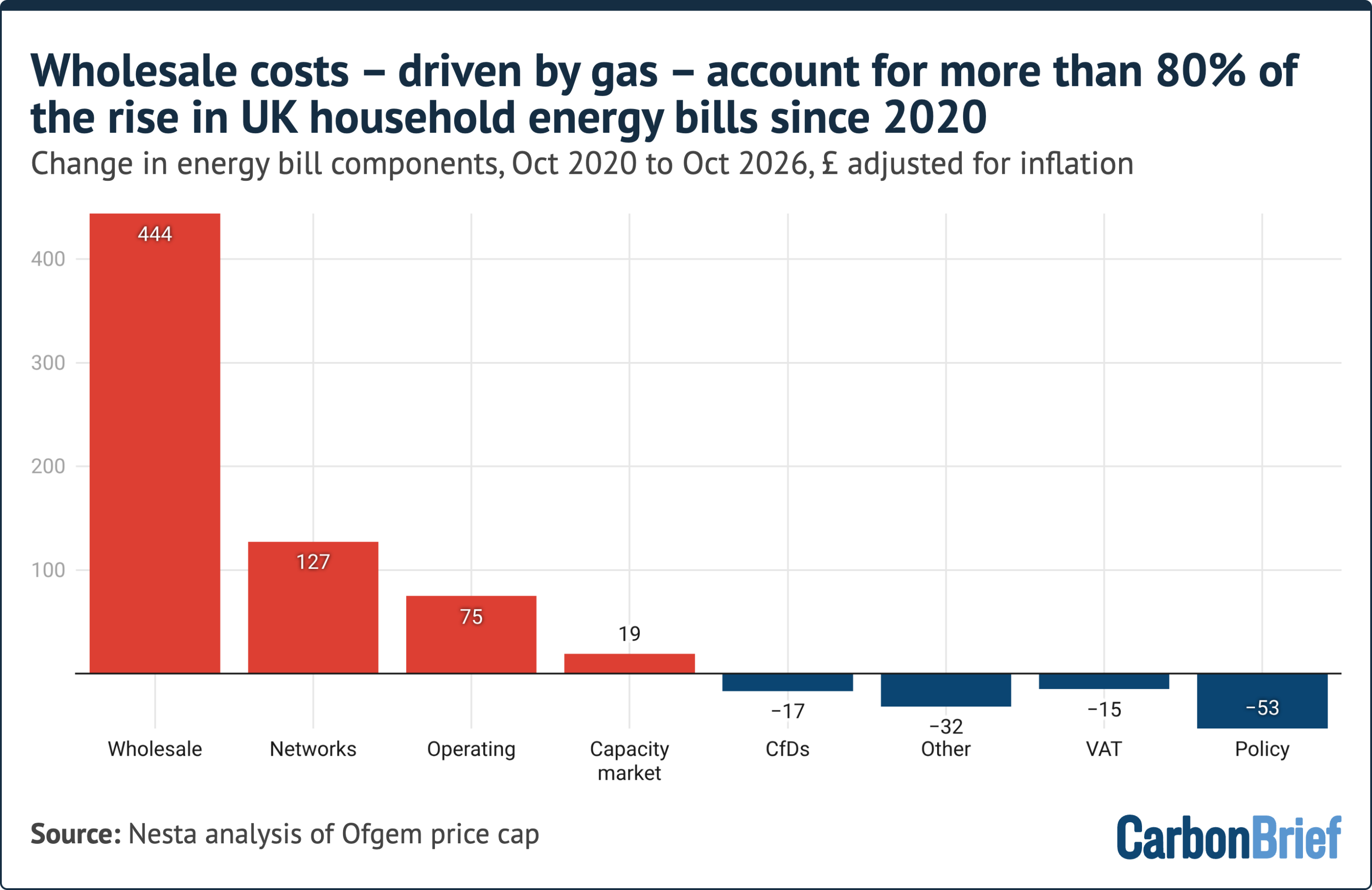
Since 2020, household gas bills have surged by £368 in real terms, with 77% of that increase—or £283—driven purely by wholesale gas costs. When combined, total dual-fuel bills for a typical UK household have escalated from £1,175 per year in October 2020 to £1,723 per year by October 2026, marking an aggregate real-terms increase of 47%.
The escalation in wholesale costs driven by high gas prices accounts for £444, or 81%, of this overall dual-fuel increase.

The £127 real-terms rise in network costs includes £72 for electricity transmission, distribution, and system balancing, alongside £55 earmarked for ongoing investment and maintenance in the national gas distribution grid. According to the Energy Networks Association, up to 80% of total investments in electricity grids are required simply to maintain and modernize existing infrastructure, with the remaining fraction dedicated to expansion for net-zero readiness.
Government social and climate policies accounted for £183, or 16%, of a typical dual-fuel bill back in October 2020. By the time of the October 2026 price cap, that figure had dropped significantly to £114, representing just 7% of the total cost.
Presently, wholesale costs constitute the largest single share of the energy price cap at £757, or 44%. Network costs form the second-largest component at £417, or 24%, followed closely by supplier operating costs at £291, or 17%.
Reflecting on the broader economic picture, Sissons emphasized that modernizing infrastructure is essential for long-term stability. "Upgrading the grid is not cost-neutral, but that price tag is dwarfed by the impact of rising gas prices," he said. "In fact, net-zero is helping to shelter Britain from the impact of expensive gas. Since the start of the Iran war, electricity bills have begun to decouple from gas bills, thanks to the UK’s increased renewable power and support from contracts for difference."
Looking forward, Sissons argued that deeper structural changes will be necessary to insulate consumers permanently. "Going further will require British households to have clean electricity, electric vehicles, and heat pumps over fossil-fuel cars and boilers," he explained. "By focusing on growing electricity demand, the government can spread upgrade costs more widely. This can lock in the consistent investment in electrification that is Britain’s best path to stop global turmoil showing up on winter energy bills."
Political and media circles are already anticipating potential interventions. Reports indicate that the chancellor may unveil major targeted measures to assist vulnerable households and businesses cope with compounding energy pressures during the upcoming national budget.
Meanwhile, independent energy market forecasters warn that bills are poised to rise sharply under the forthcoming January price cap, with potential increases reaching as high as a quarter if international gas markets remain volatile.