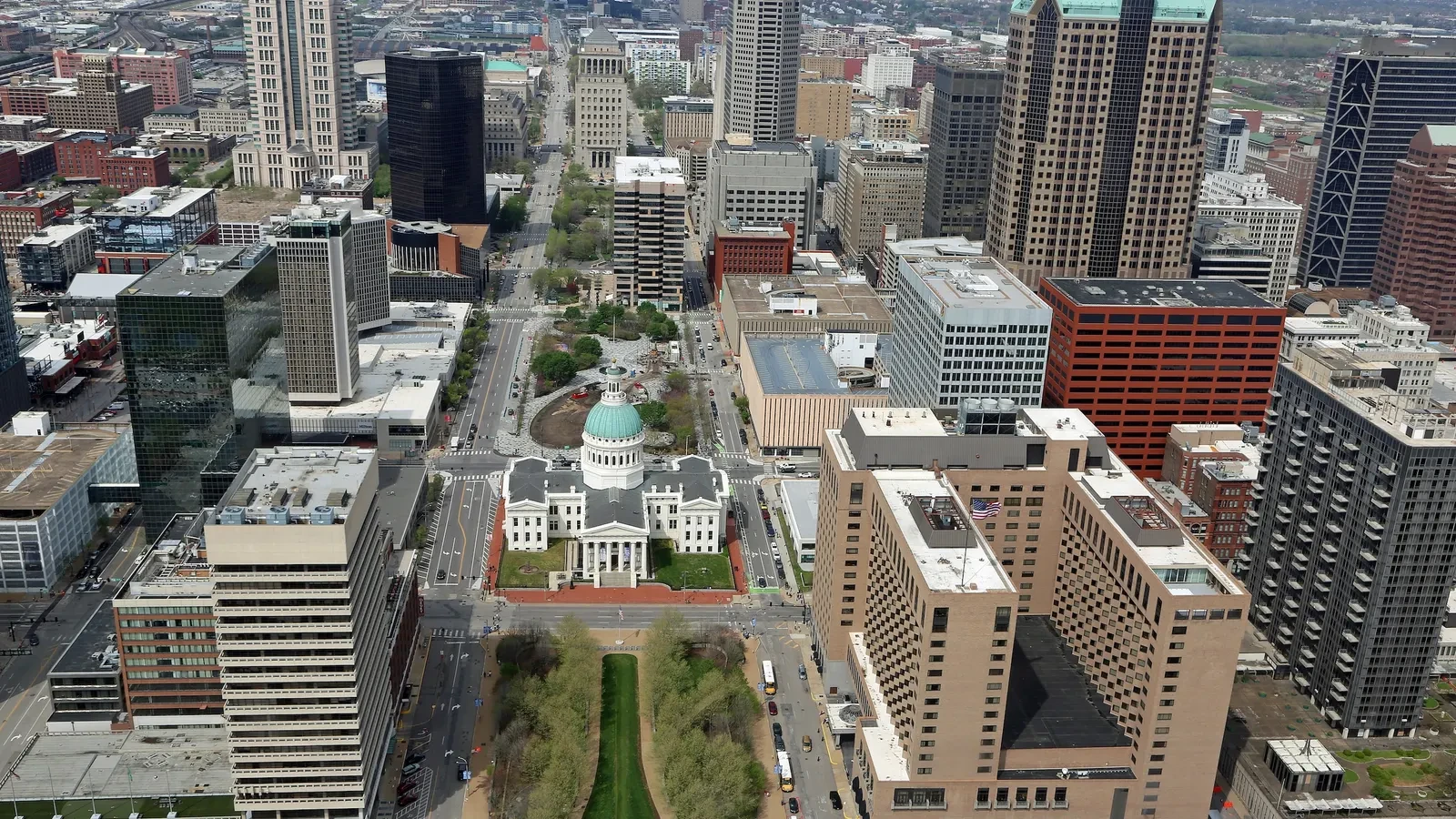
St. Louis Mayor Cara Spencer holds an unshakeable belief in the future of her city’s downtown, having made its revitalization the central focus of her administration since taking office last year.
Like many Midwestern legacy cities, St. Louis has grappled with significant population loss and post-COVID-19 office vacancies within its central business district. Iconic, landmark properties—such as the soaring 44-story AT&T Tower and the historic 21-story Railway Exchange building—have stood vacant for years. In some instances, unauthorized occupants and thieves moved in to replace the commercial tenants that once filled the towers, prompting The Wall Street Journal to label the Missouri city a "real estate nightmare" in a 2024 report.
Despite these hurdles, Mayor Spencer remains entirely unfazed by the negative national headlines. "Downtown St. Louis is a sleeping giant," she remarked in an interview.
Local business leaders share her optimistic outlook. Robert O’Loughlin, chairman and CEO of St. Louis-based Lodging Hospitality Management, asserts that despite the well-documented challenges, St. Louis offers structural and cultural advantages that outpace other Midwestern metropolitan areas he views as direct competitors.
"We have a world-class zoo, and our Forest Park rivals Central Park," O’Loughlin noted. "The [Gateway] Arch draws 1.5 million people per year. We have a lot of concerts and sporting events. I boast that if you take all of those assets, they far exceed Indianapolis and Kansas City combined."
Even so, municipal leaders acknowledge that neighboring cities have moved aggressively ahead in recent years. While Kansas City has poured more than $3.5 billion into district development projects and Indianapolis officials boast an expansive $9 billion downtown construction pipeline, St. Louis has historically lagged behind regional peers—until now.
A Trio of Revitalization Initiatives
"It’s a vibrant time in St. Louis," said Ron Kitchens, managing partner of the economic development nonprofit Greater St. Louis. "The next three years are going to be maybe the greatest investment in the urban core since the [1904] World’s Fair."
The momentum shifted significantly in July when Missouri Governor Mike Kehoe signed House Bill 3231, officially known as the Missouri Downtown and Rural Economic Stimulus Act. The legislation, which easily cleared the Missouri House of Representatives by a bipartisan vote of 119 to 24, creates millions of dollars in targeted tax incentives for downtown innovation zones. Crucially, it also introduces powerful new tax credits designed specifically to help developers convert vacant, outdated office towers into modern residential housing units.
"This law recognizes the critical importance of downtown St. Louis to the state’s economy, catalyzing hundreds of millions of dollars in new investment in the economic engine of the state," Kitchens explained.
Although St. Louis is a traditionally blue city situated within a predominantly red state, Mayor Spencer maintains that the Missouri legislature clearly understands the city’s broader economic importance to the entire state, a sentiment that is actively echoed by private sector leaders.
"I can’t overstate the alignment we currently have in St. Louis to revitalize our downtown," Spencer emphasized.
Alongside the implementation of HB 3231, this multifaceted revitalization push incorporates a newly formed public-private downtown redevelopment partnership. This initiative is tasked with deploying $55 million that St. Louis secured as part of a high-profile lawsuit settlement following the departure of the St. Louis Rams National Football League franchise to Los Angeles.
Furthermore, looking ahead to St. Louis hosting high-profile soccer matches during the group stage and knockout rounds of the 2028 Olympic Games, the St. Louis Board of Aldermen voted in February to approve the creation of a new Downtown St. Louis Sports and Entertainment Community Improvement District. The district is specifically engineered to remediate urban blight and stimulate further commercial and residential redevelopment downtown. According to O’Loughlin, the state will provide $4.5 million annually to fund the district, supporting crucial public safety initiatives, pedestrian access enhancements, upgraded street lighting, and upfront capital for sports and entertainment events.
"The impetus is to [improve] a large metropolitan area so businesses functioning there can see it’s a safe area to go to, it’s well lit, it’s walkable," O’Loughlin stated.
Downtown Innovation and Tax Incentives
Explaining the mechanics of the new law, Kitchens noted that HB 3231 allows cities and regions throughout the state to designate specific geographical areas, such as a downtown core, as formal innovation zones. Beyond establishing these zones, the bill expands existing tax incentives for office-to-residential conversions, creates the Missouri Angel Investment Tax Credit to support capital expenditures for budding startup businesses, and broadens the state’s existing Missouri Works program to back large-scale capital investment projects, particularly inside designated innovation zones.
"Collectively, these tools will give St. Louis an unprecedented ability to revitalize downtown by leveraging private investment to generate new public revenue for infrastructure, public safety, and housing," Kitchens said.
Within designated innovation zones, the legislation permits municipalities to retain 50% of all new state sales and income taxes generated in the area, provided that the retained funds are strictly reinvested into public safety or critical infrastructure improvements.
"HB 3231 also establishes some of the most robust office-to-residential conversion incentives in the nation," Kitchens added. To qualify for the program, commercial buildings must be at least 25 years old, and more than 50% of the total floor space must undergo conversion to residential use. Mayor Spencer specifically pointed to a provision authorizing state tax rebates for investments made in massive properties exceeding 750,000 square feet as a game-changer for the architectural landscape of downtown St. Louis.
The state’s business community played an active role in shaping the legislation. "Worked very diligently with the state legislature on this set of tools that work for everyone," Kitchens said, noting the extensive coalition-building required. "We had to build a coalition of 28 communities around the state to help get the bill passed."
Kitchens anticipates that at least four major downtown buildings, including the sprawling AT&T tower, will take advantage of these new incentives to launch major redevelopments over the next five years. "Overall, we have $1.5 to $2 billion in new and redevelopment construction going on in the next 18 months," he said.
Rams Tough: Turning Litigation into Leverage
The road to financial recovery has roots in past conflict. After the St. Louis Rams packed up and moved to Los Angeles in 2016, the city government, St. Louis County, and the St. Louis Regional Convention and Sports Authority jointly filed a lawsuit against the NFL, alleging a serious breach of contract for permitting the franchise relocation to proceed.
"When we lost the Rams, our city leaders and some private sector attorneys took a big risk in suing the NFL," Mayor Spencer recalled.
That high-stakes legal gamble ultimately paid off. In 2021, the NFL agreed to a massive $519 million settlement to resolve the litigation. The city of St. Louis alone received $280 million from the total payout, though municipal deliberations regarding how best to distribute the windfall stretched on until earlier this year.
In June, lawmakers finalized an allocation plan earmarking $55 million of the settlement specifically for downtown revitalization initiatives. "And the business community will match that total," Kitchens noted.
"Our business community is aligned with us in doing this work. It’s an exciting time when you have the private sector willing to come to the table and match us dollar for dollar," Spencer said.
According to Kitchens, approximately half of that combined private investment will be directed toward foundational infrastructure projects, while the remaining half will be utilized to incentivize small business development in the urban core.
"I hope to get every dollar out the door prior to the Olympics," Kitchens said. "The world stage is going to be here. It’s like a dinner party—you need to get your house ready in advance."