The ongoing "super El Niño" climate phenomenon is on track to reach its peak intensity at the end of 2026, a development that climate scientists warn will drive average global temperatures to extraordinary new record levels by next year.
According to Carbon Brief’s latest comprehensive "state of the climate" update—which incorporates El Niño forecasts drawn from more than a dozen leading climate models alongside six global temperature datasets—the planet is heading into an unprecedented meteorological period. Dr. Zeke Hausfather, a prominent climate science contributor at Carbon Brief, characterized the current El Niño event as "simply staggering" while addressing participants during an interactive "ask me anything" session hosted for the publication’s community members.

El Niño is a naturally occurring climate pattern originating in the tropical Pacific Ocean. During an event, vast amounts of heat are released from the ocean surface into the atmosphere, which temporarily provides a powerful upward boost to global temperatures. Although long-term global warming is driven almost entirely by human emissions of greenhouse gases, short-term variations in yearly global temperatures are heavily influenced by the presence and intensity of these cyclical El Niño events.
The weather phenomenon currently underway has been active since June and has already shattered numerous historical benchmarks, fundamentally disrupting weather patterns across the globe. Among its early impacts are severe, drought-fueled fires in Indonesia and the formation of destructive "super typhoons" sweeping across the western Pacific Ocean.
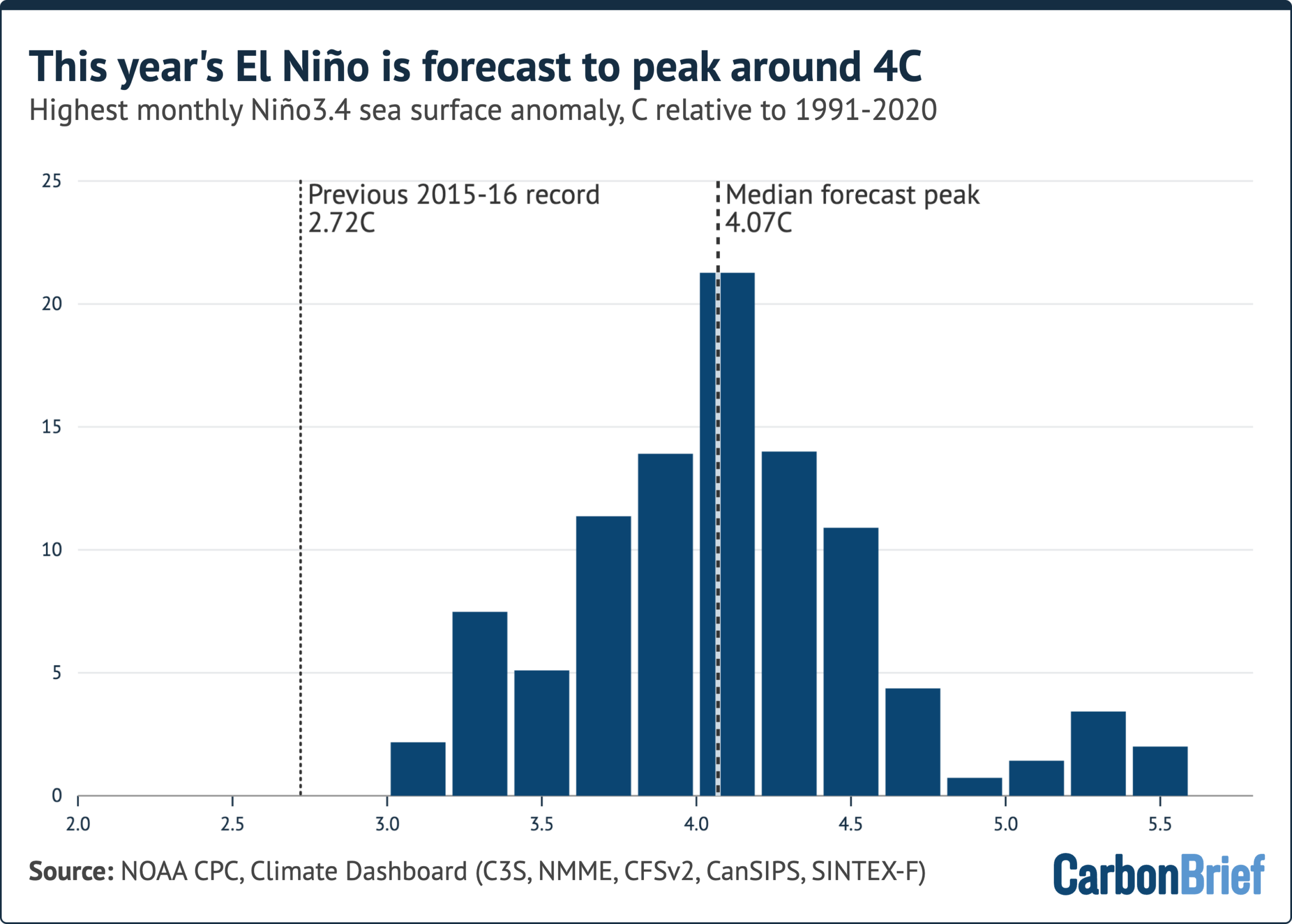
The physical strength of an El Niño event is scientifically monitored through what is known as the "Niño3.4 anomaly." This metric calculates the specific degree to which sea surface temperatures exceed historical averages within a designated sector of the central Pacific Ocean.
Through an intensive examination of more than 600 individual forecasts generated by 14 distinct dynamical climate models, Hausfather’s analysis for Carbon Brief illustrates how the models project the current event will culminate with a staggering sea surface temperature anomaly of approximately 4 degrees Celsius. If realized, this peak would tower more than a full degree above the previous high-water mark established during the historic 2015-2016 El Niño event.
Reflecting on the unprecedented nature of the data, Hausfather wrote on the Carbon Brief Connect platform that the current system is developing at an astonishing pace. He noted that the sea surface temperatures have climbed to levels so elevated that they have no modern parallel. In his assessment, researchers have never witnessed anything comparable in the historical records, raising the distinct possibility that this could evolve into the strongest El Niño event recorded over the past millennium.
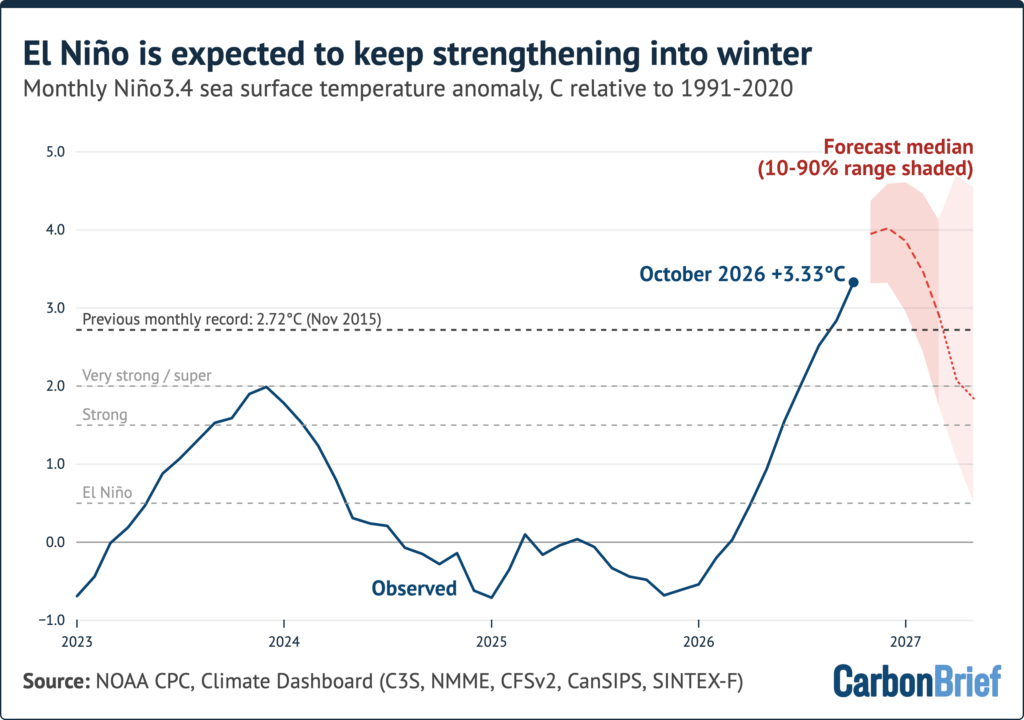
The extraordinary scale of the phenomenon has already been underscored by a series of successive milestones over the past several months. On September 18, the daily sea surface temperature anomaly within the Niño3.4 region officially surpassed the previous satellite-era record—which had stood since 2015—when it surged to 3.11 degrees Celsius.

Shortly thereafter, the entire month of September registered the highest monthly Niño3.4 temperature anomaly ever documented since systematic sea surface temperature record-keeping began in the mid-nineteenth century, reaching an average of 2.84 degrees Celsius.
Hausfather noted in his analysis that this year’s El Niño has consistently tracked significantly higher than any preceding recorded event since June, occasionally outpacing historical benchmarks by a full degree Celsius.

The updated "state of the climate" projections indicate that the weather pattern will continue to intensify as the year draws to a close. Ten out of the fourteen analyzed climate models project that sea surface temperatures in the Niño3.4 region will reach their absolute peak during December, while the remaining models anticipate the maximum intensity will occur slightly earlier in November.
While greenhouse gas emissions remain the primary driver behind multi-year global temperature trajectories, the timing of specific record-breaking years is frequently dictated by these oceanic cycles. The Carbon Brief analysis explains that the full brunt of this year’s intense El Niño will translate into record global surface temperatures in 2027. This delayed reaction occurs because global average temperatures typically lag behind the peak warming observed in the tropical Pacific by roughly three months.
Based on historical relationships tracking year-on-year temperature fluctuations alongside autumn El Niño conditions, paired with statistical modeling accounting for remaining uncertainties through the end of 2026, Carbon Brief projects that the average global temperature in 2027 will climb to approximately 1.74 degrees Celsius above pre-industrial levels. Consequently, statistical calculations indicate a 96 percent probability that next year will surpass all prior benchmarks to become the warmest year in recorded human history.