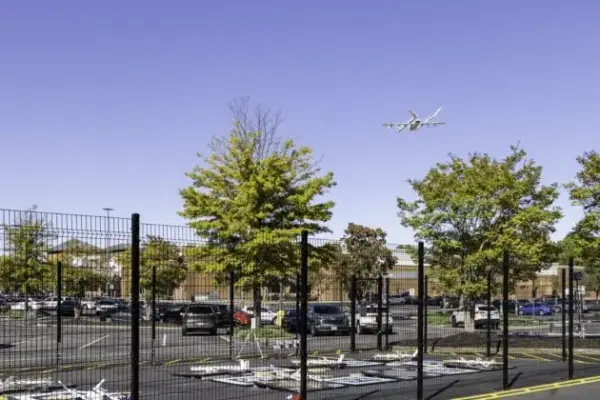
TALLINN, Estonia — In the rapidly evolving landscape of unmanned aviation, where software increasingly dictates the capabilities of hardware, a lean Estonian startup is making global waves. Remänguys, a Tallinn-based drone autonomy company founded just last year, has successfully secured its place in the finals of the prestigious AI Grand Prix. Organized jointly by defense technology heavyweight Anduril Industries and the Drone Champions League, the global competition pits the world’s most innovative software teams against one another in a high-stakes test of autonomous drone navigation without any human pilot intervention.
Out of more than 3,000 teams from around the globe that initially entered the grueling competition, Remänguys carved out a formidable reputation by advancing through both virtual and physical qualification stages. The journey culminated in a stellar ninth-place finish during the physical qualifying round held in Costa Mesa, California, this past September. That performance cemented the team’s status among the elite contenders heading into the championship showdown.
The ultimate test of hardware uniformity and algorithmic superiority will take place from December 7 to December 11, 2026, in Columbus, Ohio, where the remaining top-tier teams will vie for supremacy. Supported by strategic backers such as CSG and Excalibur International for the upcoming December finals, Remänguys is positioning itself at the forefront of vision-based navigation technology, bringing a mix of agile software engineering and practical flight expertise to the international stage.
Testing Autonomous Flight Under Equal Conditions
What makes the AI Grand Prix particularly rigorous—and a true benchmark for software engineering talent—is its insistence on a level playing field. The competition challenges participating teams to develop sophisticated onboard software capable of piloting high-speed racing drones through intricate indoor courses entirely on their own, completely removing human pilots from the loop.
Crucially, all competing teams are given the exact same drone hardware. Every aircraft is outfitted with identical physical components and restricted to a single camera for visual input. Because physical design variations, specialized sensors, and custom hardware modifications are strictly off the table, victory relies entirely on the brilliance, efficiency, and adaptability of the software code.
The road to the finals required immense perseverance from the Remänguys squad. The startup first proved its mettle by finishing tenth in the second virtual qualifying round, successfully translating algorithmic concepts into simulated flight stability. They then packed their code for California, where the transition from virtual simulation to physical flight in Costa Mesa yielded an even more impressive ninth-place finish.
The core of Remänguys is a tightly knit, three-person team that blends seasoned leadership with multigenerational programming talent. The company is led by CEO Štěpán Kaiser and CTO Jan Sechovec, alongside Sechovec’s 16-year-old son, Jan Sechovec Jr. Uniquely, all three members roll up their sleeves to actively contribute to the software development process, creating a dynamic and highly responsive engineering unit.

Reflecting on the milestone achieved in Southern California, CEO Štěpán Kaiser emphasized the validation that physical testing provided for their proprietary algorithms.
"California showed us that our software holds up outside the simulator," Kaiser said. "Three thousand teams, the same drone, no pilot. In Columbus we want to show how fast our software can improve."
Navigation Without GPS or LiDAR
Beyond the high-octane spectacle of drone racing, the technology being developed by Remänguys addresses one of the most critical operational challenges facing modern unmanned aerial systems: navigation in environments where traditional positioning signals are compromised.
Remänguys specializes in developing autonomy software for unmanned vehicles, encompassing advanced areas such as vision-based navigation, high-fidelity simulation, and remote drone operations conducted seamlessly over the internet. Their racing software relies exclusively on data streams captured by a single onboard camera. By processing these sequential images in real time, the algorithm estimates the exact position of the drone while simultaneously constructing a comprehensive, three-dimensional map of its unfamiliar surroundings.
During rigorous demonstrations recorded during actual race flights, the software’s capabilities were put on full display. As the drone zipped through the course, the system actively mapped the interior of the racing hall on the fly. According to internal company metrics, the software’s camera orientation estimates deviated by a mere 1.6 degrees from the telemetry data reported directly by the aircraft’s internal flight controller, demonstrating exceptional precision under high-stress conditions.
Importantly, this advanced spatial awareness is achieved entirely without the aid of Global Positioning Systems (GPS) or Light Detection and Ranging (LiDAR) sensors. By relying purely on monocular computer vision, the technology becomes exceptionally relevant for defense, industrial, and emergency response operations where satellite navigation is frequently jammed, spoofed, or entirely unavailable.
"Our drone sees the world through one camera," explained CTO Jan Sechovec. "It builds its own map as it flies and knows where it is. That is exactly what drones need when GPS signals are jammed or unavailable."
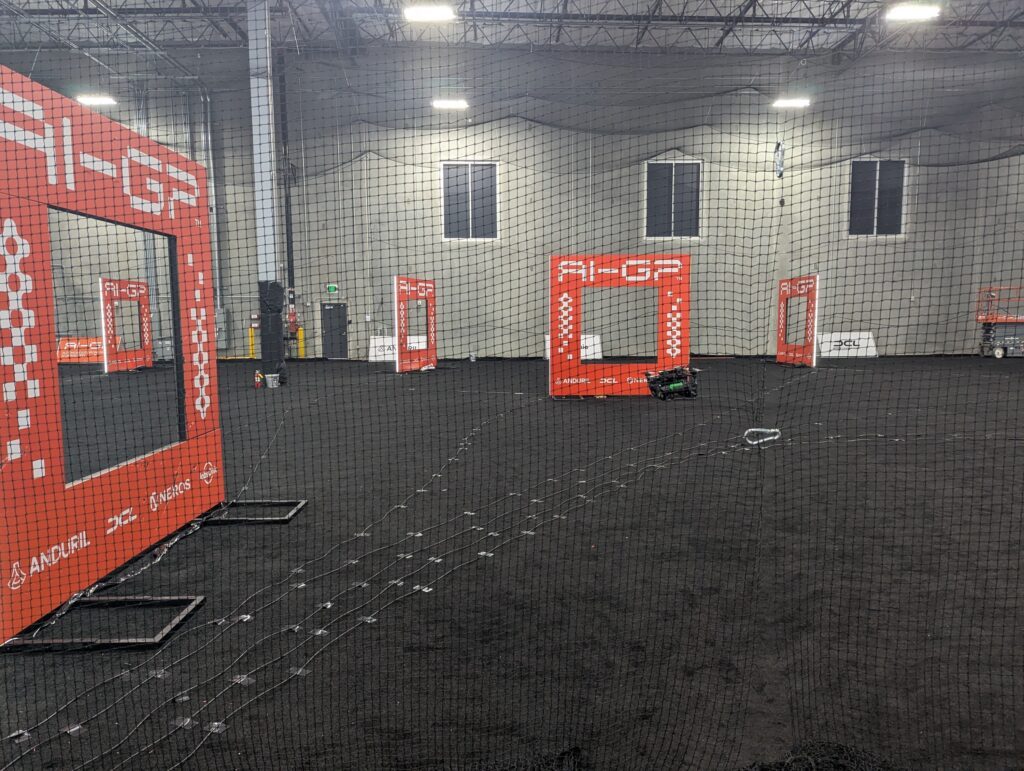
Autonomous drone racing serves as an unforgiving proving ground for such technology. Navigating a complex course at high velocities requires an aircraft to identify obstacles, calculate relative positioning, and execute rapid, split-second flight decisions without the benefit of human reflexes. While conquering a controlled racing track is a distinct challenge from navigating unpredictable real-world environments, the underlying principles remain foundational for future autonomy.
The inclusion of Jan Sechovec Jr., who brings valuable firsthand experience as an active drone pilot, provides the team with a unique operational perspective. Balancing his dual passions for flying and programming, the 16-year-old bridges the gap between theoretical computer science and practical aerodynamics.
"As a pilot I know what a good line through the gates looks like," noted the younger Sechovec. "In this race the software has to find it on its own, so we write the code together and test it until it does."
From Drone Racing to Commercial Applications
The story of Remänguys is remarkably young for a company making waves on the global stage. Štěpán Kaiser and Jan Sechovec founded the startup in Tallinn in April 2025, strategically positioning the company’s operations between Estonia and the Czech Republic to tap into Central and Northern Europe’s robust technology talent pools.
While the AI Grand Prix provides an invaluable platform to test, refine, and stress-test their algorithms against the brightest minds in the industry, the company’s long-term vision extends far beyond the racing circuit. Remänguys is already looking ahead to the commercialization of its research and development. The startup plans to introduce a specialized artificial intelligence flight controller known as the SILM N6 in 2027. According to company leadership, this upcoming product will integrate their proprietary autonomy software directly onto a single, highly efficient hardware board, bringing advanced vision-based navigation capabilities to a broader commercial market.
As the countdown to the December finals in Columbus, Ohio, continues, Remänguys stands as a testament to the power of small, highly focused engineering teams in the modern tech ecosystem. By proving that a single camera and clever code can successfully replace GPS and heavy sensor suites, the Estonian startup is not only chasing victory on the racing track but also charting a resilient path forward for the future of autonomous flight.