Extreme heat stands as one of the deadliest hazards driven by a changing climate, yet meteorologists and climate scientists alike emphasize that no two heatwaves are identical. While mid-summer temperatures regularly capture global headlines, extreme heat events occurring outside of peak summer months are frequently more dangerous. These out-of-season spikes often catch populations entirely off guard. Heatwaves striking during the spring, or functioning as the very first heatwave of the summer season, carry heightened risks because human bodies have not yet physiologically acclimatized to high temperatures. Furthermore, critical cooling strategies—such as widespread air conditioning or operational public cooling centers—may not yet be active or fully deployed.
Conversely, heatwaves arriving in the autumn, trailing behind a long and exhausting summer of continuous heat exposure, place an unprecedented strain on human bodies and local infrastructure that are already battered and fatigued. As global temperatures continue to rise amidst ongoing climate change, robust scientific research demonstrates that heatwaves across the globe are becoming markedly more frequent, intense, and lengthy.
A landmark study published in AGU Advances has now provided the first global measurement of whether the timing of extreme heat throughout the calendar year is shifting. The research reveals that in more than half of the world’s land areas, extreme heat events are bleeding into the transitional "shoulder seasons." However, this expansion is happening unevenly, creeping further into either autumn or spring depending heavily on the geographical location.
Defining Heat Seasons
Meteorological summer is traditionally assumed to be the warmest three-month period of the year. It is simplistically defined as June through August in the northern hemisphere and December through February in the southern hemisphere. However, extreme heat seasons vary dramatically from place to place and do not always neatly conform to these standardized calendar boundaries.
To capture a more accurate picture, the new study goes far beyond traditional seasonal definitions, focusing instead on what the researchers term "local heat seasons." These are defined as the specific three consecutive months when extreme heat events occurred most frequently during the baseline decade of the 1980s.
From this foundational starting point, the research team investigated how extreme heat is creeping into the two-month periods situated directly before and after each local heat season—periods they designated as the "shoulder seasons." This flexible, localized definition of heat and shoulder seasons enabled the scientists to measure precisely how the timing of extreme heat has evolved over time.
Specifically, the study analyzed the percentage of annual heat days that occurred within the core heat season versus the shoulder seasons at every location across the globe, measuring how those relative shares shifted over a 45-year period. To conduct this comprehensive analysis, the researchers utilized climate data spanning from 1980 to 2024 drawn from the MERRA2 reanalysis dataset. To guarantee the absolute robustness of their findings, they replicated the entire analytical process using ERA5 global atmospheric reanalysis data.
The 1980s were intentionally selected as the baseline decade because it marked the beginning of the common timeframe shared by both reanalysis datasets. Researchers then compared this baseline against climate data recorded between 2015 and 2024. Comparing these two opposing ends of the datasets allowed the scientific team to register larger magnitude changes while successfully accounting for the cumulative, compounding effects of ongoing global climate change.
Crucially, the study evaluated measures for both dry and humid heat, noting that each type carries distinct environmental and biological impacts. Dry heat tends to pose a more severe threat to plant and ecosystem health, while humid heat proves significantly more strenuous and dangerous for human physiology. To quantify these distinct conditions, the researchers utilized dry-bulb temperature to measure dry heat and wet-bulb globe temperature to measure humid heat.
Originally developed in the 1950s by the United States military, the wet-bulb globe temperature boasts a long history as an internationally recognized standard used extensively for outdoor sports safety and occupational hazard monitoring. It provides a comprehensive metric by combining measurements of ambient temperature, relative humidity, wind speed, and solar radiation.
Changing Heat Seasons
The research findings demonstrate that back in the 1980s, extreme heat across the globe was tightly confined to a single, predictable heat season. For instance, roughly 93% of the world’s total land area experienced more than 80% of its extreme dry-heat days squarely within its traditional dry-heat season. Surprisingly, this strict seasonal confinement held true even in tropical regions, where seasonal swings in ambient temperature are traditionally far less pronounced.
Furthermore, the study illustrates that extreme dry-heat seasons and extreme humid-heat seasons frequently differ from one another, typically offset by roughly one month. This temporal offset is particularly evident in regions heavily influenced by regional monsoon systems, such as northwestern Mexico and central India, where the extreme dry-heat season consistently precedes the arrival of the extreme humid-heat season.
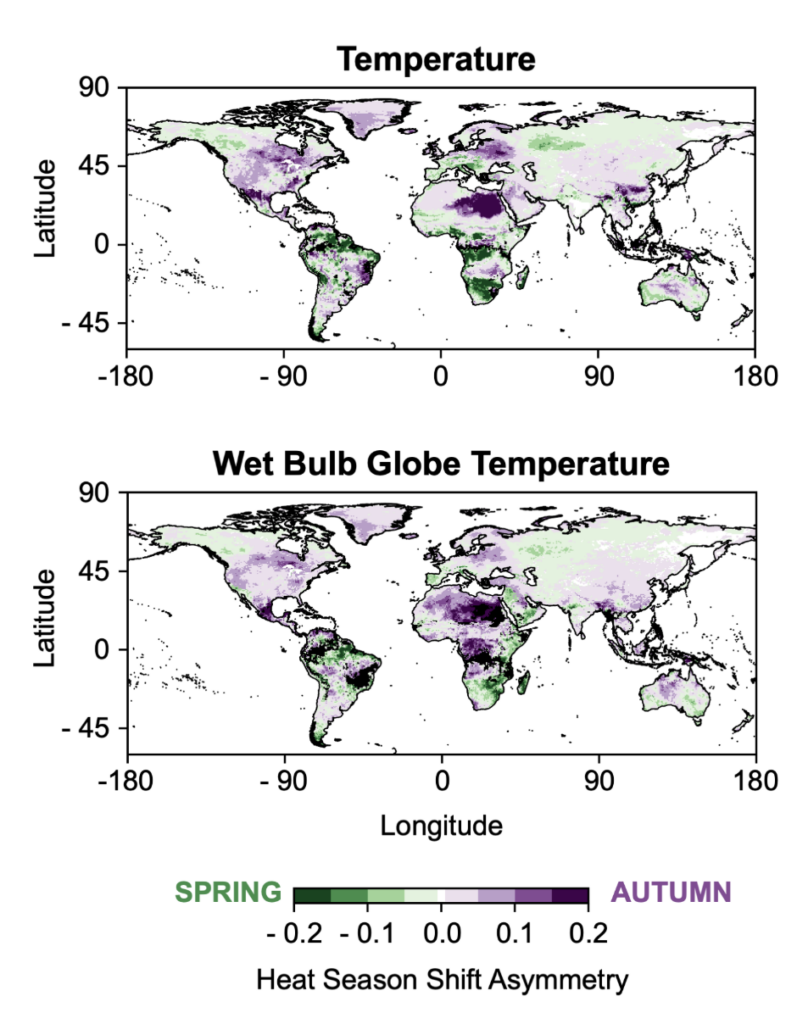
Today, however, the hard edges of these extreme heat seasons are beginning to blur. Extreme heat events are spreading out significantly across the calendar year in more than majority of the world’s landmasses. This widening of both dry- and humid-heat seasons means that dangerous thermal conditions have started infiltrating the shoulder seasons—though the distribution is far from uniform.
Global mapping from the study reveals stark regional differences. In western Europe, southern Africa, and northwestern India, a considerably larger fraction of each year’s extreme heat events is now occurring during the months immediately preceding the historical dry- and humid-heat seasons. These regions are shifting earlier into the year. Conversely, across much of the United States, eastern China, northern Africa, and eastern Europe, extreme heat events are increasing in frequency during the months following the traditional heat seasons, stretching warmth deeper into the back half of the year.
Boosting Existing Seasons
At first glance, it is tempting to assume these observed shifts have a straightforward, simple explanation. In many parts of the world, one shoulder season—whether spring or autumn—is naturally warmer than the other. One initial hypothesis explored by the researchers was whether a simple, uniform step-up in daily heat across the entire calendar year makes it statistically more likely for extreme heat days to emerge in one shoulder season over the other.

However, the research data proved that the atmospheric reality is far more complex. To investigate this mechanism thoroughly, the team constructed a new "synthetic" time series designed specifically to isolate and identify the isolated impact of annual average warming. By taking the baseline 1980s time series and shifting the data upward by the exact average change in local dry or humid heat recorded between the first and last decade of the dataset, they tested the uniform warming theory.
The analysis revealed that in most geographic locations, intensifying the baseline seasonality through even warming over the course of the year adequately explains the changes in extreme heat timing occurring within the traditional core heat season. However, annual average warming alone completely fails to account for the asymmetric, uneven changes observed in how extreme heat is manifesting within the shoulder seasons.
Consequently, the researchers concluded that additional, complex environmental factors must be at play. Long-term shifts in seasonal precipitation patterns and soil moisture levels—whether trending toward drying or moistening—could be actively contributing to the shift. Potential links to major human-driven land-use changes, such as agricultural intensification or expanded irrigation practices, are also under consideration. Additionally, natural fluctuations in regional climates governed by large-scale oceanic and atmospheric phenomena, including the Pacific Decadal Oscillation and the Atlantic Multidecadal Oscillation, likely play a critical role in shaping these localized timing shifts. Teasing apart the precise contributions of each distinct driver will require focused, regional-scale scientific studies moving forward.
Managing Hazards
The ongoing expansion of extreme heat events into the shoulder seasons carries profound implications for disaster preparedness and public safety. It indicates that vital societal protections—such as heat early warning systems, public health advisories, and the establishment or reopening of municipal cooling centers—may need to be deployed and maintained well outside the traditional summer months.

Further academic research is urgently required to investigate whether the overlap between extreme heat and other seasonal environmental hazards is similarly intensifying. The study notes that throughout much of the United States, there is a much larger expansion of the heat season into the autumn than into the spring. In the western United States, extreme heat stretching later into the calendar year could significantly widen the dangerous temporal overlap between extreme heat and peak wildfire seasons.
Meanwhile, a parallel extension of the heat season into the autumn months in the eastern United States increases the likelihood of compounding disasters by overlapping extreme heat with the peak of the Atlantic hurricane season. Understanding how the intersection of these seasonal hazards is evolving is essential for developing targeted, effective climate adaptation strategies. Multiple climate hazards occurring simultaneously or in rapid succession pose exponentially greater risks to human life, infrastructure, and ecosystems than when such extreme events occur entirely in isolation.