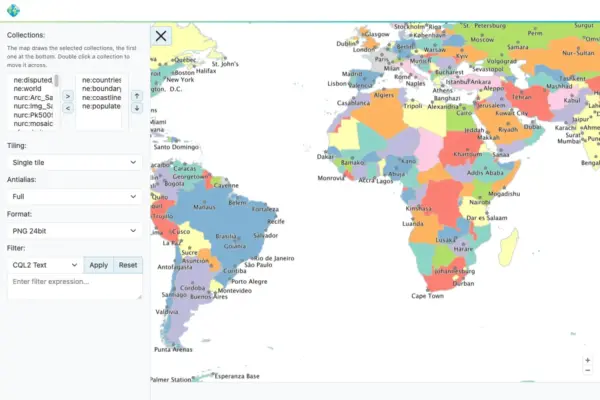
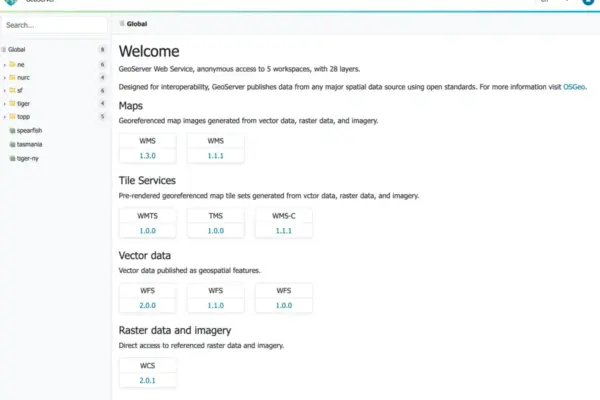
The GeoServer project team has officially announced the immediate availability of GeoServer 2.28.6, the latest maintenance release in the 2.28 series. Aimed at bringing critical bug fixes, minor updates, and essential security patches to existing production deployments, this new version is now ready for download across multiple platforms. Administrators and spatial data infrastructure managers can acquire the updated software in standard binary archive format, Web Archive (WAR) distribution for servlet containers, and a dedicated Windows installer package. Accompanying documentation archives and a comprehensive suite of extensions are also available via the project’s official distribution channels on SourceForge.
As part of the continuous integration and release cycle for the 2.28 series, GeoServer 2.28.6 incorporates updated foundational libraries to ensure optimal performance, stability, and compatibility. Specifically, this release bundles GeoTools 34.6 and GeoWebCache 1.28.6. Furthermore, concurrent with today’s core software release, the development team has made GeoServer Cloud 2.28.6 available, catering to modern cloud-native spatial architectures and containerized microservice environments.
Coordinating and executing a stable software release requires the collaborative effort of developers and contributors distributed across the global open-source geospatial community. The release team extended specific acknowledgments for this version, thanking Peter Smythe of AfriGIS for managing and building the release package, Andrea Aime of GeoSolutions for conducting rigorous pre-release testing, and Gabriel Roldan of Camptocamp for overseeing the deployment and packaging of GeoServer Cloud 2.28.6.
Security Considerations
A critical highlight of the GeoServer 2.28.6 deployment cycle is its focus on platform security. This maintenance release addresses several security vulnerabilities identified within previous versions, making the upgrade an essential priority for administrators operating production-grade spatial data infrastructures. To protect enterprise systems and web mapping services from potential exploits, the project maintainers recommend planning an immediate transition to version 2.28.6.
Detailed information regarding the specific vulnerabilities resolved in this release, along with mitigation guidance, will be officially published at the beginning of November. In the interim, organizations seeking deeper insight into how the GeoServer project handles security alerts, vulnerability disclosures, and patches are encouraged to review the official project security policy hosted on the main GitHub repository.
Release Notes and Ecosystem Updates
The core development team has maintained transparency regarding all changes integrated into the 2.28.6 version. The complete and exhaustive list of improvements, bug fixes, and maintenance tasks can be explored directly through the official 2.28.6 release notes on the GitHub repository. While this particular maintenance cycle focuses primarily on backend stability, underlying library refinements, and vulnerability mitigation rather than sweeping new user-facing features, these incremental enhancements collectively contribute to a more reliable mapping server environment.
Alongside the core server software, the GeoServer ecosystem continues to foster community-driven innovation through its community modules. These experimental components are shared primarily as source code to encourage collaborative development, testing, and peer review among geospatial developers. Users who find a specific experimental module or topic of exploratory interest are actively invited to reach out directly to the respective module developers to offer assistance, feedback, or code contributions.
About the GeoServer 2.28 Series
GeoServer 2.28.6 represents the latest milestone in the ongoing lifecycle of the 2.28 release series. As organizations continue to build robust, interoperable spatial data infrastructures utilizing Open Geospatial Consortium (OGC) standards, the 2.28 branch remains a primary focus for maintenance and support. Administrators looking to review the historical evolution of this specific series can reference the individual release notes spanning from the initial 2.28.0 deployment through subsequent maintenance milestones, including versions 2.28.1, 2.28.2, 2.28.3, 2.28.4, and 2.28.5, all of which remain accessible via the project’s version control and release archives.