In recent years, Reform UK—led by Nigel Farage and heavily driven by figures like deputy leader Richard Tice—has established itself as a prominent force in British politics. Pushing hard-right populist narratives anchored by vehement opposition to immigration and aggressive anti-net-zero policies, the party has wielded significant influence despite grappling with funding controversies and holding only a handful of seats in Parliament. Until recently, it even enjoyed leading positions in national opinion polls for more than a year.
As has been observed with similar populist political movements across Europe and beyond, a calculated rejection of mainstream climate science and environmental policy sits at the absolute core of Reform UK’s ideological outlook. Richard Tice, serving as the party’s energy spokesperson, has emerged as a vocal and relentless critic of what he dismissively terms "net stupid zero." He has repeatedly and erroneously blamed natural phenomena such as the sun and volcanic eruptions for human-driven global warming. Tice has been explicit that if Reform UK were ever to form a national government, it would immediately scrap the UK’s legally binding net-zero targets, aggressively support fossil-fuel expansion, and tear up existing contracts for renewable energy infrastructure.

While party leader Nigel Farage tends to maintain a slightly lower profile on the direct specifics of climate science, he has nevertheless consistently echoed climate-sceptic talking points. Farage has falsely blamed net-zero policies for what he describes as the ongoing "deindustrialisation of Britain." These political assertions directly mirror long-standing, scientifically discredited narratives of delay. They find physical expression in Reform UK’s election manifestos, local council actions that threaten major green energy developments, and the deeply held beliefs of a significant portion of the party’s voting base.
To address the persistent spread of misinformation regarding these crucial subjects, experts and researchers have systematically gathered and factchecked dozens of false or misleading claims made by Reform UK’s leadership concerning climate science, renewable energy technologies, and the national net-zero transition.

Climate Science
The cornerstone of Reform UK’s environmental rhetoric involves questioning the fundamental validity of human-induced climate change. Richard Tice has asserted on multiple occasions that there is no credible evidence connecting man-made carbon dioxide emissions to global climate shifts, even pointing to a fringe report produced within the Norwegian government equivalent to the Office of National Statistics to bolster his claims.
However, the Intergovernmental Panel on Climate Change (IPCC), the undisputed global authority on climate science, states unequivocally that human activities—primarily through the burning of fossil fuels—have warmed the planet. The IPCC notes that atmospheric carbon dioxide concentrations have increased at rates entirely unprecedented on centennial timescales over at least the past 800,000 years, with current levels higher than they have been for at least two million years. Furthermore, independent reviews of the Norwegian report cited by Tice revealed that its views do not represent the official stance of the statistical bureau, were not peer-reviewed, and simply repackaged standard climate-denial talking points.

Reform UK figures frequently retreat to the argument that the climate has always naturally cycled through various phases over millions of years. While it is true that Earth’s climate has experienced historical shifts driven by orbital variations and natural phenomena, global temperatures today are approximately 1.4C hotter than the pre-industrial baseline of 1850-1900. Scientific consensus overwhelmingly affirms that essentially 100% of this recent, rapid warming is attributable to human activities. Natural influences like solar output and volcanic eruptions have only a negligible effect on the long-term upward trajectory of global temperatures.
Further compounding these misconceptions, leaders like Nigel Farage have claimed that humans produce only a tiny fraction—roughly 3%—of global annual carbon dioxide emissions, dismissing CO2 as a harmless gas. While annual human emissions are indeed a small percentage of the massive global carbon cycle, natural emissions from oceans and land are naturally balanced by equivalent absorption. Human industrial activity has fundamentally broken that ancient equilibrium, driving the atmospheric accumulation of greenhouse gases to dangerous new heights.

Tice has also claimed that thousands of scientists fundamentally disagree with the necessity or pace of reaching net-zero, pointing to circulating online declarations. A closer examination of those lists reveals that fewer than 1% of signatories were actual climate scientists, with several individuals even listed posthumously. Conversely, the IPCC’s comprehensive reports rely on hundreds of active, peer-reviewed experts worldwide, all agreeing that achieving global net-zero emissions is the only viable path to halting further temperature increases.
Additional arguments from Reform UK attempt to minimize the urgency of emissions cuts by claiming that reaching net-zero will make no immediate difference to sea-level rise for centuries. While past emissions have locked in a degree of unavoidable long-term sea-level rise, rapid and deep emissions reductions will dramatically limit the catastrophic scale of future rises, while simultaneously preventing a vast array of other severe climate impacts. Similarly, attempts by Tice to frame recent shifts in high-emissions modeling scenarios, such as RCP8.5, as an admission that the IPCC was fundamentally wrong represent a profound misunderstanding of climate science and scenario planning.

Net-Zero Target and the Economy
Reform UK routinely attacks the UK’s commitment to net-zero by arguing that the policy is a unilateral, economy-destroying measure that places an unfair burden on British taxpayers for negligible global benefit. Tice has frequently stated that the UK is acting alone and that its annual emissions account for a mere 0.7% to 0.8% of the global total, making domestic climate action pointless.
In reality, the UK is far from alone. Approximately 140 countries globally, representing around 74% of total worldwide emissions, have established net-zero targets. If the UK were to abandon its goals, it would join a dwindling minority of major emitters, including the United States and Iran, without national net-zero commitments. Moreover, while the UK’s annual emissions share is under 1%, more than a third of global emissions come collectively from nations producing 1% or less each. If every small and medium emitter adopted Reform UK’s logic, global climate action would completely collapse.

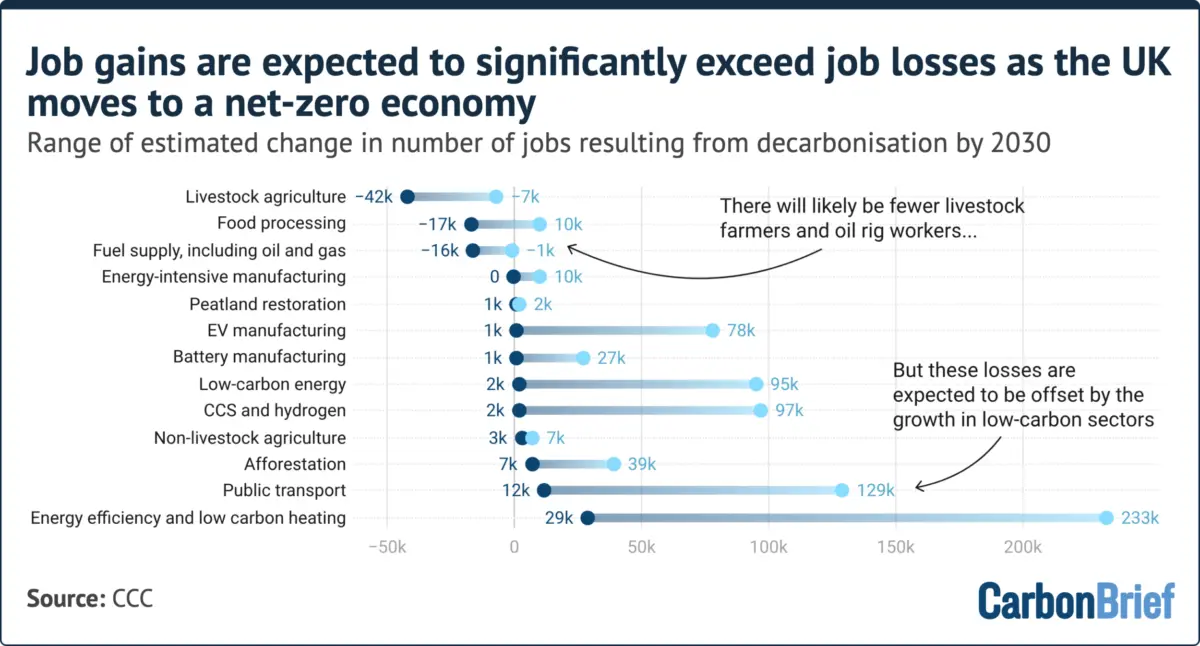
The claim that net-zero policies are "killing the economy" is similarly refuted by decades of economic and industrial data. UK emissions in recent years have fallen to more than half 1990 levels, while the broader national economy has nearly doubled in size over the same timeframe. Independent economic analyses, including reports from CBI Economics, demonstrate that the UK’s net-zero economy generates tens of billions of pounds in gross value added and supports over a million high-wage jobs across the country.
Claims regarding the exorbitant cost of net-zero—often cited by Reform UK as running into trillions of pounds—rely on flawed methodologies that ignore the massive financial savings associated with running efficient clean technologies and the catastrophic economic costs of climate inaction. Official projections from the Climate Change Committee and the Office for Budget Responsibility confirm that meeting net-zero is not only financially manageable, representing a fraction of GDP, but is overwhelmingly the cheapest long-term economic option available to the nation.

Furthermore, assertions that net-zero targets are responsible for the deindustrialisation of Britain ignore historical reality. Major British industries, such as coal mining and steel manufacturing, experienced structural declines over many decades due to global market shifts, automation, and competition long before modern climate legislation was enacted.
Energy Costs and Infrastructure
A central pillar of Reform UK’s political messaging is the assertion that renewable energy and net-zero policies are directly responsible for soaring household energy bills and industrial cost pressures. Party leadership has frequently argued that wind and solar power, combined with the necessity of grid backup, inevitably drive up electricity prices.

Economic data and energy research centers consistently demonstrate that the primary driver of high electricity bills in the UK and across Europe is not renewable energy, but rather the rising and volatile cost of imported fossil gas. Because the UK electricity market remains heavily exposed to gas-fired power stations, wholesale gas prices frequently dictate the final cost of electricity. Far from driving up prices, the rapid expansion of wind and solar capacity has actively shielded consumers from the worst impacts of international fossil fuel price shocks, saving billions of pounds during recent geopolitical crises in the Middle East and Eastern Europe.
Reform UK has also targeted national grid infrastructure spending, claiming that putting new electricity transmission cables underground would be just as cost-effective as building overhead pylons, and proposing a windfall tax on renewable energy generators to lower bills. Comprehensive engineering studies from bodies such as the Institution of Engineering and Technology and independent consultancy Ramboll have repeatedly shown that burying high-voltage transmission cables is between 3.5 and 5 times more expensive than using overhead lines, potentially adding tens of billions of pounds to consumer bills.

Similarly, imposing retrospective windfall taxes on renewable energy developers—who operate under fixed-price contracts and help lower wholesale electricity prices—would severely undermine investor confidence, threatening tens of billions of pounds in vital infrastructure investment and stalling the transition toward genuine energy independence.
Oil, Gas, and Fracking
Reform UK frequently romanticizes the North Sea oil and gas boom of the 1980s and 1990s, arguing that current energy difficulties stem entirely from government hostility toward fossil fuels rather than geological reality. Party leadership insists that issuing new drilling licenses and embracing domestic fracking would flood the market with cheap energy, mirroring the low gas prices seen in the United States.

Energy experts and regulatory authorities point out that the decline in North Sea oil and gas production is the result of simple geology rather than political interference. Approximately 90% of the economically recoverable oil and gas in the UK’s sector of the North Sea has already been extracted and burned. Unlike the United States, where vast shale formations and unique market dynamics keep gas cheap and abundant, the UK possesses neither the geological reserves nor the accessible shale deposits required to replicate American production levels. Issuing new licenses cannot alter the physical depletion of the basin.
Moreover, the UK operates within a globally integrated fossil fuel market. Even if domestic extraction were marginally increased, it would have virtually no discernible impact on global commodity prices, which dictate what British consumers pay at the meter. The most reliable and effective route to insulating the UK from international price volatility and securing long-term energy independence is accelerating domestic renewable generation and electrification, rather than chasing dwindling reserves of expensive fossil fuels.

Impacts, Adaptation, and Clean Energy
Rather than viewing emissions mitigation and climate adaptation as complementary necessities, Reform UK leadership frequently presents adaptation as a convenient alternative to cutting carbon. Tice has argued that it is far cheaper and more practical to simply adapt to a changing climate than to attempt to stop it through emissions reductions.
Climate scientists and economic advisors emphasize that there are hard limits to adaptation. As global temperatures continue to rise past critical thresholds, the severity of climate impacts—ranging from extreme heatwaves and unprecedented droughts to catastrophic flooding—will rapidly overwhelm defensive infrastructure. The cost of failing to act on emissions is astronomically higher than the cost of mitigation, with unmitigated climate change already inflicting tens of billions of pounds in annual damages on the UK economy through lost productivity, infrastructure strain, and severe weather disruptions.

Throughout their public commentary, Reform UK figures continue to promote a series of misconceptions regarding clean energy technologies, claiming that wind turbines are uniquely deadly to wildlife and workers, that battery storage systems represent an unacceptably high fire risk, and that solar farms destroy national food security by consuming productive agricultural land.
Extensive empirical data from safety organizations, agricultural unions, and energy researchers thoroughly debunk these assertions. Wind and solar power are orders of magnitude safer than fossil fuel extraction and combustion, which contribute significantly to global air pollution and public health crises. Large-scale battery storage facilities maintain an exemplary safety record comparable to standard household electrical appliances, while ground-mounted solar installations occupy a negligible fraction of total UK land area, pose no threat to national food production, and are frequently integrated successfully alongside agricultural activities.

As the political and economic debate surrounding the UK’s energy future intensifies, the chasm between Reform UK’s populist rhetoric and the empirical findings of scientific, economic, and engineering institutions remains stark, leaving voters to weigh political promises against established technical realities.