A comprehensive new economic analysis shatters a prevailing political and media narrative by revealing that skyrocketing wholesale costs, driven primarily by expensive natural gas, are responsible for nearly 90% of the rise in United Kingdom household electricity bills since 2020.
The figures, shared with analysts by the sustainable future thinktank Nesta, directly challenge the persistent claim that the UK’s legally binding net-zero targets and green energy policies are the primary culprits behind crippling household energy bills—an argument that has become increasingly embedded in political discourse and media commentary over recent years.
According to the data, wholesale gas costs are also behind the vast majority—77%—of the overall increase in household gas bills during the same period. The findings arrive at a critical juncture for British energy policy, following the government’s recent regulatory approval for the Jackdaw gas field development in the North Sea, a decision pushed through despite official admissions that the extraction project would not meaningfully alter consumer prices.

Another Gas Crisis and Global Vulnerabilities
The research builds upon earlier warnings highlighting the severe vulnerability of British consumers to international fossil fuel markets. Earlier, energy analysts pointed out that two-thirds of the rise in electricity bills since the onset of the 2022 global energy crisis stemmed directly from elevated gas prices.
Today, compounding geopolitical tensions and ongoing conflicts in the Middle East have sent wholesale gas prices soaring to their highest levels since Russia’s 2022 invasion of Ukraine. Recent market data shows UK wholesale gas trading at roughly 220p per therm, or approximately £75 per megawatt-hour, eclipsing the annual average seen during the acute market shock of 2022.
When adjusted for inflation, typical annual household electricity bills jumped by £180 by the final quarter of 2026 compared to the same period in 2020. The Nesta breakdown demonstrates that approximately 90% of this increase—amounting to £161—is directly attributable to wholesale costs dictated by the global price of gas.
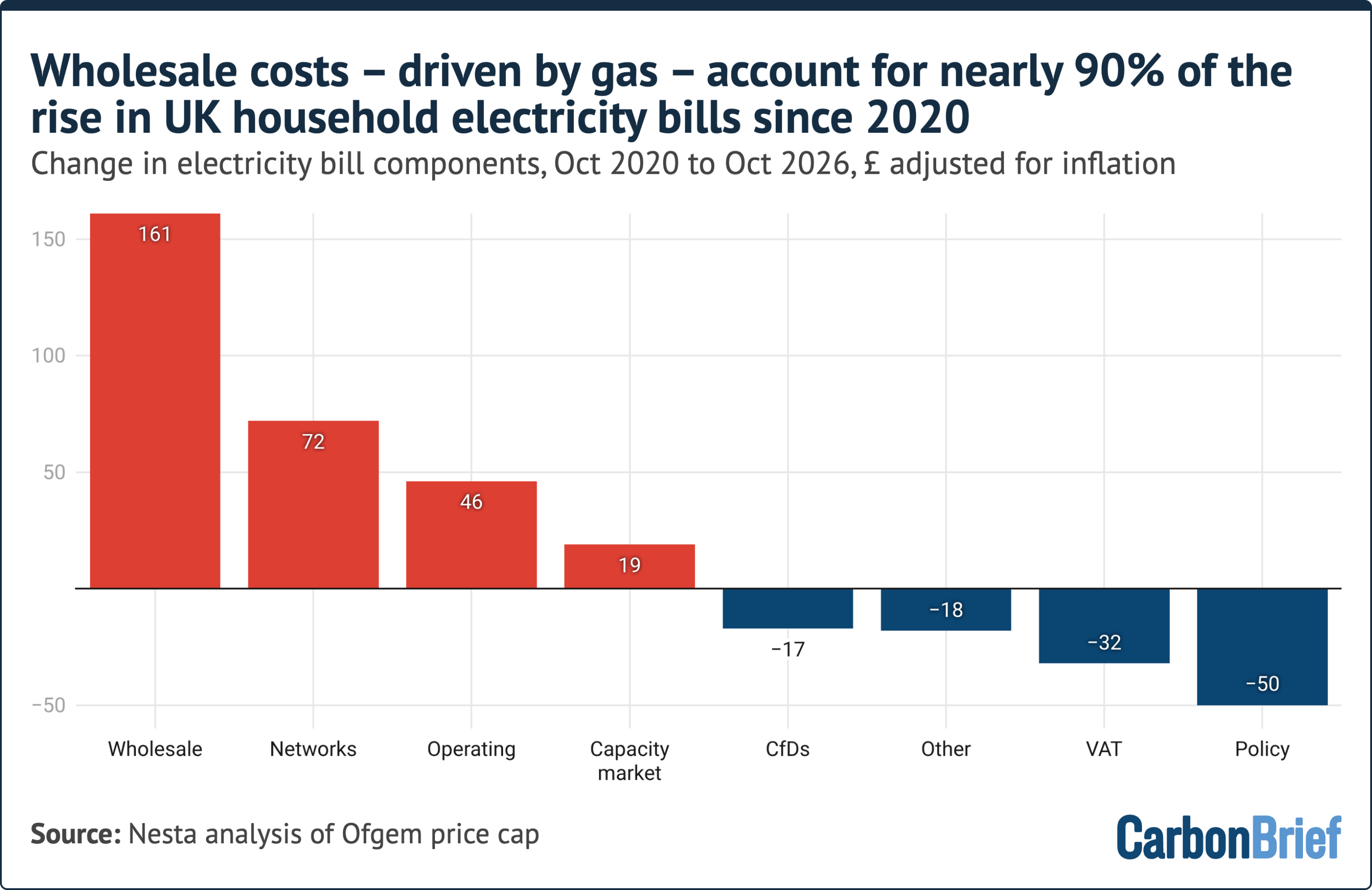
In stark contrast, renewable energy mechanisms have acted as a financial buffer rather than a burden. Under the current price cap framework, renewable energy contracts for difference are actually reducing household electricity bills by £17, according to the Nesta metrics. Furthermore, the government has deliberately trimmed policy-related costs from electricity bills by transferring roughly 75% of legacy renewable support schemes onto general taxation, phasing out legacy efficiency initiatives, and temporarily adjusting value-added tax rules.
Meanwhile, network infrastructure costs have contributed £72 to the typical bill since 2020. The vast majority of this figure—some £46—represents necessary, long-term capital investment into the electricity transmission network, often described colloquially as the digital and physical "motorways" of the national grid. By comparison, only £21 of the network cost increase relates to system balancing measures, which include constraint payments made to operators to turn off wind farms and fire up gas plants when local transmission capacity falls short.
Although wind constraint payments frequently command sweeping headlines and intense political scrutiny, total system balancing costs make up just £35, or roughly 4%, of a typical £858 annual household electricity bill.
Energy supplier operating costs have similarly climbed by £46 since 2020. While underlying regulatory data does not granularly disaggregate these operational increases, industry experts attribute the rise largely to escalating household energy debt across the consumer base. Throughout this period, retail supplier profit margins have remained tightly capped by regulators at 2.5% of overall bills.
Breaking the Link Between Gas and Electricity
A notable shift in market dynamics has begun to emerge: household electricity prices have risen significantly less rapidly than direct gas bills in the wake of recent international supply shocks. This decoupling is largely credited to higher clean-energy generation capacity, which helps sever the historical pricing link that dictates that gas must set the marginal price of electricity.
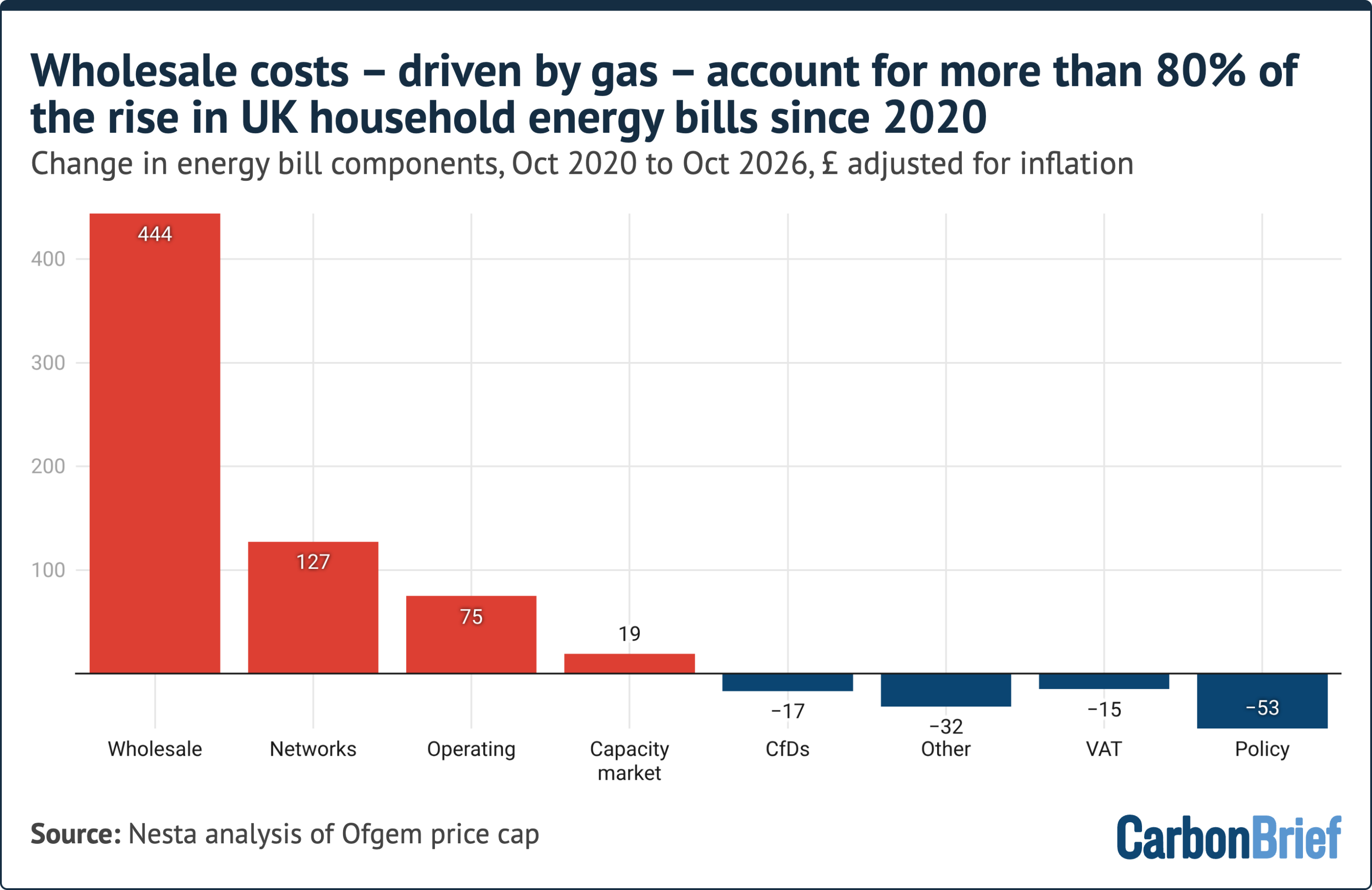
Since 2020, household gas bills have escalated by £368 in real terms, with 77% of that figure—or £283—driven explicitly by wholesale gas expenses. When factoring in inflation, the combined dual-fuel energy bill for an average UK household has climbed from £1,175 per year in October 2020 to £1,723 per year under the October 2026 price cap, marking a cumulative increase of 47%.

Wholesale expenses account for £444, or 81%, of this overall dual-fuel surge. Network costs account for a real-terms rise of £127—encompassing transmission, distribution, and system balancing for electricity alongside necessary investments to maintain and upgrade the gas grid itself. Industry bodies note that the vast majority of expenditure on electricity grids is dedicated to preserving existing assets, with only a fraction required for net-zero expansion.
Government-backed social and climate policies tell a story of declining consumer impact. These policy costs represented £183, or 16%, of a typical dual-fuel bill back in October 2020. By the October 2026 price cap, that figure had dropped to £114, representing just 7% of the total household expenditure.
At present, wholesale costs command the largest share of the energy price cap at £757, or 44%. Network costs form the second-largest component at £417, or 24%, followed by supplier operating costs at £291, or 17%.

Andrew Sissons, director for sustainable future at Nesta, emphasizes that while modernizing and upgrading the national grid involves substantial capital, those expenses are completely overshadowed by the volatility of international gas markets.
"Rising gas prices, not net-zero, have driven most of the recent surge in Britain’s energy bills," Sissons explains. "Britain is particularly exposed, with over 80% of households connected to gas mains, while our electricity system still relies too much on gas as the marginal unit. Upgrading the grid is not cost-neutral, but that price tag is dwarfed by the impact of rising gas prices. In fact, net-zero is helping to shelter Britain from the impact of expensive gas."
Sissons points out that maintaining momentum toward a low-carbon grid will require widespread adoption of clean electricity, electric vehicles, and efficient heat pumps to displace fossil-fuel equivalents. By purposefully expanding electricity demand and spreading infrastructure upgrade costs across a broader base of electrification, policymakers can secure the consistent investments required to insulate winter household bills from future global market turmoil.
As political pressure mounts ahead of the autumn budget, reports indicate that the chancellor is weighing significant policy interventions to assist vulnerable households and businesses navigating the persistent cost-of-living pressures. With wholesale gas markets remaining stubbornly high, consumer advocacy groups warn that upcoming price caps could trigger steep further increases for households across the country.