A policy document recently published by the UK’s opposition Conservative Party has sparked debate after it was revealed that its central estimate for the cost of achieving net-zero emissions was inflated due to a fundamental spreadsheet error.
The policy document, titled “The Right Way” and positioned as a “common sense” approach to governance, argues that the public ultimately desires a government competent enough to solve the challenges it takes responsibility for. Within a section warning that sophisticated mathematical modeling should never be a substitute for sound political judgment, the document takes aim at various economic projections surrounding the cost of the UK’s transition to a net-zero carbon economy.
However, in attempting to challenge the official figures, the Conservative publication mistakenly claimed that the Climate Change Committee (CCC)—the government’s independent statutory adviser—had originally projected the cost of the net-zero transition to be close to £1 trillion. Specifically, the document states: “In 2020, the CCC estimated that its route to net-zero would cost £957bn.”
In reality, the CCC’s actual 2020 estimate was precisely half that amount, standing at £478bn. Furthermore, the committee updated its projections last year, lowering the expected net cost down to £108bn, a reduction driven largely by the rapidly falling costs associated with electric vehicles (EVs) and renewable energy technologies.
Spreadsheet Error
The origin of the £957bn figure cited by the Conservative Party traces back to a misunderstanding of a technical spreadsheet published by the CCC in December 2020 alongside its landmark Sixth Carbon Budget.
The 2020 spreadsheet featured a comprehensive data table itemizing the additional capital investments required to build out a net-zero economy over a 30-year span from 2020 to 2050. These extra capital expenditures, abbreviated as CAPEX, covered everything from low-carbon electricity generation infrastructure to domestic heat pumps and electric vehicle fleets.
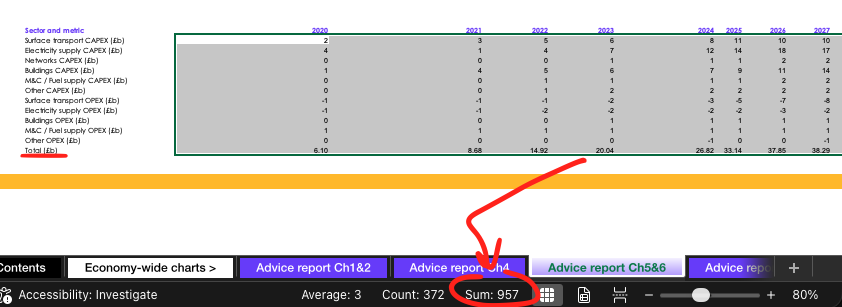
Over the three-decade period, these cumulative CAPEX investments were calculated at £1.38tn. At the same time, the spreadsheet accounted for operational savings—referred to as OPEX—totaling £0.90tn over the same timeframe, primarily achieved through reduced fossil fuel consumption and improved efficiency. When balancing the capital investments against the operational savings across the 2020-2050 timeline, the combined net cost came to the original CCC figure of £478bn.
The confusion arose because the CCC spreadsheet also included a row that summarized combined totals for individual years. Analysts reviewing the data suggest that an outside party inadvertently added all of the rows together without accounting for the fact that annual totals were already embedded in the sheet, thereby double-counting both the costs and the savings.
This error effectively doubled the net figure to £957bn, producing the exact statistic that eventually found its way into the Conservative Party’s policy booklet.
When the CCC originally published its findings in 2020, it emphasized that the £478bn net cost of reaching net-zero equated to less than 1% of the UK’s total gross domestic product (GDP) over the course of 30 years. The committee noted at the time that the massive infrastructure investments would not only generate substantial savings by cutting down costly fossil fuel imports, but would also provide an overall net boost to national GDP of around 2%.
Subsequent updates from the advisory body have further softened the anticipated financial burden. In 2025, the CCC revised its investment cost and operating savings projections to £670bn and £562bn respectively, bringing the estimated net total down to £108bn between 2025 and 2050—representing less than 0.2% of GDP. Earlier this year, the committee underscored that successfully cutting emissions to net-zero would cost less than a single major fossil fuel price shock, delivering ongoing economic benefits valued at roughly £110bn annually.
Paper Trail
A meticulous paper trail reveals how the erroneous figure migrated from an isolated calculation error into mainstream political discourse.
While the Conservative Party document formally cites the CCC’s 2020 advice on the sixth carbon budget as its source, the official reports published by the committee contain no mention of a £957bn price tag.
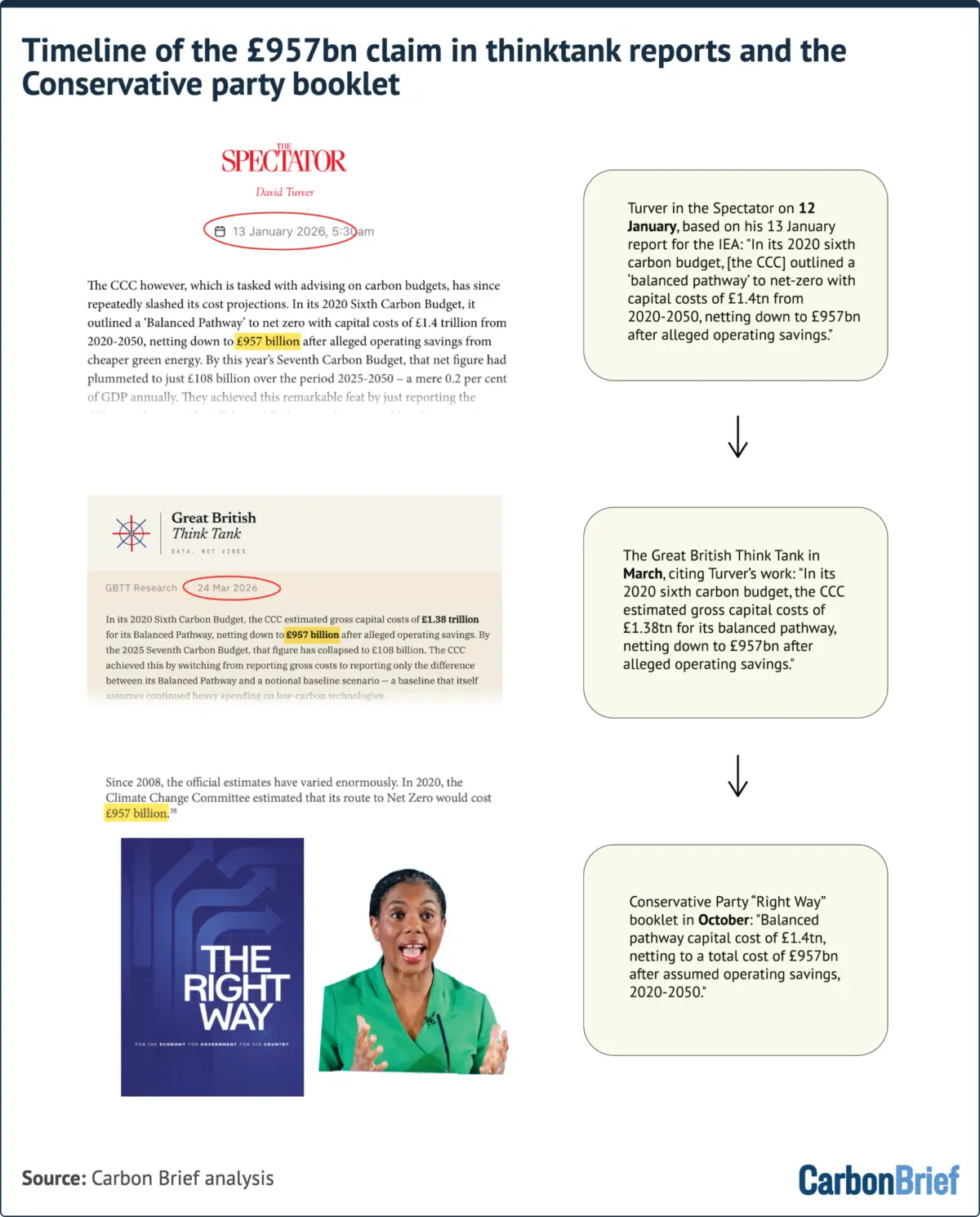
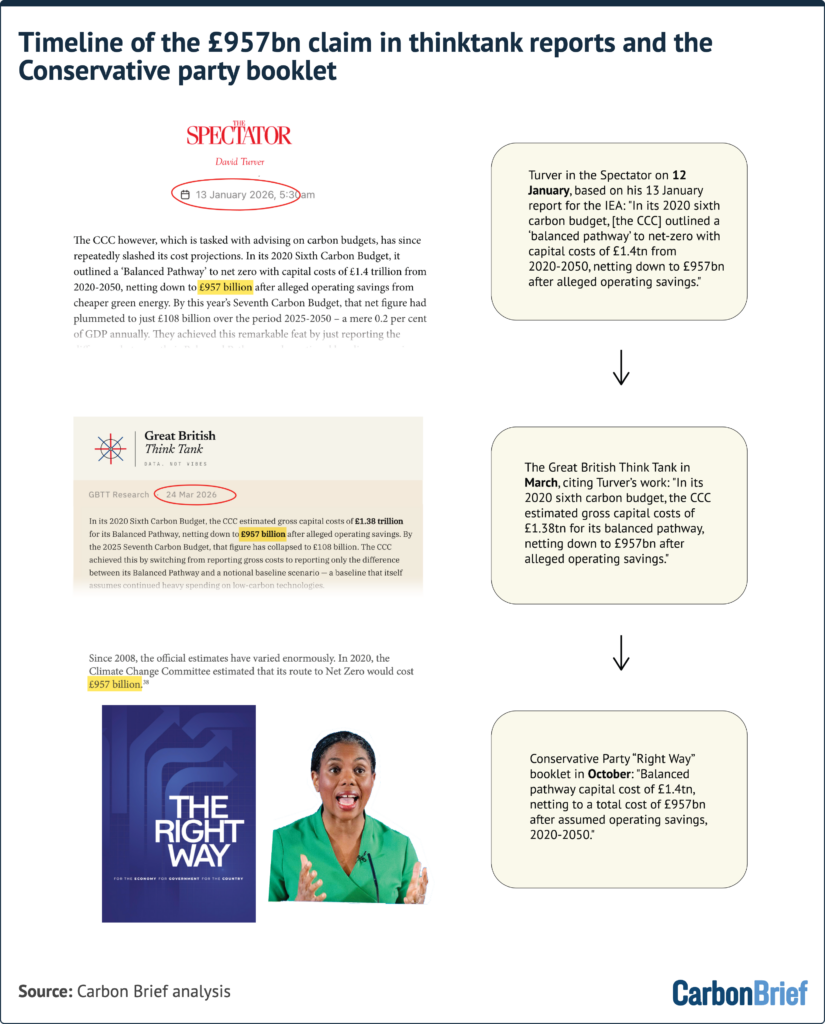
Investigative findings indicate that the earliest public appearance of the £957bn figure online occurred on January 12, 2026, in an article published by The Spectator written by David Turver, a retired engineer and self-described energy analyst. Just a day later, Turver recycled the same mistaken statistic in a formal report published by the free-market think tank, the Institute of Economic Affairs (IEA), explicitly citing Figure 5.3 of the CCC’s 2020 supporting data.
Because the underlying spreadsheet for Figure 5.3 strictly adds up to £478bn, experts point out that Turver’s methodology involved summing every single row of data without recognizing that annual totals were already factored in, thereby duplicating the financial figures.

Turver’s January report proved influential within certain political circles, subsequently triggering a wave of headlines across various platforms that cited even higher, exaggerated figures—ranging from £7.6tn to as much as £9tn. Those higher estimates were derived from assumptions that treated fossil fuels, along with the cars, home boilers, and power stations utilizing them, as entirely cost-free assets.
Following its circulation in early 2026, the £957bn figure was repeated in March by the Great British Think Tank, an organization whose stated ethos revolves around utilizing empirical data rather than political rhetoric, boasting that every statistic it publishes originates directly from official public bodies.
By October 2026, the figure had completed its journey into mainstream political strategy, being formally embedded within the Conservative Party’s “Right Way” policy booklet, where it remains part of the opposition’s ongoing critique of government climate expenditure.