Public contracting has long been recognized as a potentially powerful engine for local economic growth and community inclusion. Yet, for many small and diverse businesses in Boston, municipal procurement remained an elusive and frustrating arena. A landmark Disparity Study commissioned by the City in 2020 laid bare a stark reality: minority- and women-owned business enterprises (M/WBEs) received just 11% of the total value of Boston’s contracts over a five-year period, even though these firms were fully ready and able to compete for an estimated 16.9% of contracting dollars. Black-owned businesses faced the most severe deficit, winning roughly $12 for every $100 they could have reasonably been expected to secure.
Determined to bridge this wide economic gap, the City of Boston embarked on a comprehensive reform initiative. The goal was twofold: to open up municipal contracting opportunities to historically disadvantaged entrepreneurs and to establish a robust, data-backed mechanism to track participation, monitor spending, and verify whether these policy reforms were actually delivering tangible results.
A Strategic Pivot Toward Open Contracting
To transform municipal procurement from a risk-averse, back-office administrative function into a strategic driver of local economic equity, Boston introduced a series of targeted structural reforms. City leadership recognized that increasing M/WBE participation required more than just aspirational goals; it demanded a fundamental shift in how the government planned, executed, and monitored purchases.

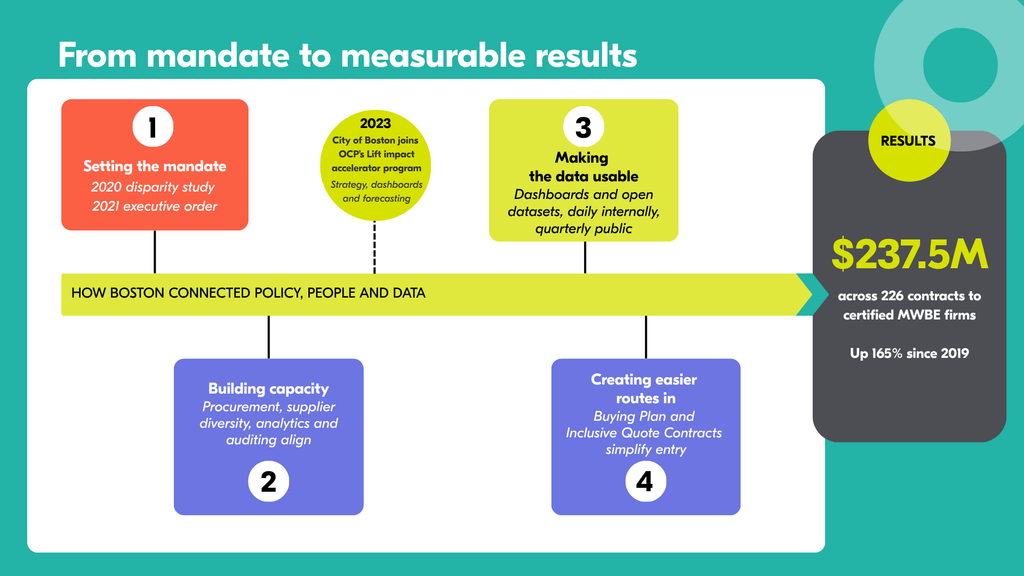
Municipal staff from traditionally siloed departments—including procurement, finance, legal, IT, auditing, and individual buying agencies—began collaborating closely. Their collective efforts focused on three core pillars: creating smoother and more accessible routes into city contracting for small and diverse businesses; strengthening cross-departmental coordination so buyers could plan purchases earlier and apply procurement methods consistently; and deploying advanced data-driven monitoring to measure impact.
As a strategic partner in this evolution, the Open Contracting Partnership (OCP) joined forces with the City through its "Lift" impact accelerator program beginning in 2023. This collaboration helped Boston sharpen its reform strategy, establish clear key performance indicators, develop public-facing spending dashboards, and improve procurement forecasting.
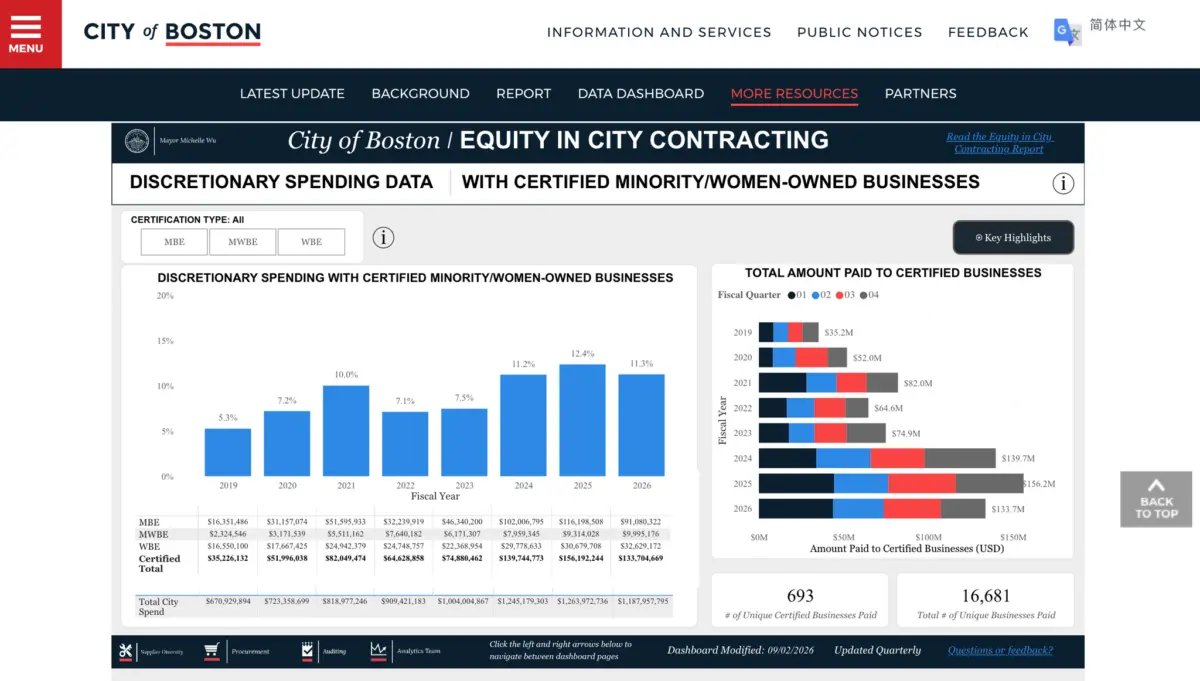
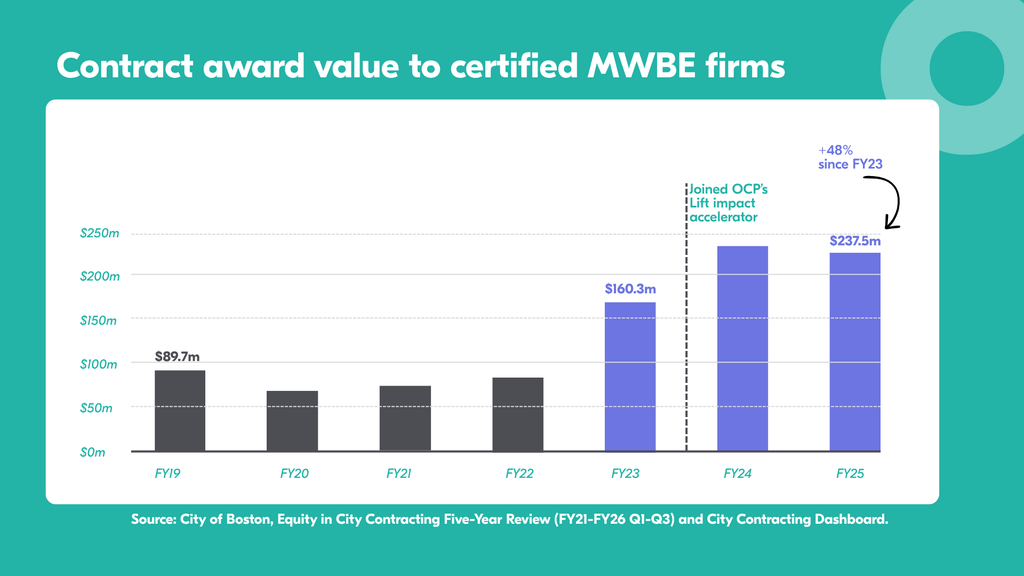
The results of these synchronized efforts have been historic. Since the Lift program began, the total value of contracts awarded to certified M/WBE firms surged by nearly 50%, climbing from $160.3 million to a peak of $237.5 million in fiscal year 2025. The annual volume of contracts awarded to these businesses also rose by 25%, increasing from 181 to 226. Furthermore, the share of "discretionary spending"—funds directly paid to suppliers where the City exercises vendor choice—more than doubled. Viewed across a broader timeline since fiscal year 2019, the value of contracts awarded to certified firms has climbed by 165% at its fiscal year 2025 high, lifting their share of total award value from 9% to 12%.
Ground Level Realities and the Path from Disparity to Opportunity
The human and economic impact of these reforms is anchored in real-world examples across Boston’s neighborhoods. On a spring morning in May 2022, local entrepreneur Sheldon Lloyd stood outside the Orchard Gardens school alongside Mayor Michelle Wu to announce a major milestone. Lloyd’s food service enterprise, City Fresh Foods, had secured a landmark three-year, $17 million contract with Boston Public Schools to provide healthy meals for nearly 50,000 students.
Founded in Roxbury in 1994 by Sheldon’s brother Glynn with just two employees, City Fresh Foods had grown into an operation employing nearly 200 workers. In 2020, the company transitioned to an employee-owned model, giving its predominantly Black, Hispanic, and immigrant workforce a direct economic stake and a pathway toward generational wealth-building. The contract represented the largest non-construction award ever given to a minority-owned business in Boston, demonstrating the tangible potential of municipal purchasing power.
That same year saw the relaunch of the Boston Contracting Opportunity Fund, which over a three-year period distributed grants to 178 businesses to help them overcome systemic barriers identified in the 2020 Disparity Study. The study itself had drawn upon five years of procurement records and extensive interviews with local entrepreneurs. It revealed that for every $100 in procurement dollars M/WBEs were capable of earning, they received only $65. Minority-owned businesses captured roughly 2.5% of municipal contracting dollars against an estimated capacity of 5.7%, while white women-owned businesses captured 8.5% against a capacity of 11.2%.
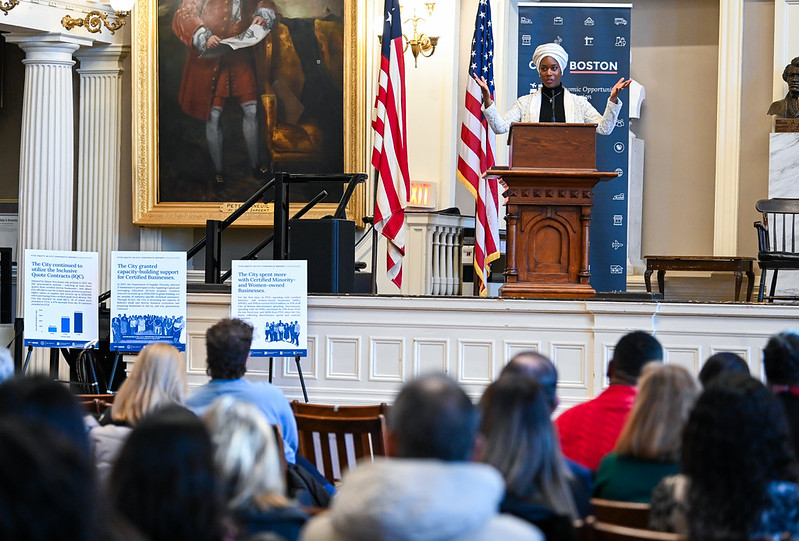
Armed with this empirical evidence, then-Mayor Martin Walsh issued an executive order in February 2021 establishing an ambitious, aspirational target of directing 25% of municipal spending toward M/WBEs. To achieve this, the City needed detailed, timely data, a comprehensive vendor directory, digitized procurement plans, and granular spending tracking. Winning acceptance into the competitive OCP Lift accelerator program in the summer of 2023 provided Boston with vital financial support and 200 hours of tailored technical assistance to turn these goals into operational reality.
Opening Routes for Small and Diverse Businesses
Boston’s reforms tackled practical barriers head-on, ensuring that small and diverse vendors gained earlier visibility into upcoming opportunities, simpler pathways into eligible contracts, and clearer channels for communication with municipal buyers.
A cornerstone of this effort is the municipal "Buying Plan," which provides enterprises with early notice of planned procurements long before official solicitations go live. This advance notice gives business owners adequate time to evaluate bidding opportunities, build operational capacity, form strategic partnerships, and prepare necessary documentation. Departmental leaders noted that compiling the buying plan requires teams to look ahead across programs and coordinate early regarding expected needs for services, instructors, equipment, and logistics.

Boston has published its procurement plans as open data for three consecutive years. The fiscal year 2027 Buying Plan detailed 688 opportunities across 56 departments with an estimated collective value of $808.3 million—representing an 82% increase over the previous year’s plan and reflecting vastly improved data collection and transparency.
To lower administrative burdens for smaller purchases, the City expanded the use of Inclusive Quote Contracts (IQCs). Instead of requiring a full public solicitation process, municipal buyers can utilize a streamlined written quote procedure that solicits at least three competitive bids from certified diverse businesses. By the time Boston published its Five-Year Supplier Diversity Program Review in July 2026, the City had awarded 81 IQCs totaling $11.4 million.
Outreach efforts were similarly broadened. By translating marketing materials for the Buying Plan into seven languages and meeting entrepreneurs directly at community events, Boston stimulated a sharp rise in subscriptions to the City Record—a digital newsletter detailing active contracting opportunities—and drove strong attendance at supplier diversity fairs.
Building the Data Infrastructure
Prior to these sweeping reforms, municipal outreach regarding upcoming bids typically occurred only one to two weeks before deadlines, and internal reporting on spending was largely manual. Purchasing Agent Casey Brock-Wilson characterized the legacy system as "people-powered," requiring staff to reconcile fragmented information across disconnected databases.
Data analysts pointed out that while aggregate figures were occasionally available, the City lacked the granular, regular insights required to manage supplier diversity effectively. Contract award data previously captured only deals exceeding $10,000, completely overlooking smaller purchase orders. Furthermore, award records tracked potential allocations rather than actual payments issued.
To resolve these hurdles, Boston integrated business certification records directly into its financial architecture and established automated processes within its PeopleSoft enterprise software to link contract awards with real-time disbursement data. Rather than replacing its core enterprise software, the City built a flexible translation layer on top of it, evolving from early visualization tools like Civis and Tableau to modern platforms like BigQuery and PowerBI.
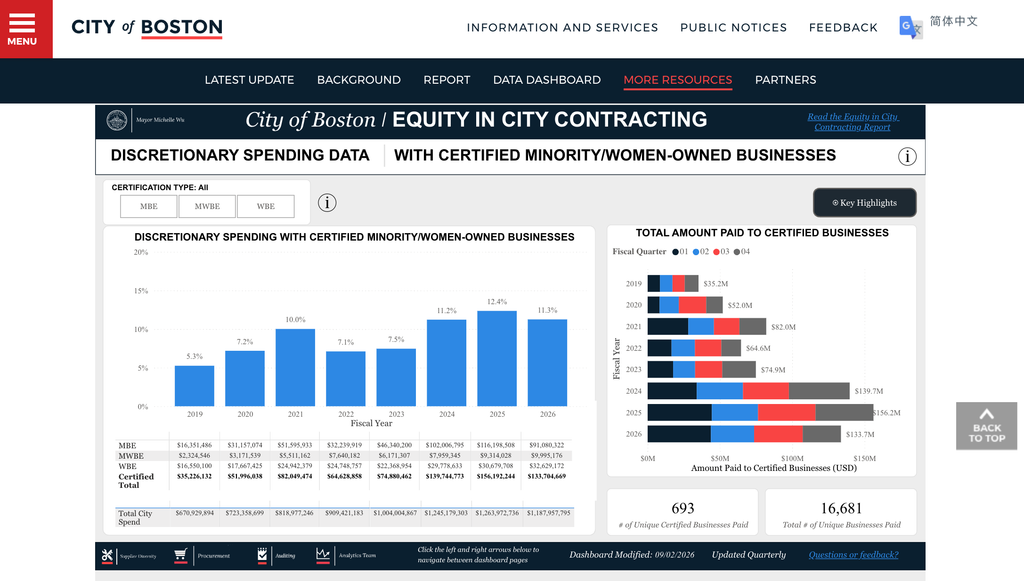
This technical integration enabled the creation of Boston’s public spending dashboard, which refreshes quarterly, alongside internal dashboards that update daily for municipal finance staff. The infrastructure allows department heads to review historical purchasing patterns instantly rather than hunting through disparate emails and phone records. For instance, the Mayor’s Office of Arts and Culture utilized these improved directories and planning tools to award nearly $950,000 to certified vendors in fiscal year 2025, marking a 265% increase over the previous year.
Sustained Impact and Lessons for Other Municipalities
While broader reform efforts began prior to the OCP Lift partnership, the period of collaboration coincided with some of the city’s most significant financial milestones. In fiscal year 2023, contract values awarded to certified M/WBE firms stood at $160.3 million. By fiscal year 2025, that figure rose to $237.5 million, while the number of awarded contracts increased to 226 and discretionary spending with these enterprises more than doubled.
Beyond the financial figures lie active local workplaces. Between January 2024 and December 2025, 514 certified businesses received municipal payments. Based on available employment records and extrapolations for firms without direct data, OCP estimates that these businesses collectively sustained more than 10,000 jobs, supporting the broader local economy through increased demand for professional and commercial services.

Reflecting on the comprehensive journey, municipal leaders emphasize that procurement reform functions as a strategic benefit rather than a zero-sum compromise. By opening up municipal opportunities to a wider array of competitive vendors, Boston has simultaneously improved the efficiency and responsiveness of how the local government buys goods and services. As municipal teams look toward the future—with construction spending and complex subcontracting remaining key areas for continued growth—the central lesson from Boston remains clear: data infrastructure, cross-departmental collaboration, and committed leadership can successfully translate equity policies into daily operational reality.