Public contracting has long been recognized as a powerful lever for local economic development and inclusive growth, yet municipal procurement systems have historically presented formidable barriers for small and diverse enterprises. In Boston, a landmark 2020 Disparity Study commissioned by the City laid bare the extent of these systemic exclusions. The comprehensive research revealed that minority- and women-owned business enterprises (M/WBEs) received just 11% of the total value of Boston’s contracts over a five-year period, despite being fully ready, willing, and able to compete for an estimated 16.9% of contracting dollars.
The disparities were particularly acute for Black-owned businesses, which data showed won roughly $12 for every $100 they might have been expected to secure given their availability in the marketplace. Determined to rectify these persistent gaps, Boston embarked on an ambitious reform agenda. The City sought to open up avenues for historically disadvantaged businesses while overhauling how it tracked participation, monitored spending, and evaluated the efficacy of its inclusion policies.
To tackle these challenges, Boston introduced a comprehensive set of reforms designed to align its procurement practices with broader municipal goals: increasing earnings for minority and women entrepreneurs, generating localized employment opportunities, and fostering a competitive marketplace that could yield better pricing and services for the City. City leadership brought together staff from various governmental units—including procurement, supplier diversity, auditing, legal, information technology, and individual buying departments—to concentrate on three core areas. These focused on creating accessible routes into municipal contracting for small and diverse businesses, strengthening cross-departmental coordination to enable earlier purchasing planning and consistent deployment of procurement methods, and improving data-driven monitoring to gauge true economic impact.
As part of this strategic evolution, the Open Contracting Partnership (OCP) acted as a key partner through its Lift impact accelerator program, helping Boston sharpen its reform strategy and connect open data directly to its inclusion objectives. Through tailored technical assistance, framework design, key performance indicator development, and procurement forecasting support, the partnership bolstered the City’s administrative capacity.

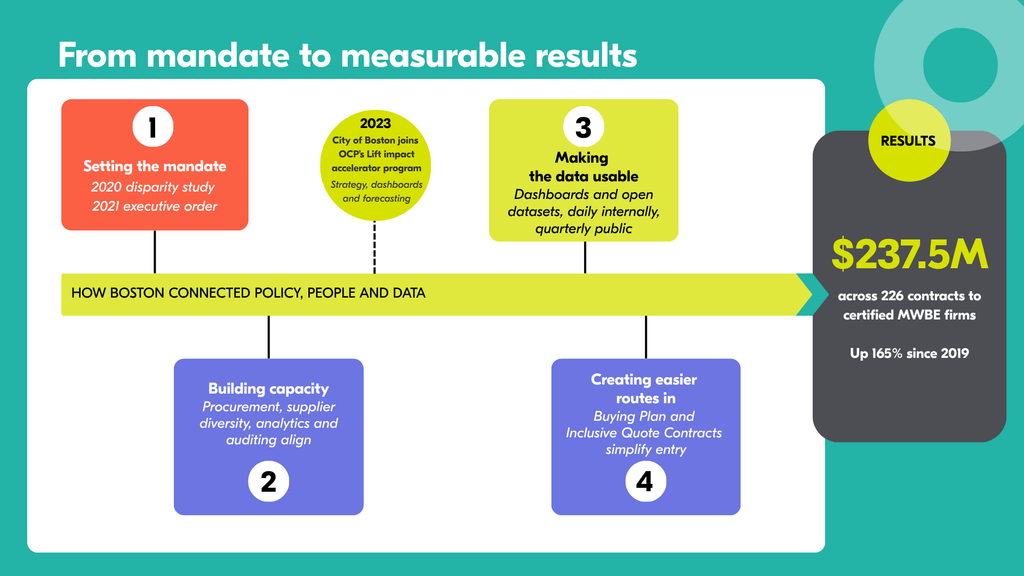
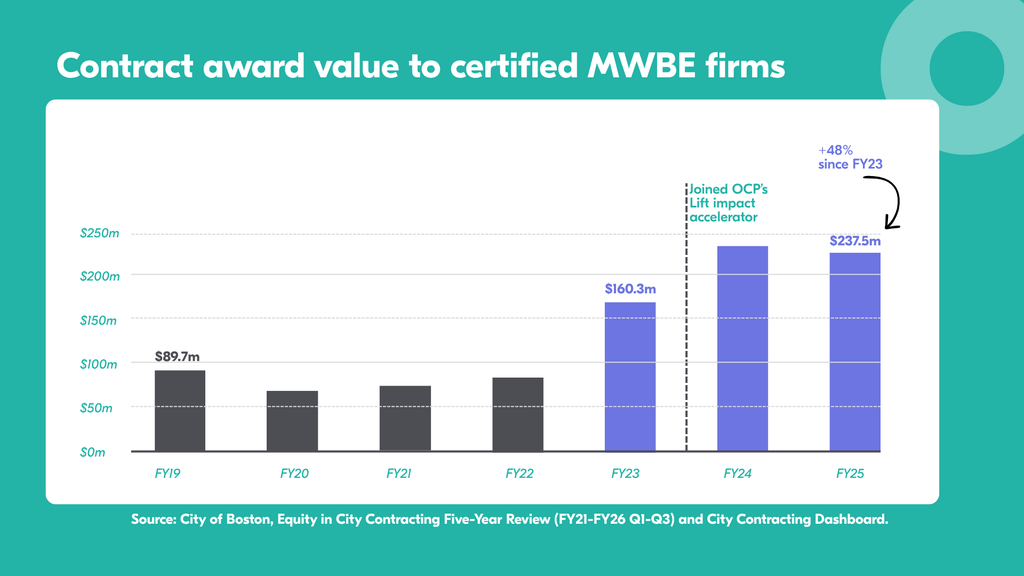
The measurable impacts of these concerted efforts have been profound. Since the Lift program commenced in 2023, the total value of contracts awarded to certified M/WBE firms climbed by nearly 50%, rising from $160.3 million to a peak of $237.5 million in fiscal year 2025. The volume of individual contracts awarded to these enterprises grew by 25%, jumping from 181 to 226 in that same fiscal year, while the share of discretionary spending—representing funds directly disbursed to suppliers where the City holds vendor discretion—more than doubled.
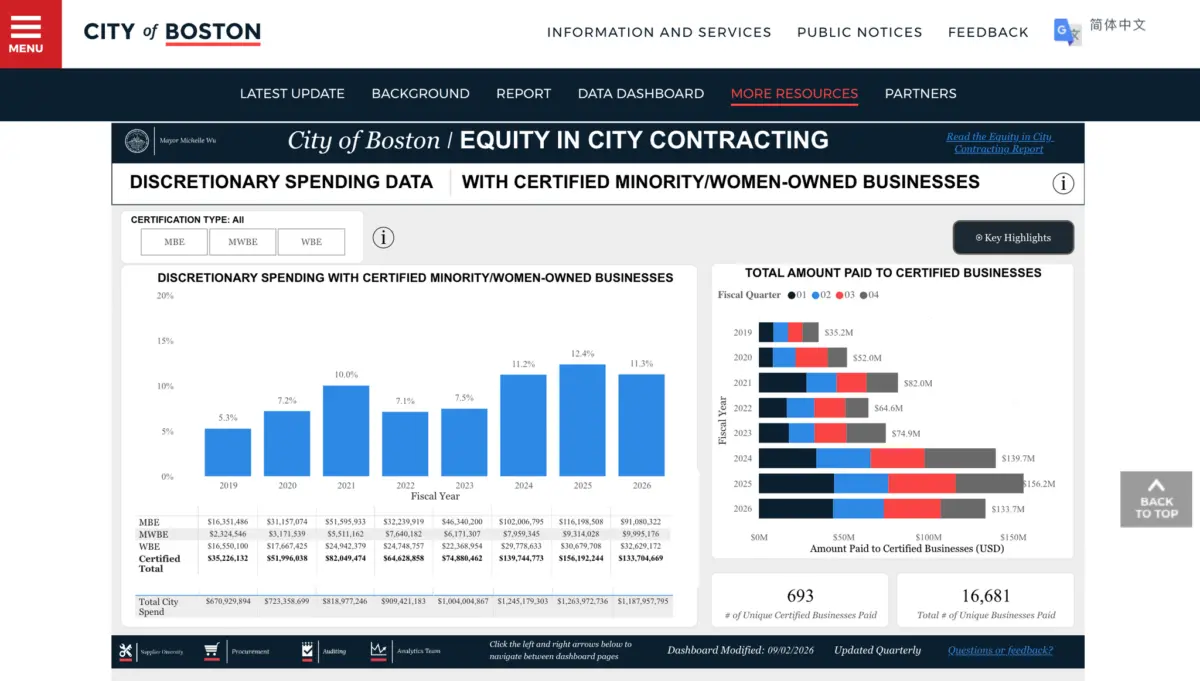
Looking across the broader timeline of reforms since fiscal year 2019, the value of contracts awarded to certified firms surged by 165% at its fiscal year 2025 high, lifting their share of total award value to 12% of all City contract value, up from 9%. Although overall contract award values adjusted to $115.4 million in fiscal year 2026 amidst fluctuating municipal procurement activity, discretionary spending channeled to minority- and women-owned businesses remained remarkably stable, hovering between 11% and 12% annually from fiscal year 2024 through fiscal year 2026.
Today, Boston tracks these metrics automatically through a public spend dashboard, supported by three new open datasets providing transparent, timely insights into contract awards, vendor payments, and future purchasing plans. According to OCP estimates derived from public government records, these public contracts have directly benefited more than 10,000 employees across 514 businesses over a two-year span.
A Local Win, and the Bigger Picture
The human and economic impact of these policy shifts has been evident in landmark agreements across the city. On the morning of May 18, 2022, entrepreneur Sheldon Lloyd stood outside the Orchard Gardens school alongside Boston Mayor Michelle Wu to announce a milestone agreement. Lloyd’s food service enterprise, City Fresh Foods, had secured a three-year, $17-million contract with Boston Public Schools to provide daily meals for nearly 50,000 students starting that summer.
Founded in Roxbury in 1994 by Sheldon’s brother Glynn with just two employees, City Fresh Foods had expanded into a major operation employing nearly 200 people. The company transitioned to employee ownership in 2020, providing its predominantly Black, Hispanic, and immigrant workforce with a meaningful economic stake and a pathway toward wealth generation. This historic agreement—the largest non-construction contract ever awarded to a minority-owned business in Boston—exemplified the municipal government’s explicit pivot toward leveraging its purchasing power to advance racial equity, environmental sustainability, and neighborhood-level economic development.
The momentum generated by such contracts coincided with the relaunch of the Boston Contracting Opportunity Fund. Over a three-year period, the fund distributed grants to 178 businesses, with approximately 80% going to minority-owned enterprises and 34% to women-owned firms. This financial intervention was purposefully designed to dismantle structural barriers identified in the 2020 Disparity Study.
The 700-page disparity study served as the analytical foundation for these targeted programs. By examining five years of historical procurement records and surveying local enterprises about their operational experiences, the study provided empirical backing for what civil rights advocates and minority business owners had long argued: that certified M/WBE firms were readily available in the local market, but existing municipal support mechanisms were insufficient to prevent them from being systematically sidelined. The findings indicated that for every $100 in procurement dollars minority- and women-owned businesses were expected to earn based on their capacity, they received only $65. Minority-owned businesses captured roughly 2.5% of contracting dollars despite an estimated availability of 5.7%, while white women-owned businesses secured about 8.5% against an availability benchmark of 11.2%. Black-owned firms experienced the starkest disparity, capturing approximately $12 for every $100 of expected contracting value.
Following the publication of the study in February 2021, then-Mayor Martin Walsh signed an executive order translating its core findings into official municipal policy. The order established an ambitious aspirational target of directing 25% of overall City spending to minority- and women-owned businesses over a five-year review cycle, tasking departments with developing supplier diversity plans, conducting aggressive vendor outreach, and embedding participation benchmarks into individual contracts.
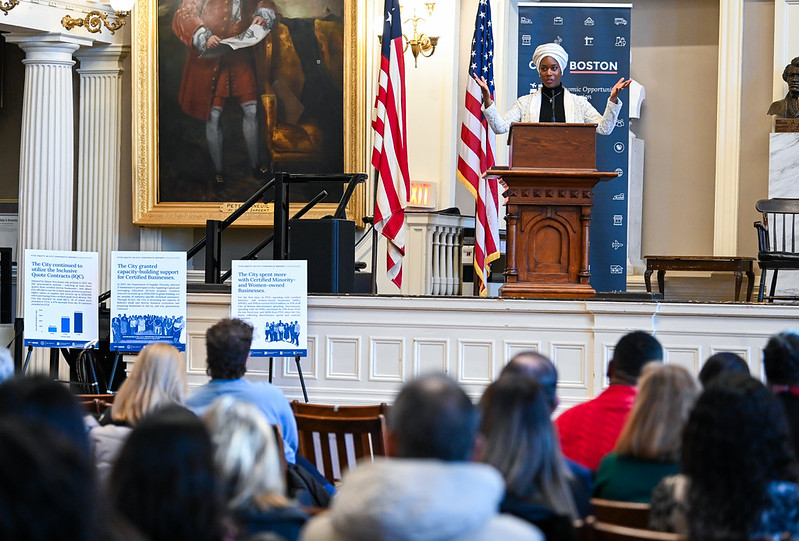
By 2023, while Boston possessed the political mandate, empirical justification, and initial program frameworks, municipal buyers still lacked the integrated, timely data infrastructure necessary to execute these goals effectively. The City needed a comprehensive vendor directory, digitalized procurement forecasts to keep diverse suppliers informed of upcoming market trends, and real-time spending analytics to monitor ongoing progress. Applying to the OCP Lift impact accelerator program provided the strategic catalyst needed to operationalize these objectives.
Opening Routes In for Small and Diverse Businesses
Boston’s reform strategy targeted three practical friction points in the procurement ecosystem: providing enterprises with earlier visibility into upcoming opportunities, establishing streamlined routes into eligible contracts, and simplifying channels for information and engagement. Andrea Swain, Director of the Department of Supplier Diversity, noted that familiarity with complex procurement workflows often grants an unfair advantage to established incumbent businesses, making systemic simplification essential for expanding market competition and reducing public costs.
To address the timing barrier, the City introduced the Buying Plan, a forward-looking scheduling tool that provides businesses with early notification of planned procurements well before formal solicitations are published. This advance notice affords suppliers adequate time to evaluate bidding opportunities, build operational capacity, form strategic partnerships, and prepare complex administrative documentation.
For municipal departments, compiling the Buying Plan required a fundamental shift in internal planning. Naida Faria, Director of Administration and Finance at Boston Centers for Youth & Families, explained that preparing the plan requires department leaders to look across disparate programs and consult colleagues early about anticipated service needs, instructional support, equipment, and transport. While unexpected procurements inevitably arise, the structured exercise establishes a predictable pipeline of upcoming purchases, granting buyers the lead time required to select appropriate procurement paths.

Boston has published its procurement plans as open data for three consecutive years. The fiscal year 2027 Buying Plan detailed 688 commercial opportunities across 56 municipal departments with an estimated cumulative value of $808.3 million—an 82% increase over the previous year’s projections—reflecting deeper institutional data collection and heightened transparency.
This visibility fostered an active feedback loop between municipal officials and the business community. Katherine Cutler, Deputy Director of the Department of Supplier Diversity, noted that while vendors appreciated tracking public spending, they frequently sought clarification regarding complex distinctions, such as the variance between initial contract award values and actual cash disbursements. Focus groups led by municipal analysts helped surface these concerns, directly improving how procurement data is presented to the public.
For smaller, eligible purchases, the City introduced Inclusive Quote Contracts (IQCs), which offer a lower-barrier entry point for vendors. Rather than undergoing a full-scale public solicitation process, municipal buyers can utilize a simplified written quote protocol that solicits at least three competitive proposals from certified diverse businesses. By the release of the City’s Five-Year Supplier Diversity Program Review, Boston had awarded 81 IQCs totaling $11.4 million.
Simultaneously, the City widened its outreach efforts by translating marketing materials for the Buying Plan into seven languages and meeting entrepreneurs directly at community events. These efforts contributed to a noticeable surge in subscriptions to the City Record—a digital bulletin highlighting active contracting opportunities—and strong attendance at Supplier Diversity Week events.
Achieving these shifts also demanded internal organizational realignment. Under Mayor Wu’s administration, Boston expanded personnel within its procurement, supplier diversity, and analytics units while forging closer operational links between auditing, legal, information technology, and individual purchasing departments that previously operated in departmental silos. Laura Melle, Director of Procurement Planning and Support Services, observed that the City successfully transitioned procurement from an administrative, risk-averse back-office function into a strategic partner capable of mitigating operational risk while delivering superior public solutions.
Building the Data Infrastructure
Prior to these institutional reforms, municipal outreach regarding upcoming bids was restricted to a narrow one-to-two-week window prior to deadlines, and reporting on contract awards and spending was largely manual. Casey Brock-Wilson, Purchasing Agent for the City of Boston, characterized the legacy environment as "people-powered," requiring staff to manually reconcile records across disconnected software systems while relying on a patchwork of portal alerts, direct buyer phone calls, and departmental newsletters.
Data Analyst Ryan Nicoll pointed out that while historical reporting could capture aggregate figures, it lacked the granular, routine transparency required to effectively manage supplier diversity goals. Contract award data typically reflected potential contract ceilings rather than actual disbursements or payment timelines, and historically captured only deals exceeding $10,000, omitting smaller purchase orders entirely.
To resolve these blind spots, Boston integrated business certification data directly into its financial architecture while establishing automated data-sharing protocols within its enterprise resource planning software, PeopleSoft. Rather than replacing the underlying software, the City constructed a flexible translation layer—evolving from early tools like Civis and Tableau to BigQuery and PowerBI—that allowed procurement and financial data to be synthesized and displayed effectively.
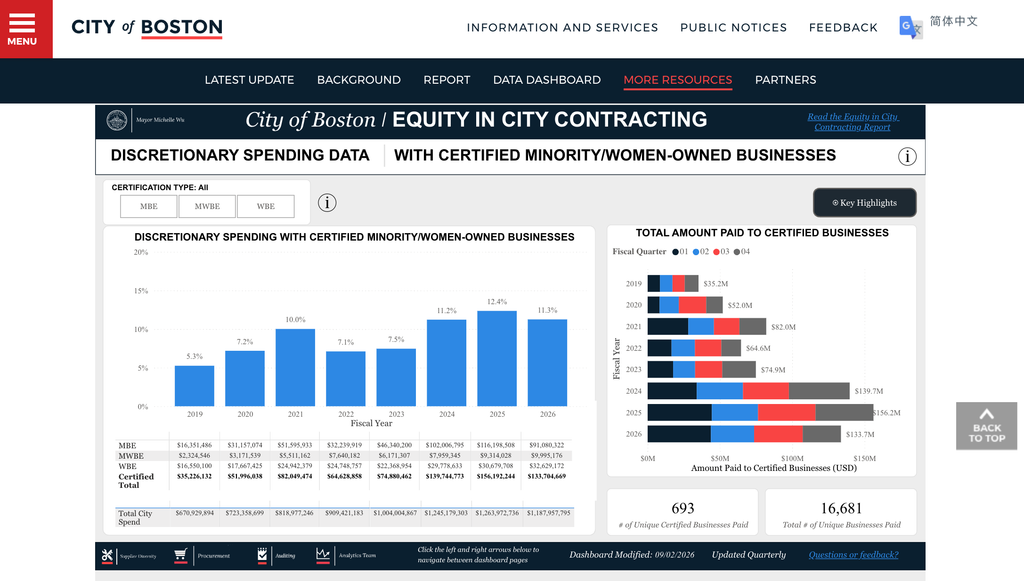
This integration yielded the City’s first public dashboard tracking expenditures with certified M/WBE firms, refreshing on a quarterly basis. To maximize utility for public stakeholders and government agencies, the City simultaneously published three distinct open datasets covering contract awards, vendor payments, and planned procurements. Internal dashboards designed for municipal finance staff refresh daily, granting buyers direct access to current figures without routing routine inquiries through a single data analyst.
Linking payment records directly to specific contracts also enabled the City to identify irregular spending patterns, such as situations where multiple smaller contracts issued to a single vendor collectively exceeded thresholds that would normally mandate competitive bidding. Furthermore, departments across municipal government experienced tangible shifts in operational capability. The Mayor’s Office of Arts and Culture, for instance, reported awarding nearly $950,000 to certified vendors in fiscal year 2025—a 265% increase over the previous fiscal year. Kenny Mascary, Senior Advisor for the Creative Economy, emphasized that relying on the certified business directory ensures vendor outreach remains sustainable and accurately reflects the demographic diversity of the communities the City serves.
Dollars and Data: The Results
While Boston’s broader policy initiatives predated its involvement with the OCP Lift program, some of the most substantial performance gains materialized during the active partnership window. In fiscal year 2023, the final complete fiscal year before Lift began, contract value awarded to certified M/WBE firms stood at $160.3 million. By fiscal year 2025, that figure had climbed 48% to $237.5 million, with total contracts awarded increasing by 25% to 226, and discretionary spending with these businesses more than doubling.
Beyond financial aggregates, these procurement practices have translated into localized economic vitality. Between January 2024 and December 2025, 514 certified enterprises received municipal disbursements. With complete workforce records available for 238 of those firms and statistical extrapolations applied to the remainder, OCP estimates that these contracting businesses collectively support upwards of 10,000 employees. Meanwhile, the active supplier base has continued to expand, with 1,037 businesses holding active City certifications in fiscal year 2025.

Reflecting on the broader implications of the reform model, Laura Melle stressed that effective procurement reform represents a dual bottom line rather than a zero-sum compromise, proving that expanding market access to a wider pool of vendors simultaneously enhances municipal purchasing efficiency. Her core guidance for peer municipalities centers on the importance of maintaining an active voice in policy formulation, positioning procurement not merely as an administrative necessity, but as an indispensable instrument for achieving overarching municipal priorities.