Standard retrieval-augmented generation chatbots are notoriously reliable when handling isolated, straightforward inquiries. Ask a standard RAG system what a specific return policy states, and it typically retrieves the correct document chunk, hands it to a large language model, and delivers an accurate response. However, when users pose complex, multi-hop queries—such as inquiring how a return policy interacts with warranty terms for international orders—traditional systems frequently struggle. These nuanced answers rarely reside within a single, isolated chunk of text. Instead, they require synthesizing multiple disparate document sections that may be physically distant from one another in the source material. Standard vector searches, which rely solely on measuring the semantic similarity between an embedded question and individual text chunks, lack the inherent capability to bridge those conceptual gaps independently.
To address this structural limitation in enterprise search and retrieval, AWS Labs has introduced the open-source graphrag-toolkit, a Python framework designed to bridge the gap between unstructured text and interconnected data. This open-source development addresses a fundamental flaw in modern generative artificial intelligence applications: the inability of traditional vector-based retrieval mechanisms to follow explicit relationships between pieces of information across large document collections. Industry analysts and major database providers have increasingly turned their attention toward graph-enhanced retrieval, often referred to as GraphRAG, to resolve these multi-hop reasoning challenges.
The Evolution and Limitations of Plain Vector RAG
To understand why traditional retrieval struggles with complex inquiries, it is necessary to examine the underlying mechanics of standard vector stores. In a conventional setup, documents are segmented into smaller chunks, embedded into a high-dimensional vector space, and indexed. When a user submits a prompt, the system retrieves chunks purely based on semantic similarity to the embedded question, processing each chunk in absolute isolation. The retrieval pipeline contains no native representation of how one chunk relates to another. It cannot inherently track whether two paragraphs discuss the same corporate entity, whether one section provides foundational context required by another, or whether a cause-and-effect relationship exists across different parts of a document repository.
This architecture creates a bottleneck for multi-hop questions, which demand the assembly of two or more interconnected facts before a coherent answer can be formulated. This failure is a structural characteristic of the retrieval mechanism itself rather than an issue that can be permanently resolved through prompt engineering or expanded context windows. The primary obstacle is rarely the reasoning capability of the underlying large language model; rather, it is the failure of plain vector search to surface all the necessary, related pieces of information in the first place.
Independent convergences across the database industry have highlighted this exact challenge. Prominent database firms have noted that standard retrieval treats every text chunk as an independent island, whereas a graph captures how those islands connect, identifying overlapping entities and cross-document relationships. The widespread acknowledgment of this problem across different sectors of the database industry underscores that the limitation of isolated vector chunks is a genuine architectural hurdle rather than a temporary marketing talking point.
Inside the graphrag-toolkit Architecture
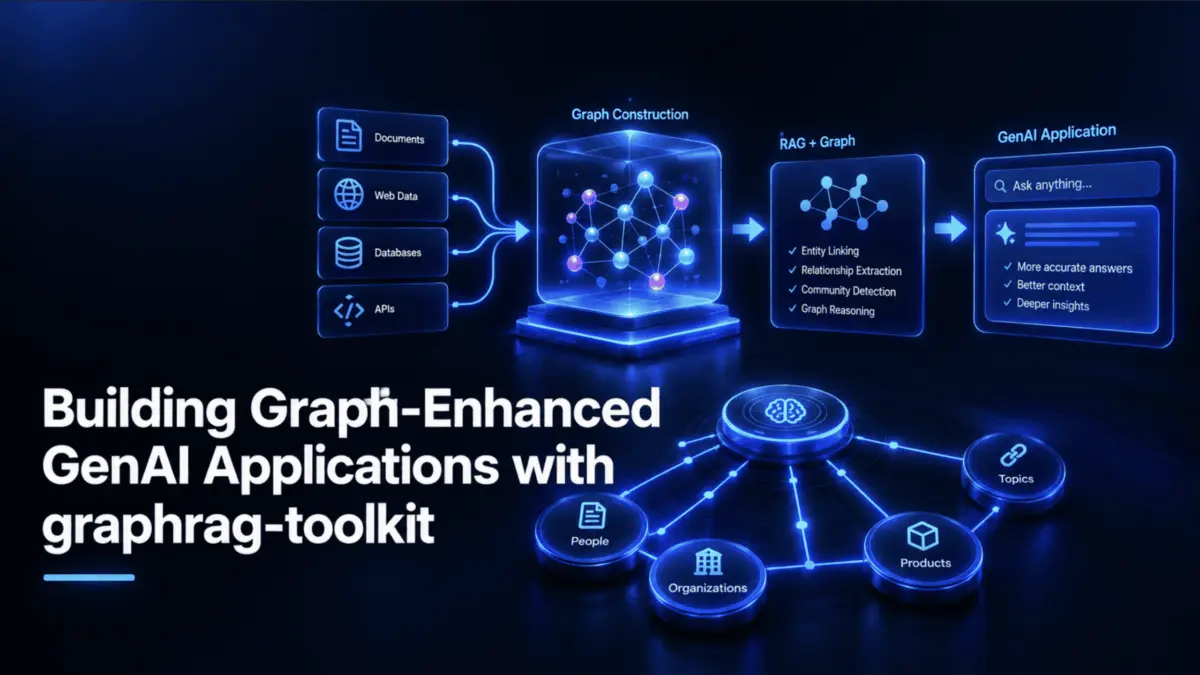
The newly released graphrag-toolkit, published under an Apache 2.0 open-source license by AWS Labs, is structured to overcome these exact retrieval boundaries. The toolkit is partitioned into two primary components. The first is lexical-graph, a framework designed for the automated construction and querying of a hierarchical knowledge graph derived directly from unstructured documents. The second component, known as BYOKG-RAG, or Bring Your Own Knowledge Graph, provides an alternative multi-strategy question-answering layer for development teams that already maintain an established knowledge graph and wish to query it without re-extracting data from scratch.
The design principles behind the hierarchical lexical-graph model have also been detailed in academic literature, specifically in a research paper titled "Hierarchical Lexical Graph for Enhanced Multi-Hop Retrieval." Furthermore, this technology has moved beyond theoretical research into enterprise production environments. Major professional services networks, such as Deloitte, have incorporated lexical-graph frameworks into secure intelligence platforms operating on managed graph databases, demonstrating the framework’s viability at scale.
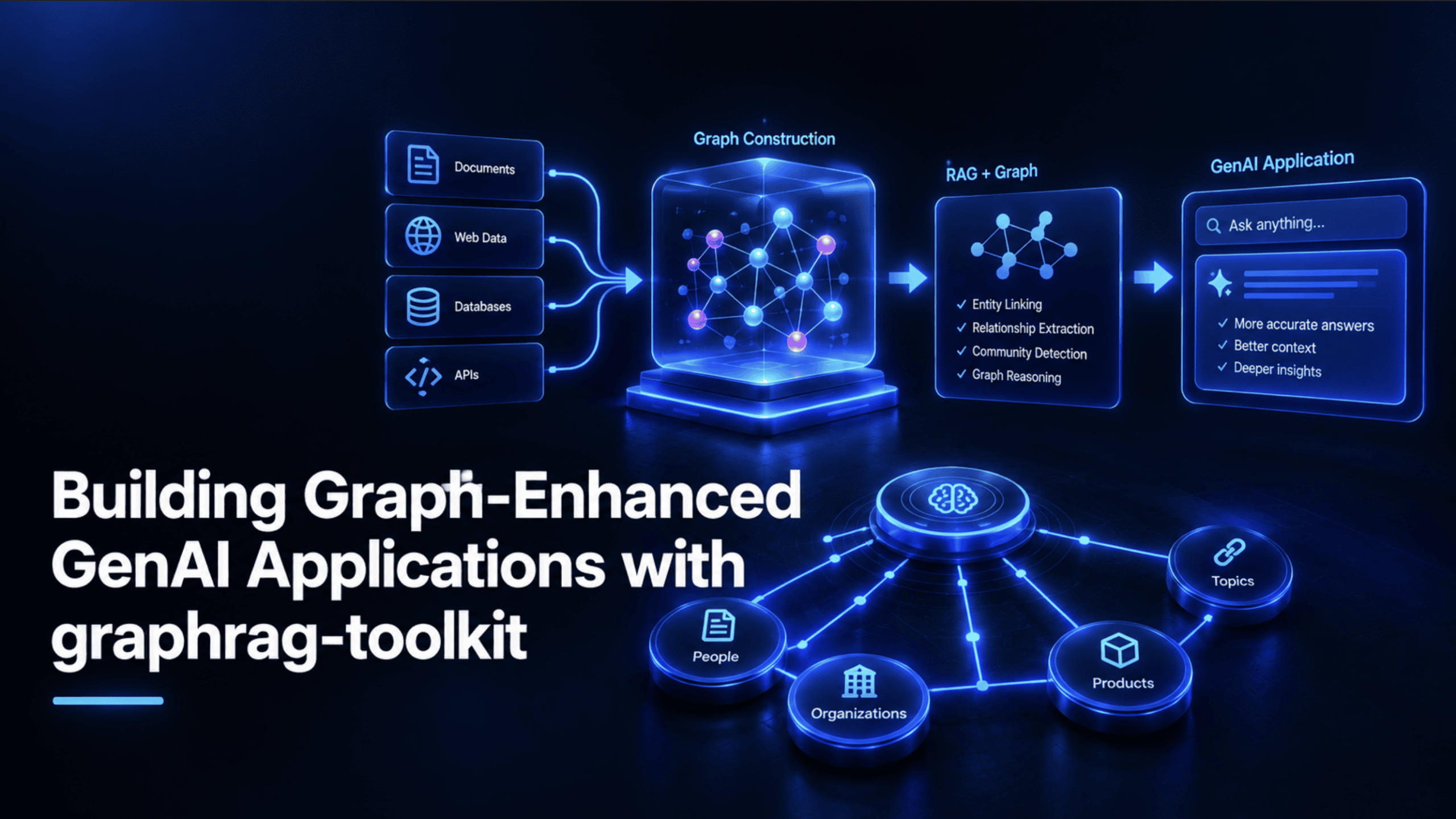
Operationally, the lexical-graph organizes extracted information across six distinct, interconnected tiers: source documents, chunks, topics, statements, facts, and entities. Unlike traditional vector databases that restrict retrieval strictly to the chunk level, this hierarchical structure allows retrieval algorithms to hop dynamically between any of these interconnected levels. This multi-level traversal capability is the core engineering feature that enables complex, multi-hop queries to be answered accurately.
The graph construction pipeline is intentionally divided into two separate phases: extraction and building. During the extraction stage, raw source documents are ingested, segmented into manageable chunks, and processed by a large language model to identify underlying topics, statements, facts, and entities. The building stage then takes those extracted components to populate the graph and vector indexes. By separating ingestion into distinct, resumable micro-batches rather than executing a monolithic operation, large document processing jobs can be paused, inspected, or filtered mid-stream without sacrificing progress.
To maintain high extraction fidelity, the pipeline utilizes a two-step processing approach per chunk. Rather than attempting to extract entities directly from messy, raw source text, an initial model pass cleans and refines the raw text into a set of well-formed, self-contained propositions. A subsequent extraction pass then analyzes these cleaned propositions to identify topics, statements, and entities. While optional, this foundational cleanup pass measurably enhances overall extraction quality.
Traversal-Based Search and Flexible Infrastructure
Querying within the toolkit relies on traversal-based search mechanisms rather than relying purely on top-K similarity metrics. When a user submits a question, the system generates an embedding to perform an initial similarity search against the vector store, identifying high-level anchor points such as relevant statements or chunks. These anchor points subsequently seed graph traversal queries, pulling in thematically connected information from across the broader graph structure. The consolidated context is then supplied alongside the original prompt to a foundational model to generate the final response.
The toolkit provides architectural flexibility by supporting multiple underlying storage backends. For graph storage, the framework accommodates managed cloud database services alongside open-source platforms like Neo4j and FalkorDB. Similarly, vector storage can be handled through managed cloud services or local relational database extensions such as PostgreSQL with pgvector, allowing development teams to run complete local testing environments utilizing containerized infrastructure. While foundation model integrations natively leverage Amazon Bedrock, the open-source nature of the toolkit allows engineering teams to adapt various components to specific enterprise environments.
The introduction of the graphrag-toolkit marks a significant step forward in narrowing the gap between semantic text search and structured relational reasoning. By shifting away from isolated text fragments toward interconnected hierarchical graphs, developers are better equipped to build generative artificial intelligence applications capable of navigating complex, multi-layered document repositories with precision.