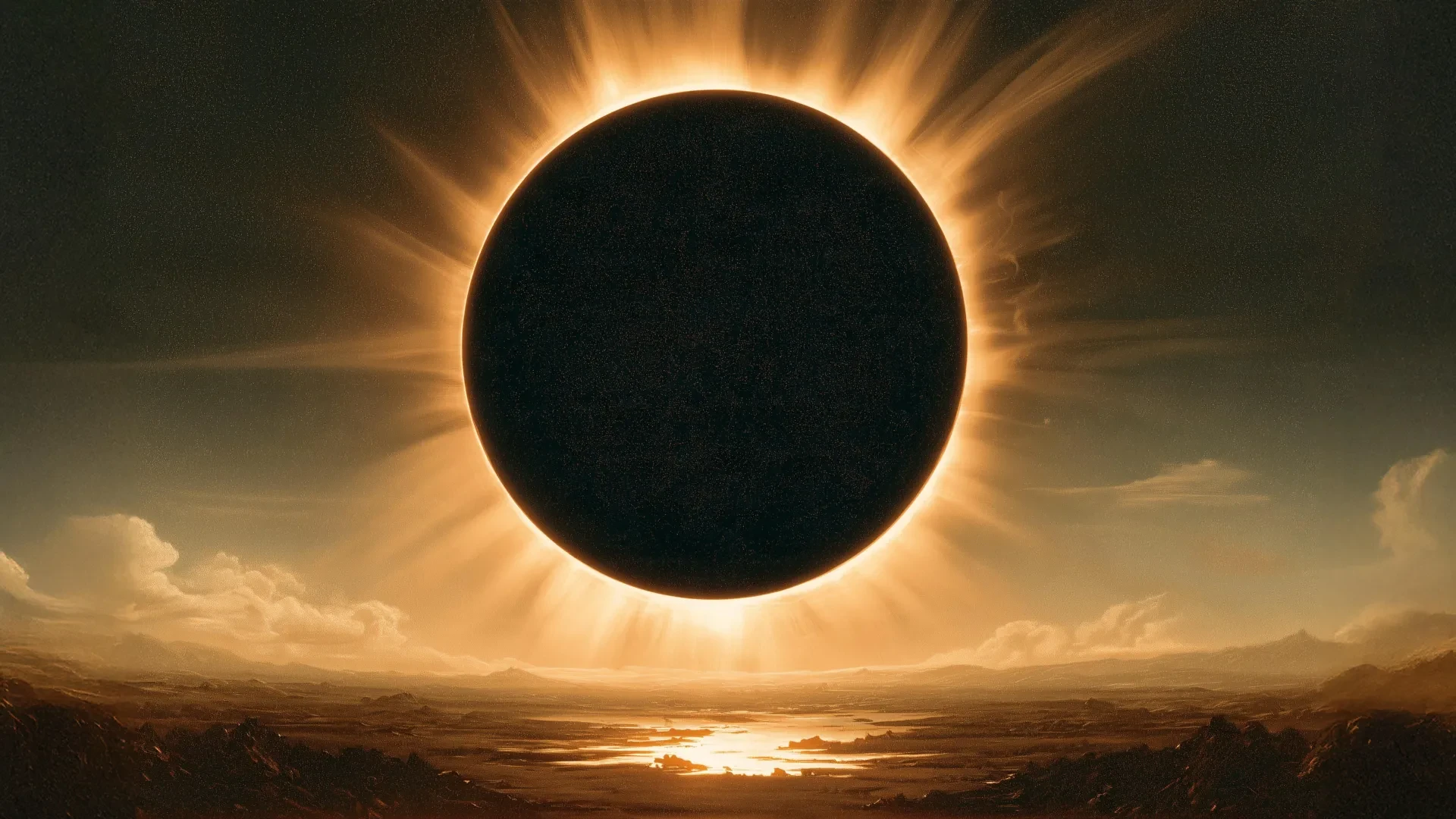
An international team of researchers has successfully revisited one of the oldest precisely dated records of a total solar eclipse in human history, unlocking unprecedented details regarding how Earth’s rotation has steadily changed over thousands of years. By seamlessly fusing historical geography with cutting-edge modern astronomical calculations, the scientific collaboration reconstructed a breathtaking total solar eclipse that plunged ancient skies into darkness in 709 BCE, determining precisely how the celestial event would have looked to skywatchers in Qufu, the ancient capital of China’s Lu Duchy.
Beyond charting the planet’s rotational shifts, the researchers carefully examined an early historical account that may preserve the world’s oldest written description of the solar corona—the shimmering, faint outer atmosphere of the Sun that remains hidden until the Moon completely blocks the solar disk during totality. Their meticulous analysis of the corona’s possible shape suggests that, at the time of the eclipse, our star was actively emerging from a prolonged period of unusual and deep quiescence, picking up its regular rhythm of magnetic activity.
Published in the Astrophysical Journal Letters, these findings furnish scientists with exceptionally precise empirical evidence concerning the speed of Earth’s rotation during ancient epochs. Furthermore, they supply critical, independent validation for previous reconstructions of solar behavior derived from radiocarbon measurements found in ancient tree rings and ice cores.
An Ancient Chinese Eclipse Record Holds a Crucial Clue
On July 17, 709 BCE, court observers in the Lu Duchy witnessed a rare and awe-inspiring total solar eclipse. This dramatic celestial event was dutifully recorded in the "Spring and Autumn Annals," a foundational historical chronicle compiled roughly two to three centuries after the occurrence. The original entry was stark and direct, noting simply that "the Sun was totally eclipsed."
Centuries later, an additional, highly descriptive layer of information emerged within the "Hanshu" (Book of Han), a monumental historical text that preserved a passage written approximately seven centuries after the eclipse took place. This later text contains an unusual phrase that modern astronomers and historians believe may be the earliest surviving reference to the structure of the solar corona.
"What makes this record special isn’t just its age, but also a later addendum in the ‘Hanshu’ (Book of Han) based on a quote written seven centuries after the eclipse. It describes the eclipsed Sun as ‘completely yellow above and below.’ This addendum has been traditionally associated with a record of a solar corona. If this is truly the case, it represents one of the earliest surviving written descriptions of the solar corona," explained lead author Hisashi Hayakawa, an assistant professor at Nagoya University’s Institute for Space-Earth Environmental Research and Institute for Advanced Research.
Initially, however, matching the historical documentation with the hard laws of modern astronomy presented a major puzzle. When the research team modeled the eclipse path using prevailing estimates for Earth’s historical rotation rate, their digital simulations revealed a striking contradiction: a total solar eclipse should not have been visible from Qufu, the long-assumed physical seat of the Lu court.
The investigative breakthrough came when the researchers traced the root of the geographical discrepancy to a minor cartographic and historical error regarding the ancient city’s precise coordinates. By cross-referencing recent archaeological excavation reports alongside detailed historical geographic evidence, the team realized that prior scholarly calculations had misplaced ancient Qufu by approximately eight kilometers from its true historical site.
Correcting this seemingly minor geographical error bridged the gap between historical text and modern astrophysics, empowering the scientists to reconstruct the ancient eclipse with unprecedented fidelity and extract vital data regarding both planetary rotation and solar physics.
"This correction allowed us to accurately measure the Earth’s rotation during the total eclipse, calculate the orientation of the Sun’s rotation axis, and simulate the corona’s appearance," noted Hayakawa, who holds doctorates in both solar physics and oriental history.
Why Ancient China Preserved Such Detailed Astronomical Records
The survival of this remarkably detailed astronomical observation underscores the profound cultural, political, and spiritual significance attached to the heavens in ancient Chinese society. Successive imperial dynasties maintained specialized bureaus of astronomers and astrologers whose primary duty was to monitor the skies continuously, because unusual or unexpected celestial phenomena were widely interpreted as powerful cosmic omens directed at the ruling house.
This deeply ingrained tradition, often referred to as omenology, was tightly intertwined with contemporary political ideology and statecraft. Extraordinary sky events—such as total eclipses, brilliant auroras, or unexpected planetary conjunctions—were frequently viewed as divine warnings that an emperor or governing official had erred in their moral duties or governance.
Consequently, court astronomers maintained rigorous, uninterrupted documentation of subtle and dramatic changes in the skies above. The vast archives compiled across successive dynasties ultimately transformed into some of the most invaluable historical datasets in the world for modern researchers studying ancient astronomical phenomena.
Even so, the research team exercises careful scientific caution, maintaining a clear distinction between the contemporaneous chronicle of the eclipse and the much later description of the corona.
The core event on July 17, 709 BCE, stands as the earliest explicit written record of a total solar eclipse that can be securely and precisely dated. While it may also be linked to one of the oldest surviving descriptions of the solar corona, that specific interpretation remains probabilistic because the key descriptive passage appears in a secondary historical source compiled centuries afterward.
Yet, even with those caveats regarding the corona text, the firmly anchored timeline of the eclipse itself provides an exceptionally reliable baseline for investigating the long-term evolution of Earth’s rotational dynamics. At the same time, the potential corona description opens a fascinating window for cross-disciplinary comparison with modern astrophysical models of ancient solar cycles.
How a 2,700-Year-Old Eclipse Reveals Earth’s Faster Rotation
Earth does not maintain a perfectly constant rotational speed throughout the ages. Over vast spans of geological and historical time, our planet’s spin has gradually decelerated, driven primarily by tidal friction—the braking effect generated by the gravitational pull of the Moon upon Earth’s vast oceans.
Because of this ongoing deceleration, Earth completed its daily rotations slightly faster 2,700 years ago than it does in the modern era.
Utilizing the corrected geographical coordinates of ancient Qufu, the research team successfully derived much tighter constraints on Earth’s rotational speed during the crucial window spanning from the eighth through the sixth centuries BCE.
Their rigorous calculations placed delta T ($Delta$T)—a standard scientific metric used to quantify variations in Earth’s rotation relative to a uniform, idealized time scale—between 20,264 and 21,204 seconds for the exact duration of the 709 BCE eclipse.
"This new dataset fixes coordinate errors in previous Earth rotation studies. Additionally, it improves the accuracy of dating and reconstructing historical astronomical events," said coauthor Mitsuru Sôma of the National Astronomical Observatory of Japan.
Refining these measurements gives geophysicists a sharper tool to understand the gradual lengthening of Earth’s day over millennia. It also dramatically improves the computational accuracy needed to determine when and where other ancient astronomical records would have been visible across different points on the globe.
Evidence That the Sun Was Awakening From a Long Quiet Period
Beyond illuminating Earth’s rotational history, the 709 BCE eclipse may capture a pivotal evolutionary moment in the magnetic life cycle of our Sun.
For years, scientists have successfully reconstructed ancient solar activity cycles by measuring concentrations of radioactive carbon isotopes preserved within the annual growth rings of ancient trees, as well as trapped air bubbles in polar ice cores. The potential coronal description from the Chinese records provides an independent, real-world check against those laboratory reconstructions.
"This unique historical addendum for the possible solar coronal structure is critical for providing a spot reference on solar activity reconstructions from tree rings and ice cores, as well as providing independent validation of solar activity models," explained coauthor Mathew Owens, a professor of space physics at the University of Reading.
Trees absorb atmospheric carbon dioxide during photosynthesis, incorporating trace amounts of radioactive carbon-14 into their wood as they grow. This creates a durable, natural archive that researchers can sample and analyze thousands of years later.
The production of radiocarbon in Earth’s upper atmosphere is heavily modulated by cosmic rays. When the Sun is intensely active, its powerful magnetic field and enhanced solar wind deflect many of these cosmic rays away from Earth, directly suppressing radiocarbon production rates. By tracing these fluctuations across successive tree rings, scientists can reconstruct historical solar activity far back into antiquity.
Normally, the Sun operates on a predictable, roughly 11-year activity cycle characterized by the waxing and waning of sunspots and magnetic storms. However, the Sun occasionally lapses into prolonged eras of suppressed activity known as "grand minima," during which sunspots virtually vanish and the standard cycle breaks down.
One such prominent era, known alternatively as the Neo-Assyrian Grand Minimum or the Homer Grand Minimum, spanned from approximately 808 to 717 BCE.
Intriguingly, the total solar eclipse of 709 BCE took place just a short time after this extended period of unusual quiet had finally come to an end.
According to the research team, the historical description hinting at a structured solar corona aligns remarkably well with a star that had just resumed its normal, vigorous activity cycles. The suggested structural characteristics imply robust underlying magnetic activity, indicating that the Sun may have been approaching the maximum phase of its 11-year cycle at the time.
While the uncertainties inherent in a centuries-later historical text mean the corona description cannot be taken as absolute proof, the interpretation fits seamlessly alongside independent solar activity models derived from radiocarbon tree-ring data.
Ancient Astronomers Are Still Helping Scientists Understand the Universe
Ultimately, the study serves as a compelling reminder of how meticulous observations preserved across millennia can continue to drive modern scientific breakthroughs.
By uniting historical textual analysis, archaeological field reports, advanced geographic research, and sophisticated astronomical modeling, contemporary scientists can extract empirical data that would otherwise remain permanently lost to time.
In this instance, correcting a map by a mere eight kilometers transformed an ancient chronicle of darkness into a high-precision scientific instrument, shedding new light on the steady ticking of Earth’s rotation and offering a rare glimpse into the distant magnetic history of our solar system.
"Some of our ancestors were very skilled observers," noted coauthor Dr. Meng Jin of the Lockheed Martin Solar and Astrophysics Laboratory. "When we combine their careful records with modern computational methods and historical evidence, we can potentially find new information about our planet and our star from thousands of years ago."