A massive asteroid slammed into the North Sea roughly 43 to 46 million years ago, triggering a tsunami more than 100 meters high. Now, after more than two decades of scientific disagreement, researchers have uncovered compelling evidence confirming the ancient collision, bringing closure to a fiercely contested geological mystery.
The impact created what is now known as the Silverpit Crater, a massive structure buried deep beneath the seafloor. Although scientists first discovered the formation in 2002, its origins remained a subject of intense debate within the geoscience community. While many researchers immediately suspected an extraterrestrial impact, others argued that terrestrial geological processes, rather than an object from space, were responsible for the unusual subsurface anomaly.
A research team led by Dr. Uisdean Nicholson of Heriot-Watt University in Edinburgh has now provided the strongest evidence yet that Silverpit was formed by an asteroid or comet. By combining advanced seismic imaging, microscopic examination of rock samples, and sophisticated computer simulations, the scientists have reconstructed the violent event and identified rare minerals that could only have formed under extraordinary pressure.
The findings, published in the scientific journal Nature Communications, establish Silverpit as one of the relatively few confirmed impact craters on Earth, offering fresh insights into how hypervelocity collisions shape our planet.
A Mysterious Crater Beneath the North Sea
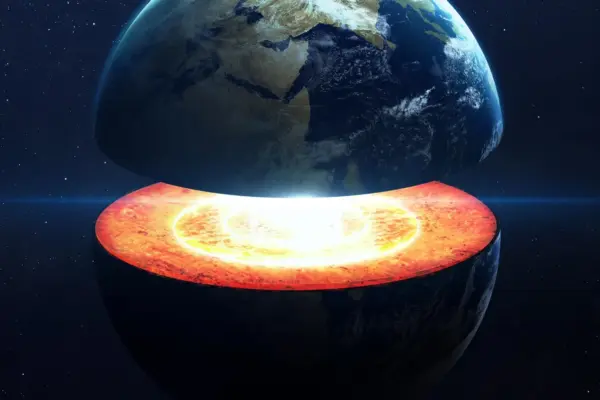
The Silverpit Crater lies approximately 700 meters beneath the seabed in the southern North Sea, about 80 miles off the coast of Yorkshire, England. The crater itself measures roughly three kilometers across and is surrounded by a much larger, 20-kilometer-wide region of circular faults, which are fractures in the rock where movement has occurred over millions of years.
When scientists first identified the formation in 2002 during routine commercial seismic surveys, several features immediately suggested that it had been created by a high-speed collision with an asteroid or comet. Its nearly circular outline, elevated central peak, and surrounding rings of faults closely resembled structures documented at other recognized impact sites around the globe. Central peaks typically develop when rocks compressed by a powerful impact rebound upward, somewhat like the way water rises in the center of a pool after an object splashes into it.
However, not everyone in the geological community was convinced by these surface similarities. Some geologists proposed that the unusual formation resulted from the slow, complex movement of underground salt deposits, which are known to shift and deform the rock layers situated directly above them. Others suggested that ancient volcanic activity had caused a localized collapse of part of the seabed, producing a structural depression that only superficially appeared to be an impact crater.
The disagreement persisted for years, dividing experts across various institutions. The debate became so pronounced that in 2009, geologists even formally voted on the competing explanations, as documented in Geoscientist magazine. During that poll, the majority of participating researchers rejected the asteroid impact hypothesis in favor of alternative terrestrial mechanisms.
The latest findings, however, conclusively demonstrate that the original impact explanation was correct all along.
Scientists Find the Smoking Gun for an Ancient Asteroid Impact
The decisive breakthrough came from a multidisciplinary approach that combined newly available, high-resolution seismic images with microscopic evidence recovered directly from beneath the seabed.
Seismic imaging allows geologists to investigate geological structures hidden deep underground by analyzing how sound waves travel through different layers of rock and sediment. This powerful non-invasive technique can reveal buried faults, impact craters, and other complex formations that cannot be observed directly from the surface. Using these vastly improved data sets, Dr. Nicholson and his colleagues were able to examine Silverpit’s internal structure and fault networks in unprecedented detail.
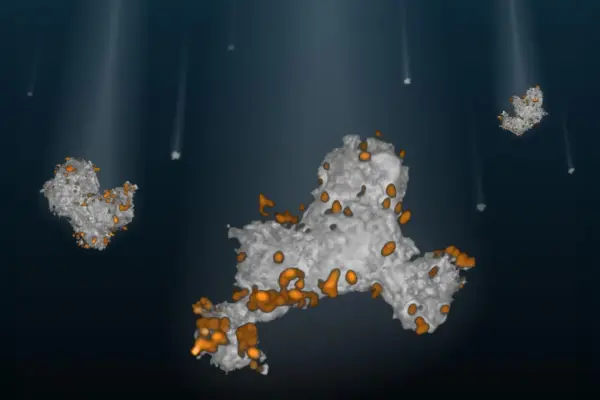
Yet the most compelling and definitive evidence came from tiny mineral crystals discovered in rock cuttings collected from an exploratory oil well drilled near the crater.
Dr. Uisdean Nicholson, a sedimentologist in Heriot-Watt University’s School of Energy, Geoscience, Infrastructure and Society, detailed the significance of the discovery. "New seismic imaging has given us an unprecedented look at the crater," Dr. Nicholson said. "Samples from an oil well in the area also revealed rare ‘shocked’ quartz and feldspar crystals at the same depth as the crater floor. We were exceptionally lucky to find these—a real ‘needle-in-a-haystack’ effort. These prove the impact crater hypothesis beyond doubt, because they have a fabric that can only be created by extreme shock pressures."
Shocked minerals are particularly important in geological research because their internal crystal structures have been permanently altered by immense, instantaneous pressure. Such microscopic changes can only occur when an extraterrestrial object strikes the planet at tremendous velocity, generating powerful shock waves that race outward through the surrounding rock strata.
Ordinary geological processes, such as tectonic movement, salt deformation, or volcanism, generally cannot produce these distinctive microscopic features. Their discovery at the exact same depth as the crater floor provides undeniable physical evidence that an extraordinarily violent impact occurred at the site.
A 160-Meter Asteroid Unleashed a Monster Tsunami
With the crater’s extraterrestrial origins firmly established, the researchers turned to numerical models—computer simulations based on the fundamental laws of physics—to reconstruct the sequence of events during the collision.
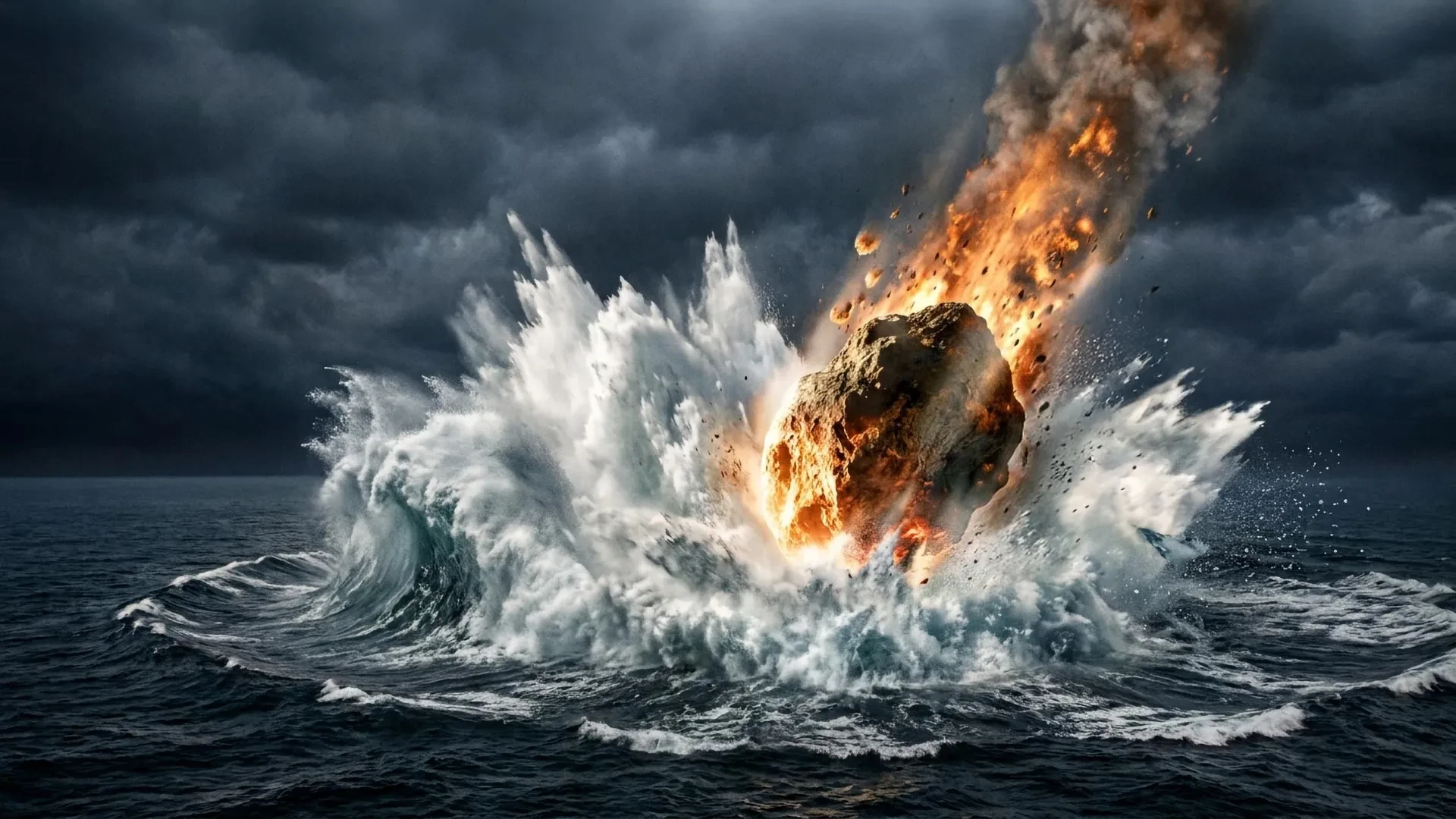
Their results suggest that an asteroid approximately 160 meters across approached from the west and slammed into the ancient seabed at a relatively shallow angle. Although significantly smaller than the massive asteroid associated with the catastrophic extinction of the dinosaurs at the end of the Cretaceous period, an object of this size would still release an astronomical amount of energy when traveling at cosmic speeds.
According to the simulations, the impact violently displaced vast quantities of solid rock and seawater, producing a towering curtain of debris before the fractured material collapsed back down into the open ocean.
"Our evidence shows that a 160-meter-wide asteroid hit the seabed at a low angle from the west," Dr. Nicholson explained. "Within minutes, it created a 1.5-kilometer-high curtain of rock and water that then collapsed into the sea, creating a tsunami over 100 meters high."
That means the high-velocity collision sent pulverized material nearly a mile into the air before it crashed back into the sea, generating a catastrophic tsunami taller than a modern 30-story building. Unlike ordinary wind-driven waves that only disturb the surface of the water, tsunamis involve the physical movement of enormous volumes of water from top to bottom. They are typically generated when a sudden, violent disturbance—such as an undersea earthquake, a massive underwater landslide, or a direct asteroid impact—rapidly displaces the water column above it.
While the estimated height of Silverpit’s tsunami is derived from sophisticated computer modeling of the ancient impact rather than direct historical observation, the reconstruction illustrates just how destructive even a relatively modest asteroid can be when it strikes the ocean.
A Scientific Debate Finally Settled After Decades
For Professor Gareth Collins of Imperial College London, the new discovery brings a satisfying conclusion to a bitter controversy that he witnessed firsthand. Professor Collins participated directly in the 2009 debate over Silverpit’s origins and contributed the numerical impact simulations used in the new research effort.
"I always thought that the impact hypothesis was the simplest explanation and most consistent with the observations," Professor Collins said. "It is very rewarding to have finally found the silver bullet. We can now get on with the exciting job of using the amazing new data to learn more about how impacts shape planets below the surface, which is really hard to do on other planets."
The findings do much more than simply settle an old academic argument among geologists. They also provide scientists with a valuable, highly preserved natural laboratory to study the extensive underground damage caused by high-speed asteroid impacts.
Because much of Silverpit’s complex internal structure remains buried and exceptionally well preserved beneath layers of younger sediment, researchers can investigate in detail how the collision fractured, displaced, and permanently reshaped the surrounding geological layers. These detailed observations could ultimately help scientists interpret impact structures on other terrestrial worlds, such as Mars or the Moon, where the subsurface effects of ancient collisions are often much more difficult to examine directly.
Why This Rare Asteroid Crater Matters
Earth has experienced countless asteroid and comet impacts throughout its long geological history, but relatively few recognizable craters remain on its surface today. Weathering, erosion, continuous sediment deposition, and relentless plate tectonics constantly reshape the planet’s outer crust. Over millions of years, these powerful geological processes can wear down, bury, or completely obliterate the physical evidence of ancient cosmic collisions.
As a result, exceptionally preserved impact sites like Silverpit are scientifically invaluable to researchers attempting to reconstruct the planet’s history.
"Silverpit is a rare and exceptionally preserved hypervelocity impact crater," Dr. Nicholson noted, emphasizing the significance of the discovery. "These are rare because the Earth is such a dynamic planet—plate tectonics and erosion destroy almost all traces of most of these events. Around 200 confirmed impact craters exist on land, and only about 33 have been identified beneath the ocean."
Dr. Nicholson added that researchers can use these findings to better understand how asteroid impacts have shaped the Earth throughout deep history, as well as to improve models for predicting what could happen in the event of a future asteroid encounter.
Hypervelocity impacts occur when extraterrestrial objects strike the planet at extremely high speeds, typically measuring several kilometers per second. At those immense velocities, even an asteroid measuring only a few hundred meters across can deliver a devastating amount of kinetic energy upon contact.
With its origins now definitively confirmed, the Silverpit Crater joins a small and elite group of important underwater and buried impact structures around the world. This group includes the famous Chicxulub Crater buried beneath the Yucatán Peninsula in Mexico, which is universally associated with the mass extinction that wiped out the nonavian dinosaurs, as well as the newly confirmed Nadir Crater located off the coast of West Africa.
Together, these rare craters provide tangible, physical evidence of the powerful and often catastrophic role that cosmic collisions have played in shaping Earth’s geological evolution and biological history. By continuing to study Silverpit’s remarkably preserved features, scientists hope to gain a clearer picture of what happens when an asteroid strikes the ocean, how the surrounding marine crust responds to the shock, and what such an event might mean for the future of our planet.
The research was funded by the Natural Environment Research Council.