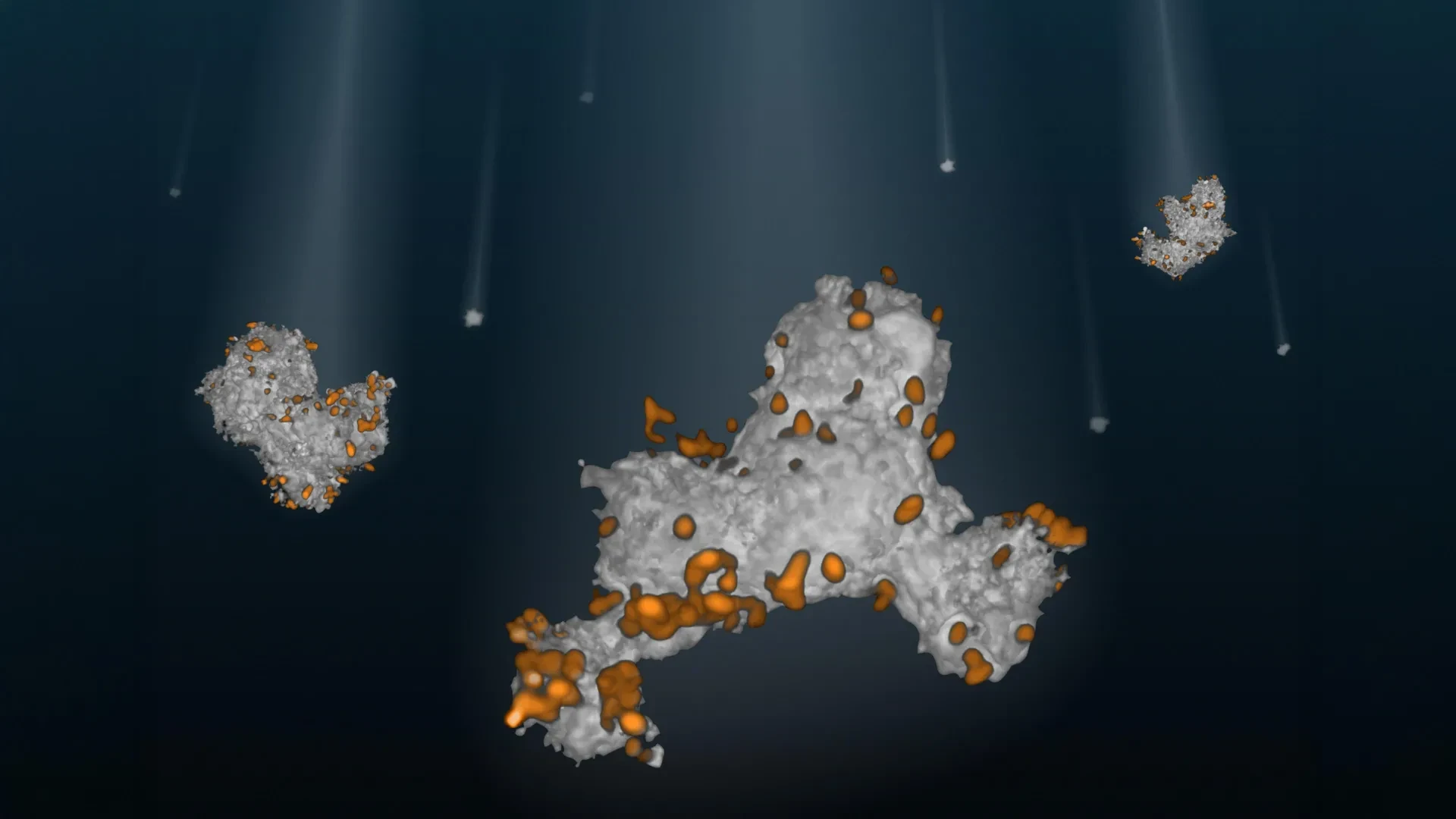
Far below the sunlit surface of the open ocean, a constant, silent snowfall drifts endlessly through the perpetual darkness. But unlike the frozen, crystalline flakes that cascade from winter skies over land, this underwater snow consists of a complex mixture of microscopic debris: tiny clumps of organic waste, dead organisms, silt, and the remnants of microscopic plankton. Known to oceanographers as marine snow, these drifting particles contain everything from animal mucus and fecal pellets to mineral grains, serving as a vital biological lifeline connecting the vibrant upper ocean to the pitch-black abyss of the seafloor.
As this detrital material steadily sinks through the water column, it carries enormous quantities of carbon away from the surface waters, playing a fundamental role in regulating Earth’s climate. Researchers estimate that marine snow acts as a massive biological pump, removing more than 10 gigatons of carbon from surface waters each year. Yet, despite this massive initial downward flux, only about two gigatons ultimately reach the deep ocean depths where that carbon can remain securely sequestered away from the atmosphere for hundreds, or even thousands, of years.
Why so much of this vital carbon fails to make it into the deep ocean has long remained a persistent puzzle for marine scientists. Now, an international team of researchers from UC San Diego’s Scripps Institution of Oceanography and the University of Lincoln has identified a surprisingly influential factor that dictates the fate of this sinking material: the stickiness, or viscosity, of the marine snow itself.
Their groundbreaking findings, published in the journal Science, demonstrate that the physical thickness and gooeyness of marine snow directly influence how quickly hungry marine bacteria can break it apart and, consequently, how far it can successfully sink before decomposing. According to the researchers, the stickiest, most viscous particles possess the remarkable capacity to transport more than six times as much carbon down to the deep ocean compared to particles with a thinner, less cohesive consistency.
How Ocean Slime Helps Store Carbon
Marine snow occupies a central, indispensable role in Earth’s global carbon cycle—the intricate, natural movement of carbon among the atmosphere, the world’s oceans, terrestrial landscapes, and living organisms. By actively transporting carbon-rich organic matter from surface waters down into the deep ocean interior, sinking particulate matter can effectively isolate a portion of the planet’s carbon budget, keeping it locked away from the atmosphere for centuries or longer, thereby moderating global climate shifts.
However, not every particle of marine snow survives the long, perilous journey to the ocean floor. As these organic aggregates descend through the water column, voracious marine bacteria feed on them, gradually breaking down the complex structural material and respiring the carbon back into dissolved inorganic forms. This microbial degradation dictates the efficiency of the biological carbon pump, directly affecting how much carbon ultimately reaches the ocean’s dark depths.
The new research provides the scientific community with its first detailed, high-resolution look at how living bacteria interact dynamically with the physical structure of marine snow and, more broadly, with biological mucus itself. These fundamental interactions carry profound biological importance well beyond the marine carbon cycle. Similar ecological relationships between bacteria and mucilaginous substances help sustain fragile coral reefs, sprawling kelp forests, complex plant root systems, and even the internal digestive tracts of humans and countless other animals.
Until recently, however, marine scientists lacked the necessary technological tools to observe these microscopic interactions at the precise spatial scales required to truly understand their mechanical and ecological nature.
A Four-Year Quest to See Inside Marine Snow
The ambitious project began in 2021, when Bryce Inman, who was then a postdoctoral researcher at Scripps Oceanography, set out to explore what he and his colleagues describe as the "muscoscape"—the complex, uncharted microscopic terrain of biological slime.
"Observing individual bacteria interacting with the physical structure of mucus had never been possible before," Inman explained, highlighting the historical technological barriers that kept these microscopic landscapes hidden from view.
Working alongside close colleagues, including renowned microbiologist and professor emeritus Farooq Azam at Scripps, Inman spent four painstaking years trying to overcome that methodological limitation. Multiple experimental attempts failed before the research team finally engineered a reliable, working technique in 2025.
Their technological solution cleverly combined advanced 3D confocal microscopy with specially engineered fluorescent molecules. Confocal microscopy utilizes focused light beams to capture exceptionally detailed optical images at varying depths within a biological sample, enabling researchers to digitally reconstruct its intricate architecture in three distinct dimensions. Meanwhile, the specialized fluorescent molecules selectively illuminated key features of the mucilaginous material, rendering them visible under microscopic examination.
For the very first time in oceanographic history, the scientists were able to examine the microscopic "physical terrain" of individual marine snow particles in high fidelity, all while watching in real time how living bacteria moved across, navigated through, and interacted physically with the organic matrix.
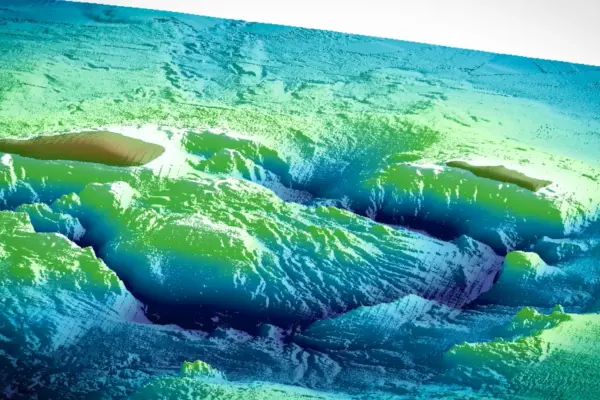
The resulting images revealed a surprisingly intricate and heterogeneous microscopic environment, complete with structural variations, dense bulges, and hidden crevasses that dictate precisely where bacteria can settle and how easily they can access the nutrient-rich material contained within.
Why Stickier Marine Snow Sinks Deeper
Much like atmospheric snowflakes, individual particles of marine snow vary considerably from one another. Each floating aggregate contains its own unique, highly variable mixture of organic compounds and inorganic minerals, creating wide disparities in chemical composition, internal structure, and physical viscosity.
The researchers’ innovative imaging approach, which is further detailed in a companion study published in the journal Nature Communications, revealed that bacteria do not distribute themselves evenly throughout a particle. Instead, they preferentially colonize peripheral areas near a particle’s surface where the material is less viscous and mechanically softer.
In contrast, the denser, significantly stickier regions located deeper inside the core of the particles present a formidable barrier that is considerably more difficult for bacteria to penetrate and degrade.
"Bacteria can latch on to less viscous portions of each particle, but cannot reach more viscous regions until they break it down," Inman noted, offering an intuitive analogy. "Think of it like a worm in an apple: the flesh is easy to penetrate, but the core is tough to chew through."
This stark structural difference has profound consequences for the structural integrity and longevity of marine snow as it traverses the water column.
In controlled laboratory experiments, the scientists observed that particles possessing greater internal viscosity successfully resisted bacterial degradation, enzymatic breakdown, and physical fragmentation for significantly longer periods of time. Advanced computer simulations conducted by the team further demonstrated that these resilient, stickier particles can descend to much greater depths before finally disintegrating.
Based on these compelling empirical results and modeling efforts, the research team estimates that highly viscous marine snow can deliver more than six times as much organic carbon to the deep ocean interior as its less viscous counterparts.
These findings finally help explain a long-standing ecological mystery: why some sinking organic material transports carbon vastly farther into the ocean depths than other particles, even when both sets of aggregates begin their downward journeys from the exact same surface waters.
"How far marine snow can sink is a surprisingly complicated problem, and we have added another—very gooey—piece to the puzzle," Inman said.
A Discovery With Implications Beyond the Ocean
Although the primary focus of the research centers squarely on marine snow and the oceanic carbon cycle, the broader implications of the work extend across numerous biological and ecological environments where bacteria routinely interact with mucus.
Mucus is historically regarded in many scientific fields as a relatively simple, slippery, and homogeneous substance. However, the deployment of this advanced imaging technology reveals that it possesses a surprisingly sophisticated internal landscape, featuring microscopic architectures that actively influence bacterial behavior, colonization, and metabolic activity.
Gaining a deeper understanding of these complex physical features could empower scientists to investigate critical biological processes in diverse settings, ranging from human gastrointestinal health and mucosal immunology to the ecological recovery of damaged coral reefs and marine ecosystems.
Furthermore, the newly established observational method opens up exciting new opportunities to explore biological interactions that were previously impossible to study directly, providing researchers worldwide with an innovative methodological framework for examining the hidden microscopic habitats inhabited by complex microbial communities.
Mucus, slime, or whatever terminology one chooses to apply, "has a surprising amount of structure," Inman observed. "There are bulges, crevasses, all this sort of structure to it that we really had no idea about at a scale smaller than bacteria. This is the first time we’re really examining this physical habitat."
This important discovery adds a crucial missing piece to the scientific community’s comprehensive understanding of how carbon cycles through the global ocean. It also vividly demonstrates that something as seemingly ordinary and mundane as the physical thickness of underwater slime can ultimately wield far-reaching consequences for the stability of the planet’s most vital natural systems.
Financial support and additional funding for the collaborative research project were provided by the Simons Foundation and the Engineering and Physical Sciences Research Council.