Most training functions start out small, clean, and remarkably readable. Give a standard machine learning script six months in a shared repository, however, and it naturally accumulates model-specific conditionals, multiple data-source branches, a hand-rolled cache check, and logging calls routed to three different destinations. No single line of code is inherently wrong. Instead, the function has simply absorbed another conditional branch every single time the underlying project changed, with the result that every caller now inherits the entire, sprawling pile.
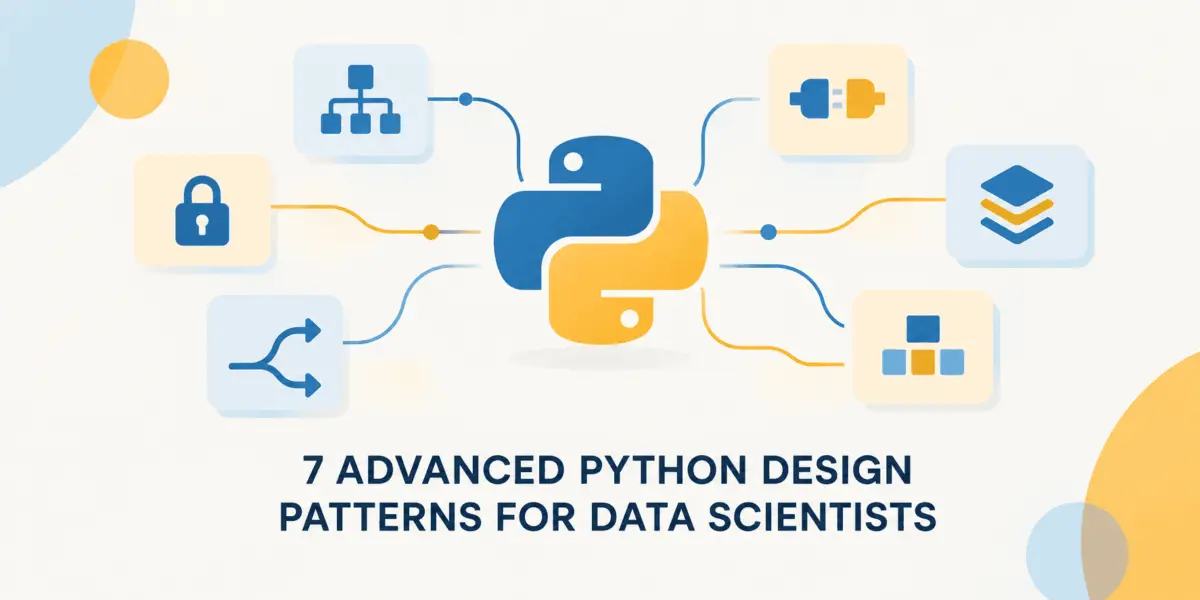
While foundational Python concepts—such as pipelines, factories, and decorators—handle everyday data science cases effectively, growing codebases eventually demand more specialized architectural boundaries. Experienced developers frequently encounter distinct pressures once a prototype notebook matures into production-grade code that other team members depend on. To address these evolving software engineering challenges, data scientists can apply seven classic advanced design patterns, carefully adapted to Python 3.10, to remove recurring sources of friction without adding unnecessary complexity.
The golden rule of restraint applies universally across all architectural patterns: if no other code or component will ever call a specific module, a pattern is nothing more than unnecessary ceremony, and a plain, straightforward function remains the superior tool. Design patterns only truly pay for themselves when they permanently eliminate a source of change that keeps returning to disrupt the development lifecycle.
When evaluation logic begins to expand uncontrollably, the strategy pattern offers a reliable remedy. An experiment runner that relies on conditional statements to pick scoring metrics inevitably grows a new branch every time the team adopts a new metric. The strategy pattern removes this branching behavior entirely by making the scoring operation a value that the caller passes directly into the function. Both evaluation calls execute against the same predictions, but the core runner never has to learn which specific policy it executed, and that strategic ignorance is where the engineering payoff lies. Each individual scorer can then be tested completely on its own, meaning that adding a new evaluation metric requires writing a new function rather than editing the core experiment script.
Developers frequently confuse the strategy pattern with the command pattern, but a clear distinction exists. The strategy pattern gives callers interchangeable ways of performing the exact same job immediately, whereas the command pattern packages a single operation alongside its specific arguments so that the work can be executed later or transferred elsewhere. In Python, a stateless strategy should always remain a plain callable function, as a class only earns its place when configuration parameters or related helper methods need to travel alongside the core behavior.
Mismatched model APIs present another common hurdle when evaluation code must check which specific library produced a model, leaking interface inconsistencies downstream. The standard solution involves writing a local contract using a typing Protocol, paired with a thin adapter wrapper around any model that fails to match the expected interface. The legacy model might expose non-standard methods and return bare scores, but the adapter neatly reshapes them into the standardized probability format that all downstream tasks expect. Once this wrapper is in place, switching machine learning libraries no longer requires rewriting the evaluation layer. However, typing Protocols carry a warning of their own, as their checking is entirely static. Decorating a protocol with runtime checks only tests for attribute presence, meaning a class that accepts the wrong arguments can still accidentally pass validation. Furthermore, an adapter translates an interface and nothing more, leaving semantic differences—such as class order, decision thresholds, or probability calibration—to pass straight through unaltered.
To combat the code drift that frequently occurs when sibling experiments copy their orchestration logic from one another, developers turn to the template method. This pattern fixes the overall run lifecycle once within an abstract base class built on Python’s built-in abc module, allowing subclasses to fill in only the specific steps that legitimately vary. A tree-model subclass implements the fitting logic while inheriting everything else, ensuring that loading, fitting, evaluating, and saving always execute in the exact same order for every experimental variant. While this approach guarantees consistency, it also couples every variant to the base lifecycle, meaning that if steps ever need to change independently or combine freely, they belong in runtime-composed strategies rather than a rigid subclass tree.
Training loops that hard-wire calls to experiment trackers, consoles, dashboards, and early-stopping mechanisms introduce numerous external reasons to change that have nothing to do with actual model training. The observer pattern flips this dependency entirely, causing the training loop to emit a single immutable event dataclass while a list of designated callbacks determines what happens next. A console logger and a best-score tracker can operate independently without ever knowing the other exists, and adding a dashboard writer later simply means appending a new callable to the observer list. Freezing the event dataclass ensures that any observer attempting to mutate the data triggers an immediate error rather than silently corrupting the information received by subsequent observers. At scale, however, event order, error handling, and per-event computational costs must be explicitly managed to prevent the system from turning into an untraceable event bus.
When experimental runs must wait for overnight compute capacity or require exact replication weeks later, the command pattern packages the request itself into an object built from a frozen dataclass. Because the object serializes cleanly, it can be easily logged, queued, retried, or shipped off to a worker machine on another network. The frozen flag guarantees that the request that eventually executes matches the request that was originally recorded. Nevertheless, developers must ensure that dataset versions, code versions, random seeds, and platform assumptions are explicitly captured inside the command object, otherwise the replay will simply produce an entirely different model under the same name.
To simplify scenarios where scoring a single configuration requires numerous imports and an extensive setup dance, the facade pattern collects an entire subsystem behind a single task-level method. The facade performs none of the heavy lifting itself; instead, it delegates tasks to focused, independent components while strictly managing the execution order. While this provides a stable entry point for callers, developers must remain vigilant against appetite creep. A facade that begins absorbing validation rules, retry policies, and complex state management quickly ceases to be a simple doorway and transforms into a new, unmanageable monolith.
Finally, loading massive models or datasets at import time forces every notebook restart and service deployment to pay a heavy performance tax for resources that may never even be used. The proxy pattern defers this resource cost while preserving the exact same contract that consumers already rely on. The real resource loads only upon the first method call and never again, while consumers continue calling standard methods entirely unaware that a boundary exists. While highly effective, proxies require deliberate decisions regarding cache invalidation, thread safety, and load failure behavior before being deployed to production environments.
Ultimately, separating a genuinely useful design pattern from an overly complicated class diagram comes down to identifying what changes repeatedly, what contract must remain stable during those changes, and what new failure modes the abstraction introduces. When code boundaries are chosen correctly, callers become simpler, subsystems become easier to test, and data science projects remain maintainable as they scale.