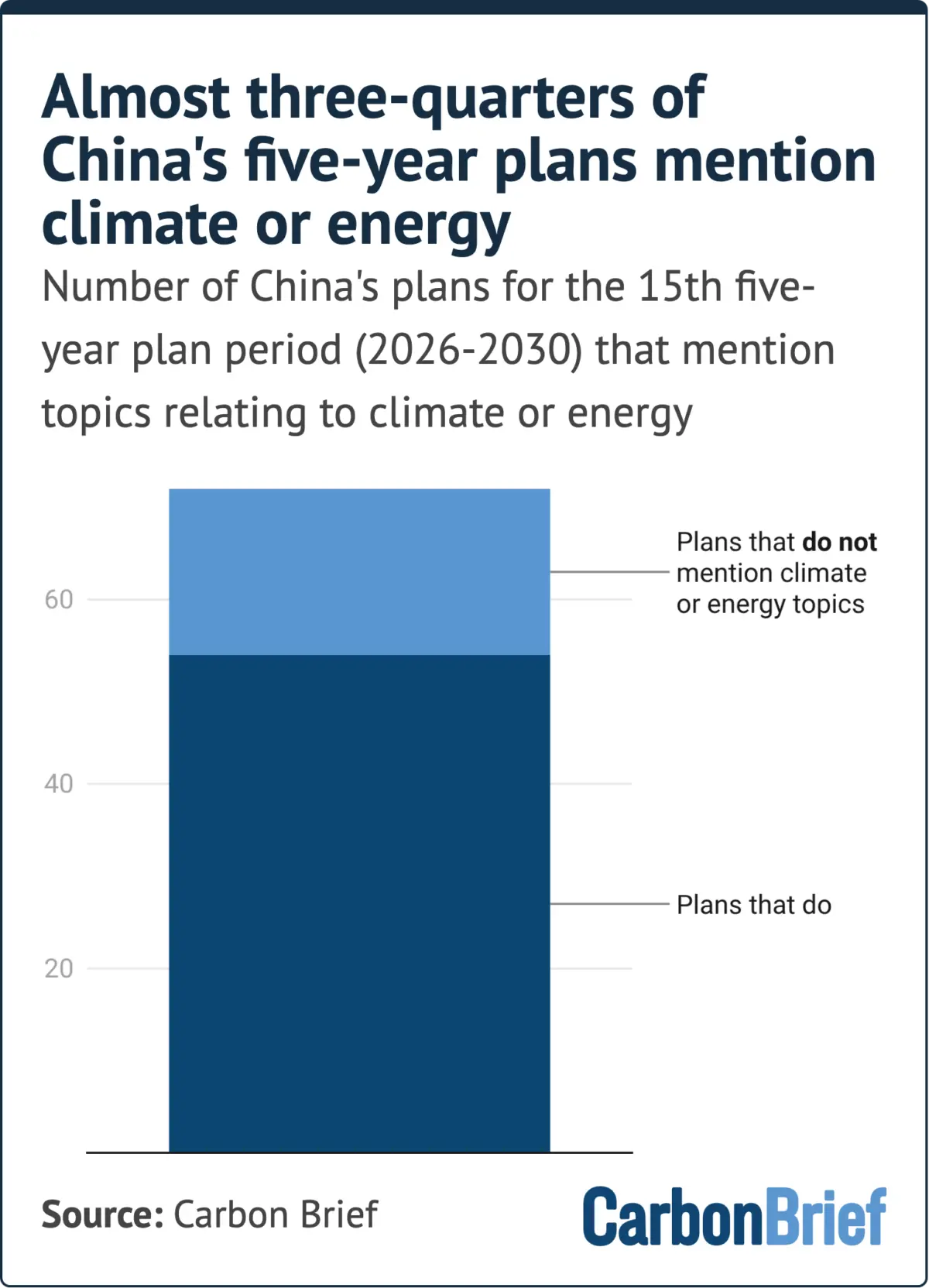
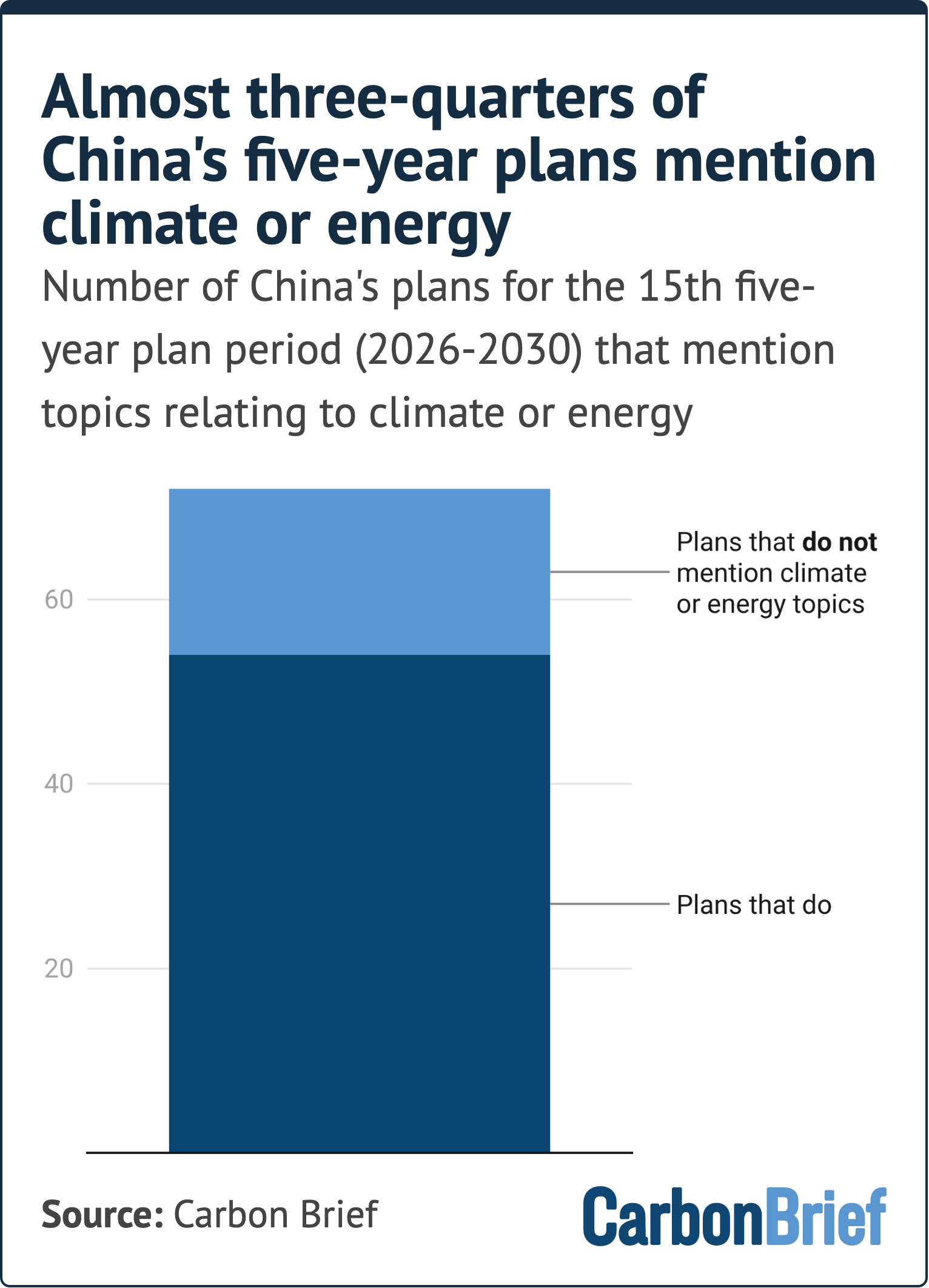
Nearly three-quarters of the 72 five-year plans published by China this year include explicit policies or targets related to climate change and energy, according to a comprehensive analysis conducted by Carbon Brief.
Five-year plans form an indispensable backbone of China’s complex policymaking machinery. They serve as critical roadmaps that signal the government’s primary overarching priorities while establishing concrete quantitative and qualitative targets for the coming years. The highest-level framework of this system, known as the 15th five-year plan, governs economic and social development across the nation for the period spanning from 2026 to 2030 and was officially published in March 2026 during the country’s annual political gatherings.
Following the rollout of this overarching blueprint, the Chinese government has steadily released a series of thematic five-year plans at the national level tailored specifically to climate action and the energy transition. These specialized administrative documents address key areas such as the rapid expansion of renewable energy generation, national strategies for responding to a changing climate, and the targeted development pathways for traditional fossil-fuel industries.
Data compiled by researchers shows that a vast majority of national-level plans not traditionally connected to environmental protection also incorporate green policies, though the depth and granularity of these measures vary significantly across different government ministries and operational sectors. Carbon Brief examined every public central-government ministry’s 15th five-year plan currently available in the public domain to scan for any references to climate change, sustainable development, and energy transition metrics.
The findings reveal that 54 out of the 72 reviewed plans feature dedicated climate policies or specific performance targets. To help analysts, policymakers, and observers navigate this complex web of regulatory documents, the organization has cataloged these findings into an interactive tracker that outlines primary goals, numerical targets, and secondary directives for each individual plan.
Navigating the Policy Tracker
Across China’s vast administrative landscape, five-year plans are deployed to steer economic growth and social development. The overarching top-level plan is published every five years in March, setting the stage by outlining high-level national priorities across all sectors. In the months and years that follow, central government bodies release dozens of granular, sector-specific blueprints that dive deep into individual industries—ranging from heavy sectors like coal mining and electric vehicle manufacturing to service-oriented fields like tourism and administrative accounting standards.
While the exact final number of plans destined for the 15th five-year cycle remains fluid as ministries continue their administrative rollouts, energy and climate experts note that the most crucial foundational documents have already been made public. The current five-year window carries immense weight for global climate diplomacy because it directly precedes China’s landmark pledge to peak its national carbon dioxide emissions before the year 2030.
The tracker categorizes the identified policies into primary goals, which are formally designated in policy texts as core objectives, and secondary initiatives. These primary targets comprise both numerical metrics and broad qualitative aims. For instance, the overarching national development plan mandates a 17% reduction in carbon intensity—defined as carbon emissions per unit of gross domestic product—over the course of the five-year timeframe.
These quantitative markers, alongside broader commitments announced prior to March 2026—such as the pledge to slash total greenhouse gas emissions to between 7% and 10% below peak levels by 2035—serve as the foundational anchor for all subsequent bureaucratic policymaking. Meanwhile, sectoral and thematic documents translate these broad national ambitions into actionable, industry-specific directives.
Qualitative primary goals are similarly integrated into specialized administrative strategies. A prominent example can be found in the national meteorological development plan, which calls for significantly enhanced capabilities in monitoring, forecasting, and early warning systems for extreme weather events, alongside major strides in comprehensive Earth system forecasting. These primary objectives are typically embedded in the opening sections of regulatory documents, either within the main narrative framework or compiled into formal tables of numerical benchmarks.
Beyond core targets, individual plan profiles also document notable secondary policies addressing climate change and energy transitions. For example, documents governing the coal industry outline detailed directives in their subsequent sections to manage production capacities and operational efficiencies. Quantitative targets within these documents generally reference 2030 as a benchmark year relative to a 2025 baseline, unless stated otherwise.
Categorizing the 15th Five-Year Plan Landscape
To simplify the vast array of documentation, the analyzed plans are sorted into several distinct functional categories. The overarching national plan sits at the pinnacle of this hierarchy, capturing the broad political consensus and top-tier targets established during the leadership meetings held in Beijing in March 2026.
Beneath the overarching framework lie core thematic plans focusing directly on the nation’s energy evolution. These documents are typically authored by influential regulatory bodies such as the National Development and Reform Commission, the National Energy Administration, and the Ministry of Ecology and Environment. Prominent entries in this category include blueprints dedicated to establishing a new-type energy system, accelerating renewable energy deployment, advancing green and low-carbon industries, reforming the power grid, and outlining the future trajectory of fossil fuels like oil, gas, and coal. Specialized industrial roadmaps also target advanced sectors, including smart and connected new energy vehicles.
In addition to traditional plans, the 2026-2030 policy landscape features specific action and implementation documents. These include dedicated strategies for carbon emission peaking during the 15th five-year period, energy conservation guidelines for public institutions, meteorological disaster prevention frameworks, and directives aimed at synchronizing the nation’s digital transformation with its green development goals.
Finally, a wide array of peripheral or non-traditional five-year plans incorporate green and low-carbon policies despite addressing subjects traditionally viewed as separate from climate and energy policy. This diverse group includes plans covering urban renewal, agricultural modernization, public health, disease prevention, transportation infrastructure, cultural heritage preservation, postal services, financial reform from the People’s Bank of China, and small- and medium-sized enterprise development.
By integrating climate metrics across such a broad spectrum of administrative documents, China’s centralized planning approach ensures that environmental considerations permeate virtually every level of government administration and industrial policy throughout the remainder of the decade.