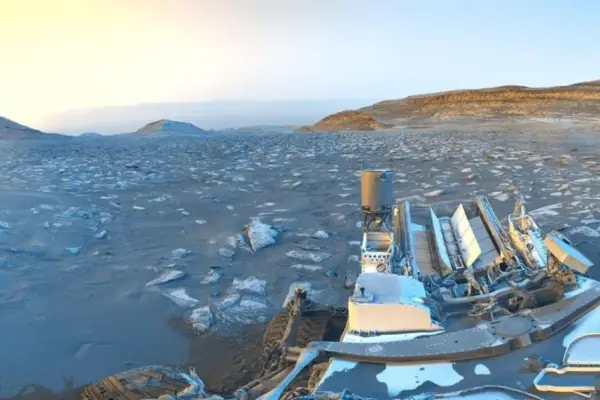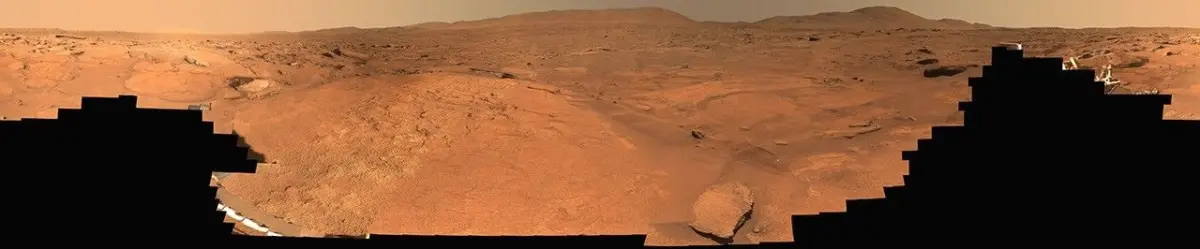
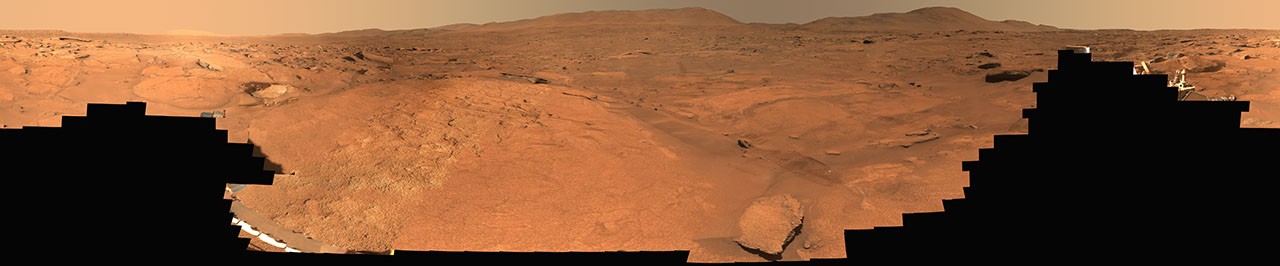
NASA’s Perseverance Mars rover has added another stunning visual milestone to its ongoing exploration of the Red Planet, capturing a breathtaking 360-degree panorama of a scientifically intriguing geologic area known as “Turquoise Bay.” Situated within a region designated by mission scientists as the “Margin Unit,” the sweeping vista offers a detailed, immersive look at the harsh yet captivating terrain that the robotic explorer continues to traverse in its search for ancient microbial life.
The sprawling panorama was meticulously assembled from an impressive mosaic of 818 individual images. These high-resolution photographs were captured by the rover’s advanced Mastcam-Z camera system over a period of nearly two weeks, specifically between October 5 and October 16, 2023. These dates correspond to the 933rd through the 944th Martian days, or sols, of the Perseverance mission. The resulting composite image showcases a vast, barren landscape defined by its distinctive reddish-orange hues, stretching outward toward distant, hazy hills on the horizon. In the immediate foreground, the jagged, mechanical silhouettes of the rover itself frame the sweeping vista, serving as a stark reminder of human ingenuity operating millions of miles away from Earth.
In addition to the standard natural-color version of the panorama, mission specialists also processed an enhanced-color variant, frequently referred to in mission documentation as Figure A. In this specially processed version, individual color bands were meticulously adjusted and refined to dramatically improve visual contrast. This technical enhancement allows researchers and the public alike to more easily accentuate subtle color variations and mineralogical differences across the Martian surface, providing critical visual data that aids in geological interpretation.
The Margin Unit, where Turquoise Bay is located, holds significant interest for the science team guiding the Perseverance mission. Geologic units like this one often provide vital clues about Mars’ ancient past, potentially preserving chemical signatures or physical structures shaped by environmental conditions billions of years ago when liquid water flowed across the planet’s surface. By studying the intricate layering, textures, and compositional diversity exposed in these marginal areas, scientists hope to piece together a more comprehensive history of the crater’s evolution and its potential to have once supported habitable environments.
The successful capture and transmission of this massive photographic mosaic highlight the ongoing technical achievements of the Perseverance mission, as well as the collaborative global efforts required to operate a complex robotic laboratory on another world. NASA’s Jet Propulsion Laboratory (JPL), a premier research and development center managed for the agency by the California Institute of Technology (Caltech) in Pasadena, California, built the Perseverance rover and continues to manage daily operations for the mission.
Meanwhile, the scientific operations of the Mastcam-Z instrument—the sophisticated camera system responsible for capturing the raw imagery behind the Turquoise Bay panorama—are led by Arizona State University. This academic leadership works in close cooperation with Malin Space Science Systems in San Diego, California, an organization that played a critical role in the design, fabrication, testing, and day-to-day operation of the powerful cameras. Furthermore, the international scope of the mission is underscored by the collaboration with the Niels Bohr Institute at the University of Copenhagen, which contributed significantly to the design, fabrication, and testing of the critical calibration targets used to ensure the accuracy of the camera systems in the harsh Martian environment.
As Perseverance continues its multi-year journey across the Jezero Crater and its surrounding formations, data products like the Turquoise Bay panorama continue to provide both invaluable scientific insight and visceral connections for a public eager to witness the exploration of the Red Planet firsthand. Space enthusiasts and researchers looking to examine the panorama in detail, along with those seeking further updates on the mission’s day-to-day discoveries, can find extensive resources, imagery archives, and mission logs through the official NASA science portal dedicated to the Mars 2020 Perseverance mission.