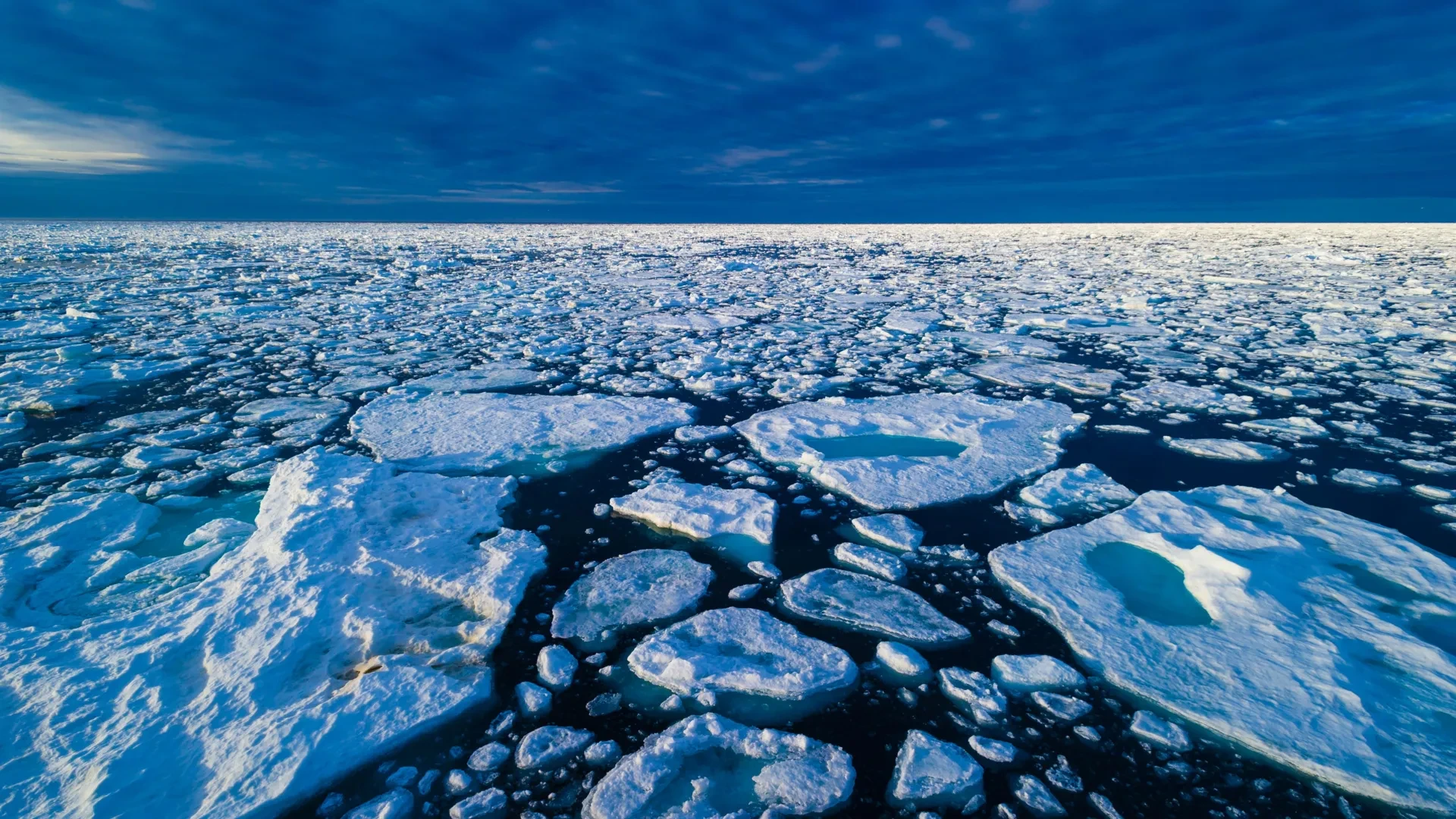
The Arctic could lose roughly one million square kilometers more winter sea ice than previously predicted by scientists, according to a major new research study that draws critical evidence from a naturally warmer Arctic period that occurred 6,000 years ago. By utilizing ancient climate records to refine and calibrate modern computer simulations, an international team of researchers has produced significantly more reliable estimates of how much frozen ocean may disappear in the coming decades as global temperatures continue to rise.
The findings, which have been published in the scientific journal Nature Geoscience, carry profound implications not only for the high northern latitudes but also for winter weather patterns across the United Kingdom and wide swaths of Europe. While much of the global scientific and public attention surrounding Arctic ice loss has historically focused on the dramatic and highly visible retreat of summer sea ice, winter ice has received considerably less scrutiny. This oversight persisted despite the fact that modern climate models display their greatest disagreements and uncertainties when attempting to predict how much ice will cover the Arctic Ocean during the darker, colder months of the year.
Why Arctic Winter Sea Ice Matters for Global Weather
Winter sea ice plays a crucial and active role in influencing global weather systems far beyond the borders of the Arctic Circle. By acting as an insulating barrier between the ocean and the atmosphere, the ice cover strictly controls how much heat and moisture can escape from the water below into the air above. When this ice cover declines or thaws prematurely, the resulting exchange of thermal energy and water vapor can fundamentally disrupt atmospheric circulation.
In recent years, declining winter ice has been increasingly associated by meteorologists with colder, more volatile winters and heightened snowfall events across the United Kingdom, northern Europe, and North America. Recent observational data has underscored just how rapidly these polar conditions are changing. In March 2025, winter sea ice reached the lowest annual maximum extent ever recorded since modern satellite monitoring began. Troublingly, the Arctic matched that bleak record yet again in 2026, reinforcing the urgency of understanding future trajectories.
To drastically improve predictions of future ice loss and clear up longstanding discrepancies, researchers at the University of Cambridge in the United Kingdom and Mexico’s Centro de Investigación en Matemáticas (CIMAT) turned their attention away from contemporary instruments and deep beneath the floor of the Arctic Ocean.
The collaborative team assembled the largest database of its kind, containing historical concentrations of a specific chemical marker produced exclusively by specialized algae that live and thrive within sea ice. The physical evidence was extracted from marine sediment cores that were deposited during the mid-Holocene epoch, approximately 6,000 years ago. During this ancient era, subtle, natural variations in Earth’s orbital geometry helped create a naturally warmer Arctic region characterized by significantly less extensive year-round ice cover.
These ancient environmental conditions offered researchers a uniquely valuable natural laboratory. By studying this historical epoch, scientists could investigate precisely how Arctic sea ice responds to sustained warming and test whether today’s sophisticated climate models are truly capable of accurately representing that complex physical response.
Ancient Ocean Sediments Reveal What Climate Models Missed
To unlock the secrets of the past, the researchers meticulously examined concentrations of a specialized organic biomarker known as IP25, which is synthesized uniquely by sea-ice algae. They combined these chemical measurements with other complementary chemical markers left behind by microscopic organisms that lived in open water, allowing them to reconstruct historical Arctic ice conditions with remarkable fidelity thousands of years before the advent of industrial instrumentation.
Next, the team compared those empirical environmental reconstructions directly against numerical simulations generated by 27 different state-of-the-art climate models for the exact same ancient period.
To bridge the gap between historical reality and computer theory, the researchers implemented a sophisticated statistical technique known as Bayesian weighting. Through this method, they assigned greater statistical importance and influence to individual climate models whose outputs closely matched the physical evidence preserved in the sediment cores. Conversely, models that performed less accurately and failed to reflect historical realities received correspondingly less influence over the final predictive outcomes.
Because the fundamental physical processes that control sea ice formation, growth, and melt remain consistent across different climatic conditions and epochs, the team could justifiably apply these exact same model weights to simulations of both the recent past and the projected future.
The comparison quickly revealed a significant and systemic flaw within contemporary climate forecasting: collectively, the unweighted climate models predicted far more winter sea ice than the ancient geological evidence actually supported.
"When we apply the model weights to historical simulations, we completely eliminated the positive bias," said lead author Crystal Fu, a researcher from Cambridge’s Scott Polar Research Institute and a member of Girton College. "The future projections similarly end up being lower than previous estimates, by about a million square kilometers."
More Accurate Arctic Ice Forecasts Reduce Uncertainty by 85%
For decades, scientists have successfully collected a massive body of evidence concerning Earth’s ancient climates, known as paleoclimate records. However, translating that historical information into reliable, actionable forecasts for the future has remained a formidable scientific challenge. Both historical reconstructions and future climate simulations inherently contain varying degrees of uncertainty that complicate direct, side-by-side comparisons.
"The scientific community has amassed lots of paleoclimate records over recent decades, but it’s remained a challenge to directly link these records to future projections, since there is uncertainty at both ends," Fu explained.
By introducing their innovative statistical weighting approach, the research team substantially narrowed those stubborn uncertainties. In some of their specific projections, the new methodology successfully reduced the range of possible future outcomes by as much as an impressive 85 percent.
"By using evidence from the past, we can now produce more reliable maps of where Arctic winter sea ice is likely to disappear," said co-author Marco Aquino-López of CIMAT. "These give us a much clearer picture of what the Arctic might look like in the coming decades, and how much uncertainty remains."
Although the prominent warming that occurred during the mid-Holocene epoch was driven primarily by natural changes in Earth’s orbit rather than the greenhouse gas emissions responsible for today’s anthropogenic climate change, Fu emphasized that the physical response of sea ice to rising temperatures strictly follows the same basic physical principles.
"It doesn’t matter if the warming is natural variation or caused by human activity: if it warms, sea ice is going to melt," she noted.
Arctic Ice Loss Could Have Wider Consequences for Europe
The profound implications of this study extend well beyond the physical disappearance of Arctic sea ice itself. When the researchers applied their newly calibrated model weighting system to broader global projections of precipitation and atmospheric moisture, they uncovered troubling indications that current standard climate models may also be underestimating future weather extremes. Specifically, the data points toward underestimated future snowfall in southeastern Greenland and significantly heavier rainfall across the Mediterranean basin.
Greater and more persistent snowfall accumulating over the Greenland ice sheet could introduce complex new variables affecting the stability and mass balance of the massive ice sheet. Meanwhile, increased Mediterranean rainfall could substantially influence future flooding risks, agricultural planning, and water resource management across southern Europe.
These potential cascading effects suggest that the overall environmental consequences of a warming Arctic may be far more extensive and geographically diverse than existing mainstream predictions currently indicate. By refining the baseline computer simulations, the revised research offers climate scientists a much clearer, more rigorous foundation for investigating these complex risks and understanding how rapidly changing polar conditions will continue to reshape weather systems across the globe.
The research study received partial financial support from the US National Science Foundation and the Cambridge Trust.