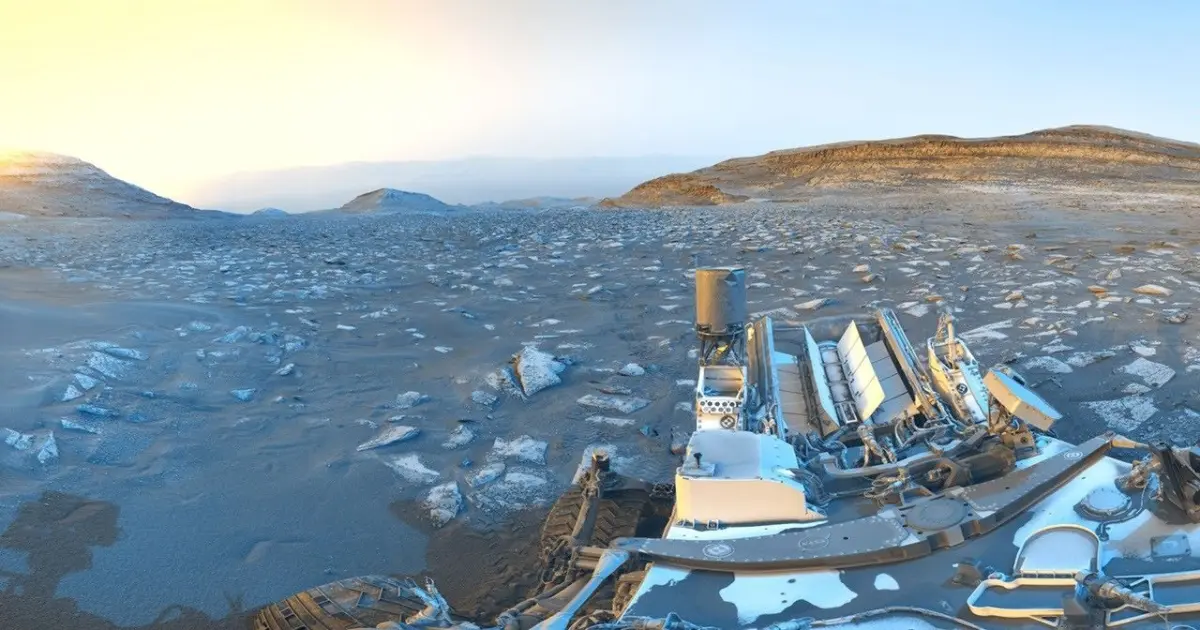
NASA’s hardworking Curiosity Mars rover has reached another monumental milestone in its historic exploration of the Red Planet. While parked at a distinctive sand ridge affectionately nicknamed “Chocolatal,” the robotic explorer paused its scientific operations to capture a rare and visually arresting dual-time panorama of the Martian landscape. The resulting image, meticulously crafted by mission scientists on Earth, offers a unique perspective on the passage of a Martian day—known as a sol—framed by the rugged, desert-like terrain of Gale Crater.
The breathtaking scene was compiled from black-and-white navigation camera images captured at two distinct times of day. The first segment of the panorama was recorded on August 30, 2026, at precisely 9:56 a.m. local Mars time, capturing the crisp light of the Martian morning. Just a few days later, on September 2, 2026, at 5:39 p.m. local Mars time, the rover turned its cameras outward once more to record the fading illumination of the late afternoon. Coincidentally and fittingly, these two dates marked the 5,000th and 5,003rd Martian days, respectively, of Curiosity’s long-running and highly successful surface mission.
Merging Worlds: Art Meets Science on the Red Planet
After the raw imaging data was successfully transmitted across millions of miles of interplanetary space back to Earth, mission specialists at NASA’s Jet Propulsion Laboratory merged the two separate panoramas into a single, cohesive composition. To help human eyes easily distinguish between the morning and afternoon lighting conditions, an artistic color treatment was applied to the composite image. In this carefully calibrated visualization, cool blue hues represent the morning panorama, while warm yellow tones signify the afternoon portion of the day.
The resulting artifact is a stunning “postcard” from the surface of Mars, following in the footsteps of previous artistic composites created by mission teams. Among the most notable predecessors is a similar dual-time vista captured by the rover in November 2021. These artistic interpretations do more than just showcase the stark beauty of the Martian environment; they provide scientists and the public alike with an intuitive sense of how sunlight shifts and shadows stretch across the planet’s surface as the sun arcs across the sky and dips toward the horizon.
A Detailed View of the Rover’s Home and Hardware
In the foreground of the newly released panorama, the complex anatomy of the Curiosity rover itself is laid out in sharp detail. Viewers can clearly observe the rover’s metallic deck, which is peppered with the dust and grit of a harsh foreign world. Prominently visible is the can-shaped Ultra High Frequency (UHF) antenna, a critical piece of hardware utilized by the mission to beam high-volume scientific data and imagery back up to orbiting spacecraft, which then relay the information home to Earth.
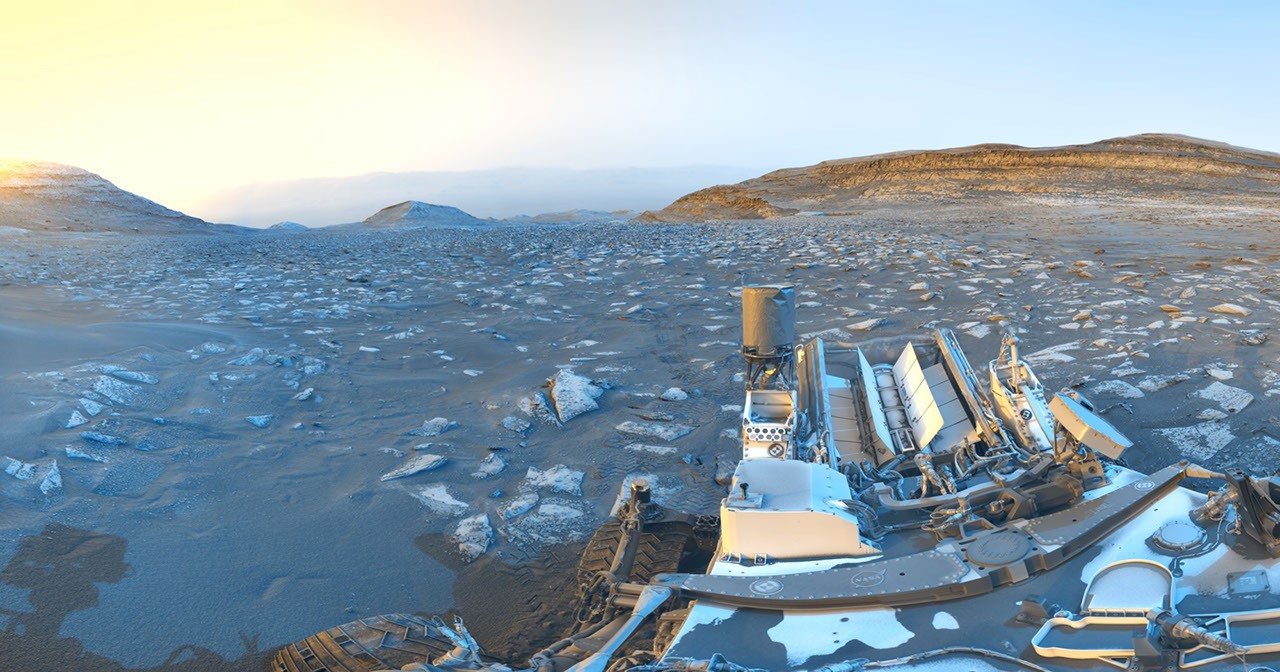
Also visible near the rear of the vehicle is its finned Multi-Mission Radioisotope Thermoelectric Generator (MMRTG). This nuclear power source has reliably sustained Curiosity through more than a decade of freezing Martian nights and demanding geological investigations by converting the heat generated by the natural radioactive decay of plutonium dioxide into steady electricity. Stretching away from the stationary robot, deep tracks carved into the sandy soil by its six aluminum wheels can be seen trailing off into the distance, bearing silent witness to the painstaking journey that brought the rover to this exact spot.
Exploring the Foothills of Mount Sharp
At the time the images were captured, Curiosity was positioned deep within the lower foothills of Mount Sharp, a massive, towering mountain that rises roughly 3 miles, or 5 kilometers, into the thin Martian atmosphere from the center of Gale Crater. The panoramic viewpoint looks outward and downward toward the broader floor of the ancient impact basin, where the distant rim of the crater appears as a faint, barely perceptible line along the hazy horizon.
This location is part of a multi-year scientific campaign designed to study sedimentary layers that record how liquid water once shaped the region billions of years ago. By analyzing the mineral compositions, rock textures, and structural strata found along the lower slopes of Mount Sharp, researchers hope to continue piecing together the environmental history of early Mars and determine how habitable conditions gradually gave way to the arid, desert landscape seen today.
The Curiosity rover was designed, engineered, and built by NASA’s Jet Propulsion Laboratory, a division of Caltech located in Pasadena, California. JPL manages the ongoing mission on behalf of NASA’s Science Mission Directorate in Washington, operating as a key flagship project within the broader framework of NASA’s Mars Exploration Program.