The data science interview has undergone a more radical transformation over the past two years than it did across the preceding five. For professionals who prepared for technical evaluations in 2023 or 2024 and are now re-entering the job market, the traditional formats and expectations they practiced for may no longer align with what hiring managers actually test in live loops.
Industry analysts point out that some of these shifts are structural, altering how companies evaluate technical competence. Take-home assignments have evolved significantly, artificial intelligence tools are now explicitly integrated into live coding rounds at many organizations, and machine learning system design questions that were once reserved strictly for senior-level candidates are now regularly appearing at the mid-level. Other changes are entirely topical, driven by the rapid mainstream adoption of generative artificial intelligence and large language models. Evaluation questions centered on large language models have crystallized into their own distinct interview category, while behavioral rounds increasingly probe how candidates manage and validate AI-generated outputs rather than simply testing how they handle ambiguous datasets.
At the same time, broader economic pressures and a tighter talent market have left their mark on the hiring landscape. Interview processes frequently run longer, involve more rounds of evaluation, and demand a substantially higher baseline for performance in system design and business case assessments.
Despite these structural and topical shifts, core competencies remain steadfast. SQL fluency is as critical as ever and is often tested with greater rigor. Statistical reasoning and experimental design, particularly A/B testing, remain absolute prerequisites for the role. Furthermore, the ability to translate complex analytical findings into clear, actionable insights for non-technical stakeholders continues to be one of the most frequently cited differentiators between candidates who receive job offers and those who walk away empty-handed.
The Modern Data Science Interview Loop
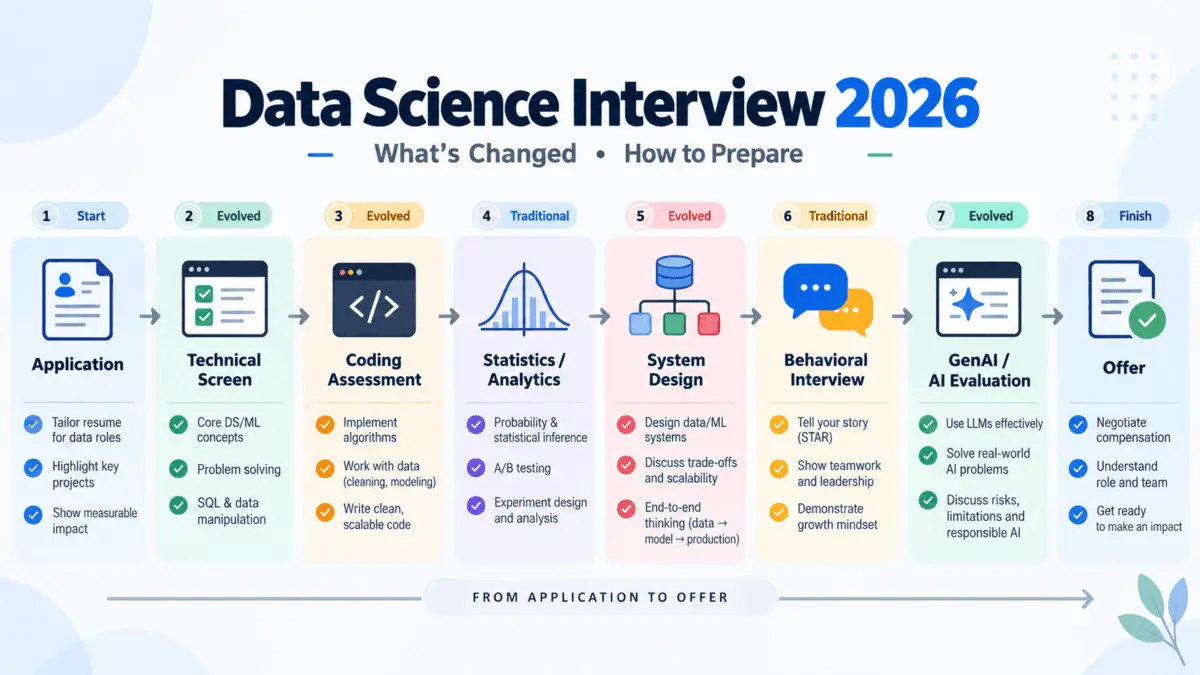
At a mid-size to large technology company, a standard data science interview loop in 2026 typically spans four to six rounds conducted over a period of two to four weeks. While the exact combination of interviews varies depending on the specific company culture and the nuances of the role, most hiring processes incorporate several familiar stages.
The journey usually begins with a recruiter screen lasting thirty to forty-five minutes, focusing on background, professional motivation, compensation expectations, and interview timelines. While this phase remains conceptually similar to past years, the bar for narrative clarity has risen noticeably. Interviewers frequently flag candidates who fail to deliver a concise, ninety-second summary detailing their career progression and the specific factors drawing them to the position. Vague responses regarding an interest in general problem-solving no longer resonate with hiring teams.
Candidates who clear the initial screen generally face a technical coding round lasting forty-five to ninety minutes, typically centered on SQL and Python within a shared live coding environment. This is followed by a statistics and machine learning fundamentals round lasting up to ninety minutes, which measures conceptual depth, model selection judgment, and reasoning behind evaluation metrics. Statistical inference, A/B testing frameworks, and the ability to diagnose model failure modes are staples of this phase.
As candidates progress, they often encounter a machine learning system design round lasting between forty-five and seventy-five minutes. This component evaluates the ability to design an end-to-end production machine learning architecture and has expanded downward to impact mid-level loops far more frequently than in previous years. Parallel to this is the business case or product sense round, which measures a candidate’s capacity to translate amorphous business challenges into structured data problems, define relevant metrics, and explain technical outputs to business leaders.
Finally, behavioral rounds lasting thirty to sixty minutes utilize situational questioning to explore collaboration, ambiguity, stakeholder conflict, and increasingly, scenarios involving unexpected model behaviors or AI-generated outputs. For roles specifically tailored to generative AI, an additional dedicated evaluation round tests the candidate’s proficiency in designing and implementing robust evaluation frameworks for large language models.
Structural and Topical Shifts in the Hiring Process
The most visible structural change in the 2026 hiring environment is the integration of artificial intelligence tools into technical interviews. The blanket prohibition on tools that governed coding rounds for over a decade has fractured into distinct formats. Proctored no-tools rounds remain standard at many large enterprises where interviewers wish to evaluate independent reasoning without AI assistance, though these tests now place less emphasis on memorizing syntax and more on explaining the architectural rationale behind choosing specific analytical methods.
Conversely, a growing share of employers explicitly permit AI tools during at least one interview stage. In these assisted rounds, the evaluation philosophy flips entirely. Interviewers operate under the assumption that working code can be generated quickly, choosing instead to observe how candidates verify, troubleshoot, and explain the code they produce. Candidates who blindly accept AI-generated suggestions without screening for edge cases or logic flaws typically fail these sessions.
Take-home assignments have undergone a similar evolution. Because automated assistants can generate polished preliminary analyses rapidly, traditional take-homes have lost some of their independent signal value. Consequently, companies have responded either by replacing them with live collaborative coding sessions or by supplementing them with mandatory live defense meetings, where candidates must explain their submissions, justify their design choices, and adapt their work to new constraints introduced on the spot.
Concurrently, coding questions themselves have become AI-resistant. Rather than asking candidates to build a solution from a blank editor, interviewers frequently present AI-generated code containing subtle bugs or suboptimal logic, tasking the candidate with debugging, explaining, and refining the work. This approach emphasizes analytical comprehension and code literacy over raw implementation speed.
In the realm of infrastructure and architecture, machine learning system design has shifted downstream. Mid-level engineers are now routinely expected to own the complete lifecycle of a model, prompting system design questions that test end-to-end architecture from business goals to monitoring pipelines. Furthermore, the proliferation of large language models has introduced specialized demands, such as designing evaluation frameworks for conversational assistants, orchestrating vector databases, and managing retrieval-augmented generation architectures while accounting for latency, hallucinations, and operational costs.
Behavioral evaluations have adapted to these technological realities as well. Hiring managers now actively probe for practical experiences involving operational judgment, asking candidates to recount instances where they had to override flawed model predictions, audit AI-generated insights for hidden biases, or communicate the inherent uncertainties of machine learning systems to skeptical cross-functional partners.
The Enduring Value of Core Foundations
Despite the expanding scope of technical requirements, foundational competencies remain entirely non-negotiable for success in the modern job market.
SQL proficiency is tested with renewed rigor, requiring candidates to demonstrate advanced command of window functions, common table expressions, query optimization, and schema navigation across diverse cloud-native data warehouses. Similarly, statistical reasoning and experimental design remain pillars of the evaluation process. A candidate’s ability to articulate the nuances of hypothesis testing, manage statistical power, and navigate the complexities of A/B testing is as vital as ever, regardless of how conversant they may be with modern neural architectures.
Business acumen and product sense continue to reward the same fundamental skills: the ability to structure messy business problems into tractable data definitions, select appropriate success metrics, and communicate findings effectively to non-technical audiences. Ultimately, as automated systems become more adept at generating code and executing routine analyses, the ability to think critically, communicate transparently, and articulate the reasoning behind technical decisions has emerged as the definitive marker of a competitive data science professional.