Unusual and powerful weather patterns high above Antarctica caused the seasonal ozone hole to expand dramatically in 2026, swelling to rank among the largest sizes recorded in nearly half a century of observation. Despite the striking physical extent of the depletion, leading atmospheric scientists from NASA and the National Oceanic and Atmospheric Administration (NOAA) emphasize that Earth’s protective ozone layer is continuing its long-term, gradual recovery and remains firmly on target to heal fully later this century.
The Antarctic ozone hole for 2026 was officially ranked as the seventh-largest observed over 48 years of continuous monitoring, evaluated by its average seasonal area. Researchers attribute this unexpected and substantial expansion primarily to an exceptionally robust polar vortex—a massive, spinning belt of high-altitude winds that heavily dictates atmospheric conditions and temperatures over the South Pole. At the same time, experts were quick to emphasize that decades of international cooperation to curb and eliminate harmful chemicals have successfully prevented the atmospheric tear from expanding to even more catastrophic proportions.
Between September 7 and October 13, 2026, a timeframe that traditionally marks the peak period of seasonal ozone depletion, the hole covered an average expanse of approximately 9.6 million square miles, or 25 million square kilometers. To put that vast surface area into perspective, it measures more than twice the total landmass of the United States. Scientists continuously and closely monitor ozone concentrations in the stratosphere because the layer acts as Earth’s natural planetary "sunscreen," filtering out and absorbing dangerous ultraviolet solar radiation that can harm living organisms across the globe. By contrast, ozone located closer to Earth’s surface functions as a harmful pollutant frequently generated by human industrial and urban activities.
Antarctica’s Ozone Hole Reaches Its Largest Size in a Decade
During the height of the 2026 depletion cycle, the ozone hole reached its maximum single-day extent on September 18, stretching across an enormous 10.5 million square miles, or 27.1 million square kilometers. This peak measurement reached approximately 90 percent of the size of the absolute largest ozone hole ever recorded in human history, which occurred on September 9, 2000.
"The annual ozone hole has been forming later in the season in recent years, which tells us the ozone layer is healing," said Paul Newman, a senior scientist at the University of Maryland and longtime leader of NASA’s ozone research team at the agency’s Goddard Space Flight Center. "But an unusually powerful polar vortex has extended ozone depletion in the Antarctic this season, allowing the hole to grow to proportions we haven’t seen in a decade."
Although the atmospheric phenomenon expanded to an extraordinary degree, the outcome simultaneously underscores the undeniable benefits yielded by decades of strict international environmental protections. Without aggressive, global reductions in the industrial chemicals known to actively destroy ozone molecules, the affected geographic area during the 2026 season could have been substantially greater.
"The 2026 ozone hole is large but could have been 1 to 2 million square miles, or about 3.5 million square kilometers, larger if ozone-depleting substances were as prevalent in the atmosphere today as they were at their year 2000 peak," Newman noted.
How a Powerful Polar Vortex Accelerates Ozone Loss
The complex scientific process of ozone depletion begins with persistent chemical compounds released through human activities, most notably industrial compounds containing chlorine and bromine. Atmospheric wind currents transport these durable chemical substances upward into the stratosphere, where harsh ultraviolet solar radiation breaks the molecules apart. The newly liberated chlorine and bromine atoms then aggressively participate in destructive chemical reactions involving icy particles found inside Antarctic stratospheric clouds, culminating in the widespread destruction of ozone molecules.
A major driving factor in this annual cycle is the stratospheric polar vortex, a powerful seasonal band of high-speed winds that circles the Antarctic continent year after year. This colossal atmospheric circulation traps extremely cold air directly over the polar region, enabling the formation of specialized polar stratospheric clouds that serve as the catalyst for rapid ozone destruction. When the polar vortex becomes unusually strong, stable, or expansive, the physical conditions favorable for severe ozone loss can persist across a much larger geographic territory.
In 2026, the atmospheric disturbances and planetary waves that would normally disrupt and weaken the vortex were uncharacteristically subdued. This absence of normal atmospheric friction allowed the circulation to remain exceptionally powerful, helping to forge a broader, uninterrupted region where atmospheric ozone could be systematically degraded.
"The polar vortex was unusually large this year in part because planetary-scale weather systems that typically well up from the lower atmosphere and break up the vortex were especially weak in August and September," explained Amy Butler, a research scientist at the NOAA Chemical Sciences Laboratory. "That weak wave action kept the strongest polar vortex winds further from the South Pole by several degrees of latitude, creating a larger area for conditions ideal for ozone depletion to occur."
NASA and NOAA Measure the 2026 Ozone Hole
Despite its remarkable geographic size, the 2026 ozone hole did not ultimately experience the exact same extreme, record-shattering depths of chemical ozone loss that scientists documented during severe events ten or twenty years earlier.
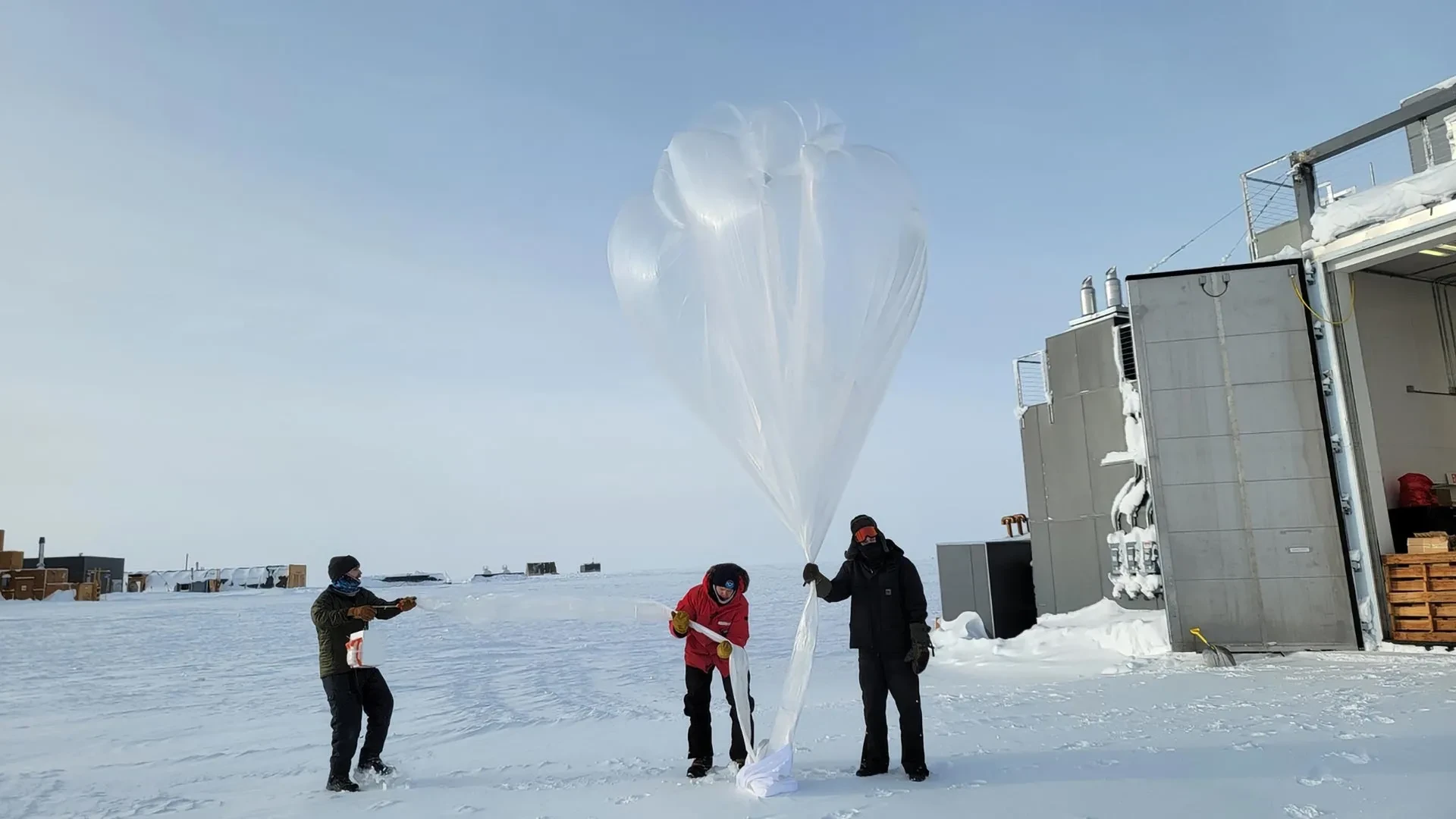
To precisely measure fluctuating ozone concentrations in the frigid air, NOAA field researchers launched specialized instruments attached to heavy-duty weather balloons directly from the South Pole Baseline Atmospheric Observatory. They additionally gathered meticulous readings utilizing the Dobson Ozone Spectrophotometer, a precise optical instrument specifically designed to measure total column atmospheric ozone from the ground. Their combined observations revealed that ozone levels directly above the South Pole fell to their lowest reading of the 2026 season on October 17, bottoming out at 105 Dobson units.
The Dobson unit serves as the international standard measurement used to describe the total amount of ozone present in an imaginary column of air stretching from the ground up to space. To illustrate the physical scale, a reading of 100 Dobson units would produce a microscopic layer of pure ozone just one millimeter thick—roughly equivalent to the physical thickness of a standard dime—if all the ozone in that atmospheric column were compressed to standard temperature and pressure at sea level. For historical comparison, the absolute lowest ozone concentration ever measured directly over the South Pole was a meager 92 Dobson units recorded back in October 2006.
Orbiting satellites provide another vital, continuous source of global information. Since 1979, sophisticated spaceborne instruments have helped researchers observe minute changes in the ozone layer and track its long-term condition over time. The comprehensive 2026 measurements relied heavily on high-resolution data transmitted from NASA’s Aura satellite, NOAA-20, NOAA-21, and the Suomi National Polar-orbiting Partnership satellite, which operates as a joint mission between NASA and NOAA.
Why Earth’s Ozone Layer Is Still Recovering
Atmospheric scientists emphasize that the latest observational data reinforce mounting evidence that international restrictions on ozone-destroying chemicals are working as intended. Much of this historical progress can be directly traced back to the Montreal Protocol, a landmark global environmental treaty adopted in 1987 to systematically phase out the industrial substances responsible for damaging the stratosphere.
Under the terms of the binding agreement, participating countries committed to replacing harmful synthetic compounds, such as chlorofluorocarbons (CFCs), with alternative substances that pose significantly less danger to atmospheric ozone. According to Stephen Montzka, a senior scientist at NOAA’s Global Monitoring Laboratory, chlorine concentrations in the Antarctic stratosphere associated with these ozone-depleting chemicals have declined by approximately one-third when compared against their maximum peak levels recorded during the 1980s.
These downward trends are highly significant because chlorofluorocarbons and related ozone-depleting compounds were once ubiquitous in everyday products, including household refrigerators, commercial air conditioning systems, building insulation materials, and numerous other manufacturing applications. Although the vast majority of these substances have long been phased out of production, they remain chemically stable and can linger in the upper atmosphere for decades. Additional trace emissions can also occasionally occur when older, discarded equipment, building materials, and decomposing landfill waste slowly release chemical reservoirs that were manufactured many years prior.
Because these synthetic compounds break down exceptionally slowly in the natural environment, repairing the global ozone layer is a painstaking process that requires many decades. Nevertheless, continued, rigorous monitoring by both NASA and NOAA indicates that the broader long-term recovery remains firmly on schedule. Even when facing unusual seasonal disruptions and large-scale atmospheric anomalies like the one observed in 2026, scientists remain confident that the Antarctic ozone hole will fully recover sometime around the 2070s.
The latest findings vividly illustrate how exceptional, temporary weather conditions in the stratosphere can produce severe seasonal ozone depletion without reversing decades of steady environmental progress. They also serve as a powerful reminder of the lasting, positive impact of global scientific cooperation in safeguarding Earth’s atmosphere for future generations.