Aviation is on track to be responsible for a staggering 80% of the United Kingdom’s entire carbon dioxide emissions by the middle of the century, according to a stark new assessment from the Climate Change Committee (CCC). The warning comes as the advisory body delivers crucial guidance to the government regarding future aviation policy, highlighting a glaring disconnect between the nation’s legally binding climate commitments and the trajectory of the aviation industry.
While virtually every other sector of the UK economy has successfully driven down its carbon footprint, emissions from flying have more than doubled since 1990. This upward trend has been fueled primarily by rising passenger numbers. Despite this divergence from national decarbonization progress, the UK government has signaled its ongoing support for major infrastructure projects, including the expansion of Heathrow Airport—the nation’s largest aviation hub.
In its official guidance, the CCC cautioned that the UK currently lacks credible policies to reverse the trajectory of rising aviation emissions. The committee warns that expanding Heathrow would only compound an already critical challenge, directly undermining the country’s path toward its net-zero emissions target.
The Shrinking Carbon Budget and the Impact of Heathrow Expansion
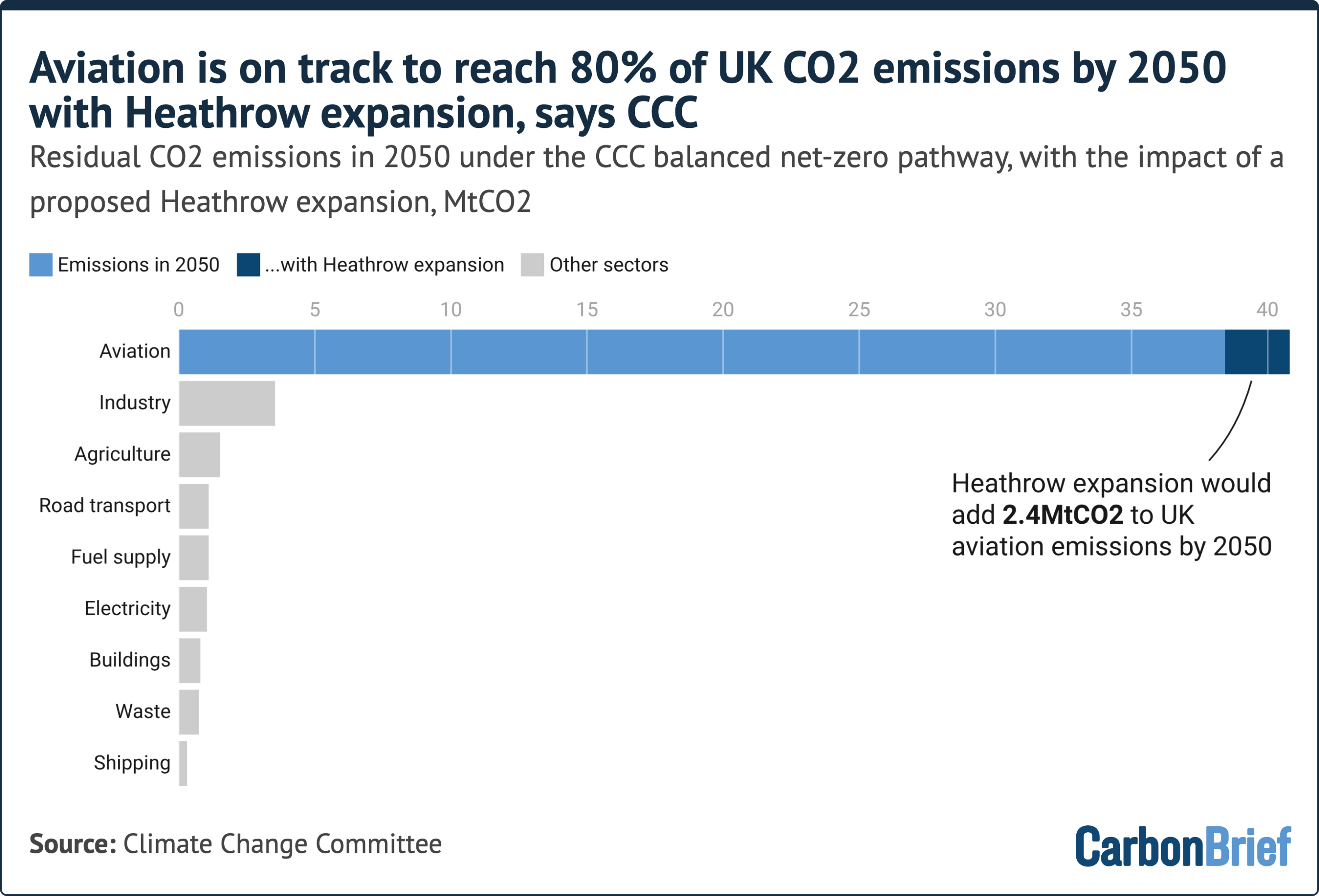
Under the CCC’s balanced pathway to net-zero, any remaining carbon dioxide emissions produced across the UK economy by 2050 must be actively removed from the atmosphere to achieve a net-zero balance. However, even if Heathrow Airport is not expanded, aviation emissions are projected to reach 38 million tonnes of CO2 (MtCO2) annually by 2050, matching or exceeding current output levels and swallowing up the vast majority of the nation’s total residual carbon budget.
Adding a Heathrow expansion to this equation would push emissions even higher, injecting an additional 2.4MtCO2 into the atmosphere by 2050. This single expansion project would account for approximately 5% of all UK emissions. Once the expansion is fully complete and operational by 2054, that specific contribution is projected to rise to 4.5MtCO2.
With a final, formal decision on the Heathrow expansion project anticipated by 2029, the government formally asked the CCC to evaluate whether the multi-billion-pound proposal is compatible with national climate targets. The committee’s conclusion is unequivocal: the existing policy framework is fundamentally inadequate, and proceeding with expansion under current conditions makes meeting legal climate obligations nearly impossible.
During a media briefing discussing the findings, CCC chair Nigel Topping addressed journalists directly, emphasizing the gravity of the situation. "The UK does not currently have a credible plan to reduce aviation emissions in line with net-zero, so that creates a serious challenge for meeting our climate commitments," Topping said.
Moving Past Unrealistic Techno-Fixes
The previous Conservative government launched the "jet-zero strategy" in 2022, outlining a roadmap intended to curb the environmental impact of commercial flights. However, the current Labour government has since acknowledged that the strategy’s core assumptions were overly optimistic. Specifically, official expectations regarding the rapid scaling of sustainable aviation fuels (SAFs), the introduction of electric commercial aircraft, and aggressive fuel-efficiency improvements have proven unrealistic.
Instead of enacting strict demand-management policies, successive administrations have heavily relied on what critics describe as unproven "techno-fixes." While sustainable aviation fuels and alternative technologies will play a role in future mitigation, the CCC emphasizes that these solutions are not currently advancing fast enough to bridge the emissions gap.
To correct course, the CCC recommends that a revised and far more robust net-zero policy framework for aviation be established within a newly planned strategy slated for 2027. The committee insists that only through such a framework could any future airport expansion realistically be aligned with the UK’s net-zero goals.
Central to this new strategy, the CCC argues, is the fundamental principle that the aviation sector needs to take direct responsibility for its environmental impact. Policies must be anchored in the "polluter pays" principle, requiring airlines and the broader aviation industry to financially support and secure their own sustainable fuels and necessary carbon dioxide removal measures.
The Cost of Decarbonization and the "Polluter Pays" Principle
To neutralize residual emissions from flights that cannot be powered directly by electricity or hydrogen in the coming decades, the CCC highlights the necessity of engineered carbon removal technologies. These include methods such as direct air carbon capture and storage (DACCS), which pulls carbon dioxide directly out of the ambient air and permanently stores it underground.

While natural solutions like mass tree planting are vital for national climate goals, the CCC notes that natural removals within the UK are already earmarked to offset remaining methane and nitrous oxide emissions from domestic livestock agriculture. Consequently, engineered removals will be strictly required to handle the persistent CO2 footprint generated by international and domestic flights.
The committee acknowledges that these advanced engineered technologies are not yet available at the commercial scale required. Furthermore, forcing airlines to internalize the true cost of their emissions and fund these mitigation measures will inevitably drive up the cost of flying.
Economic modeling conducted by the CCC estimates that incorporating these decarbonization and removal costs could significantly raise ticket prices by 2050. In terms of 2024 monetary value, a standard return trip from the UK to Alicante, Spain, could see an increase of roughly £150, while a return flight to New York could rise by as much as £400.
Despite the likelihood of consumer pushback and airline opposition, the committee argues that passing these costs onto passengers is vastly preferable to funding decarbonization through public taxation. Relying on the public purse would mean that roughly 50% of the UK population—citizens who do not fly—would end up subsidizing the carbon removal costs generated exclusively by travelers.
Moreover, the CCC points out that higher ticket prices driven by environmental accounting would naturally serve a dual purpose. By reflecting the true ecological cost of aviation, these increased costs would help manage soaring consumer demand for flights, which would otherwise continue to grow unchecked throughout the decades ahead and place an impossible burden on the UK’s shared climate future.