In the modern digital workspace, the prevailing corporate ethos has long been the relentless elimination of friction. Every software update, productivity tool, and workflow optimization is seemingly designed to streamline processes, shave seconds off tasks, and automate the tedious mechanics of getting things done. Yet, as artificial intelligence rapidly revolutionizes content creation, data visualization, and professional communication, industry experts are beginning to question whether the total eradication of friction might actually be harming our capacity for deep, strategic thought.
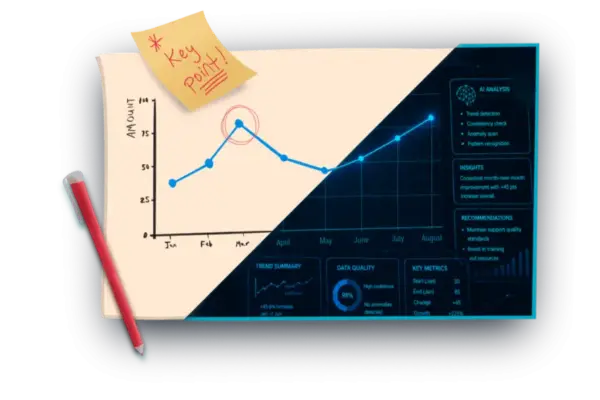
Long before opening a spreadsheet, firing up a design application, or prompting an AI model, professionals are increasingly advised to start analog. Gathering a team around a physical whiteboard, reaching for a pen and paper, or relying on low-tech tools like sticky notes forces a foundational clarity. This analog phase requires teams to confront core questions: Who is the audience? What specific decision is the communication trying to support? What concrete action needs to be driven as a result?
This foundational planning phase highlights the complex and often misunderstood role of friction in professional workflows. In the classic sense, friction slows people down, which is universally undesirable when it manifests as confusing graphs, cluttered presentation slides, and an unclear narrative structure. Throughout the modern business landscape, professionals have dedicated entire careers to removing this kind of unhelpful friction. If generative artificial intelligence can assist in eliminating these mechanical hurdles—automating the layout of charts or cleaning up design inconsistencies—it offers a welcome efficiency boost.
However, a distinct and vital category exists known as productive friction. This is the deliberate resistance that forces individuals to think more critically and clearly before they attempt to communicate complex ideas. When a person moves a physical pen across paper, literal friction occurs, slowing down the creative and analytical process in highly useful ways. It provides the necessary mental space to evaluate what truly matters, question underlying data sources, and determine which strategic actions actually make sense.
This dynamic echoes historical shifts in specialized fields, such as cartography. Over recent decades, the technological landscape of mapmaking has undergone a radical transformation. In earlier eras, the physical materials required to make a map were scarce and expensive, necessitating an incredible amount of rigorous planning long before a cartographer ever put pen to paper. The advent of Geographic Information Systems and digital mapping tools democratized the discipline, allowing virtually anyone to generate a map instantly. Yet, while the production barrier fell away, the initial planning phase remained just as vital for creating an effective, accurate map. The challenge was never merely about the materials; it was about the underlying thinking.
Artificial intelligence is currently driving a similar transformation on a vastly broader scale across nearly every industry. AI excels at removing production friction—the mechanical labor of building graphs, drafting reports, and assembling slide decks. That capability is undeniably powerful. However, it also lowers the barrier to entry so significantly that it becomes remarkably easy to bypass the most crucial step of all: rigorous thought.
The ultimate goal in the age of AI should not be to eliminate friction entirely. Instead, professionals must focus on removing the technical hurdles that get in the way of productivity while deliberately preserving the cognitive friction that fosters better decision-making. The technology should enhance human capability, not replace critical evaluation.
While AI Accelerates Production, Humans Still Own Judgment and Responsibility
This underlying tension between sheer operational speed and human judgment sits at the heart of contemporary professional challenges. Artificial intelligence is exceptionally powerful at generating options, eliminating the intimidating blank page, and accelerating early-stage exploration. These are overwhelmingly positive developments for modern workflows. Yet, someone within the organization still has to exercise oversight, determine what is genuinely worth focusing on, and validate the final direction.
This phenomenon is not entirely unprecedented in the history of enterprise technology. Organizations have repeatedly looked to silver-bullet solutions to solve complex operational challenges. There was a time, not so long ago, when companies believed that simply hiring data scientists would automatically solve all their data-related problems. Before that wave, the corporate panacea was the executive dashboard. While technical expertise and advanced tooling remain critical, neither approach directly resolved the underlying human communication gap. An organization can generate all the insights in the world, but if stakeholders do not understand those insights or know how to act upon them, nothing changes.
In this environment, the effective data storyteller bridges the gap between raw insight and decisive action. That crucial bridging role applies just as much to the era of artificial intelligence as it did to previous technological epochs. AI can generate answers and analytics at unprecedented speeds, but human professionals must still decide which questions are meaningful, which datasets are trustworthy, and what actions should logically follow. An algorithm may be capable of rendering a polished chart, but human beings retain sole ownership of interpretation. They alone must decide what the numbers mean and what steps to take next.
Furthermore, artificial intelligence is capable of generating polished, professional-looking outputs with alarming speed, a capability that frequently makes it easy for users to overlook underlying flaws, inaccuracies, or hallucinations. When utilizing AI for complex data analysis, strategic planning, or professional content creation, professionals bear total responsibility for the material they place before an audience. A timeless professional rule remains strictly applicable: never present a graph, metric, or argument that you cannot thoroughly explain.
If a professional cannot clearly articulate what a dataset shows, why those findings matter, and what an audience should do in response, the work is simply not ready for prime time. Artificial intelligence does not alter this fundamental accountability; it merely makes it easier for rushed workers to skip the foundational validation step. Ultimate responsibility has not shifted to the software. If an individual’s name is attached to a slide deck or if they are the one standing at the podium delivering a presentation, their professional judgment must underpin every element of the work.
Legal professionals navigating the integration of generative AI into their daily practices have echoed similar sentiments regarding output quality. When utilizing automated tools to assist in drafting complex legal briefs, practitioners emphasize that providing comprehensive context upfront is essential to receiving useful outputs—reinforcing the enduring principle of computational modeling: garbage in, garbage out. However, once an automated draft is complete, it still demands rigorous, critical review by a trained human professional.
AI models are fundamentally designed to satisfy the user prompt, meaning that without careful oversight, the technology can easily slip into telling the user what they want to hear. This inherent tendency underscores why a second set of eyes remains extraordinarily valuable. Introducing an independent reviewer—someone entirely outside the immediate back-and-forth drafting process—allows organizations to question assumptions and spot blind spots without algorithmic bias. Independent critique has long been a hallmark of rigorous professional work, and in an AI-driven environment, that verification step is more critical than ever.
AI Cannot Replace Human Connection
Discussions surrounding the rapid advancement of artificial intelligence frequently center on anxiety over replacement, with legitimate concerns that automated tools might stunt human thinking, erode problem-solving skills, or dull creative instincts. Yet, for many industry practitioners engaging deeply with these technologies, the experience yields a remarkably different perspective. Rather than signaling the decline of human creativity, this transitional moment serves as a clear call to double down on the distinct qualities that define human intelligence.
Professional storytelling has never been exclusively about charts, slides, or technical data visualizations. At its core, storytelling is about human connection. It is about deeply understanding an audience, meeting stakeholders where they currently are, and helping them perceive complex challenges or opportunities in an entirely new way.
While artificial intelligence can generate text, suggest structural outlines, and dramatically accelerate production timelines, the software remains indifferent to the outcome. An algorithm cannot read the mood of a room, empathize with stakeholders, or build authentic organizational trust. It cannot determine what matters based on lived human context, subtle cultural nuance, or seasoned judgment. Those responsibilities remain uniquely ours.
Rather than asking what capabilities artificial intelligence might take away from the modern workforce, a more productive question focuses on what human elements this technological shift makes even more essential. Data storytelling has always relied fundamentally on human connection and empathy. In an increasingly automated age, those human qualities matter more than ever before.