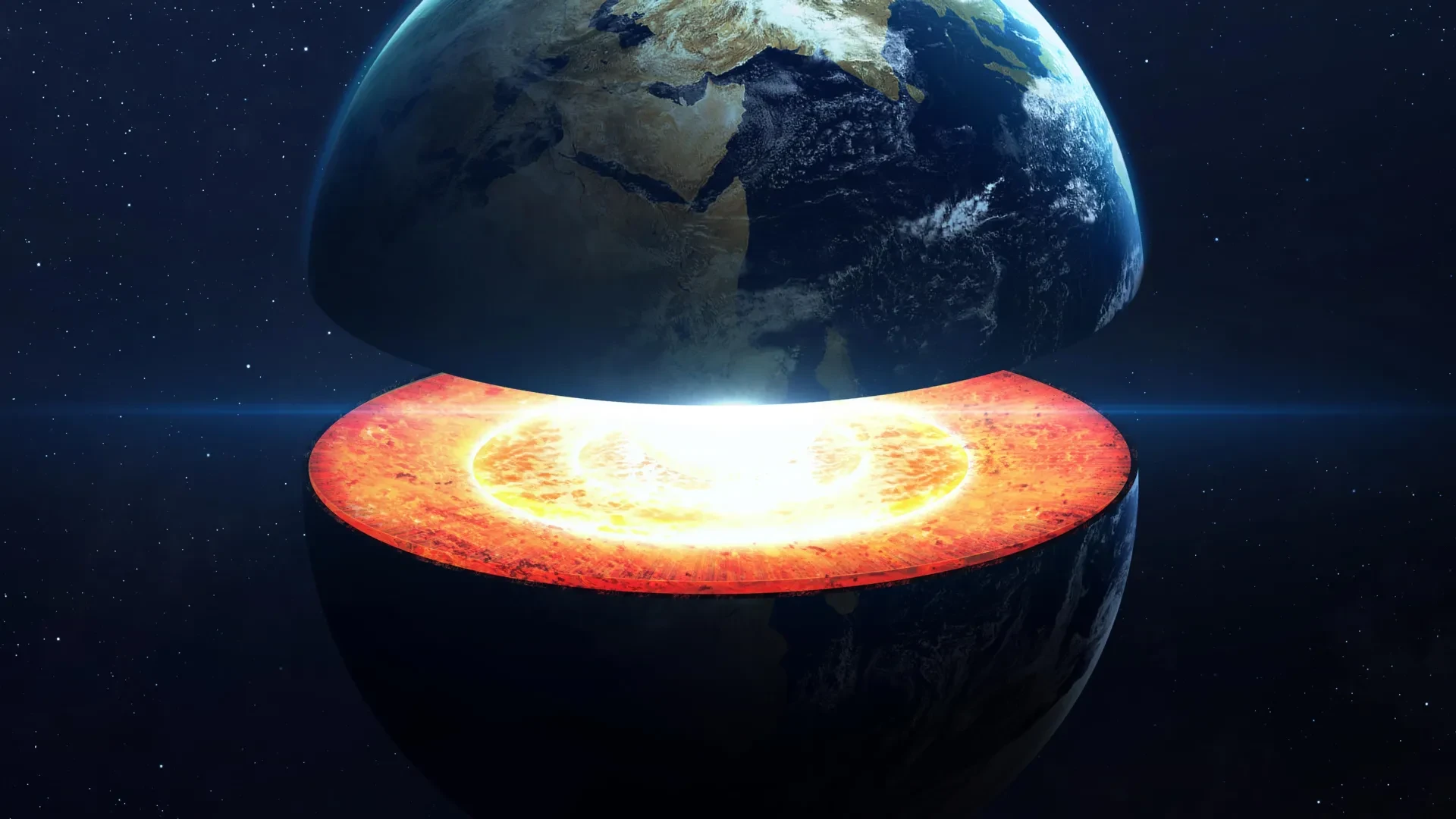
A remarkable geological discovery unearthed in the rugged landscapes of Papua New Guinea has revealed an unexpected thermal pattern deep beneath the Earth’s surface, fundamentally challenging how scientists understand the mechanics of tectonic plate subduction and the distribution of heat within the planet’s interior.
An international team of researchers spearheaded by experts at Göttingen University has determined that a unique rock recovered from the region embarked on an extraordinary subterranean journey roughly four million years ago. Plunging more than 90 kilometers—equivalent to about 56 miles—straight down into the Earth’s mantle, the rock experienced unusually intense heat at relatively shallow depths before transitioning into an environment characterized by a significantly cooler subduction profile.
The findings, which offer a rare window into the volatile and dynamic processes operating out of human sight beneath our feet, were published in the prominent scientific journal Nature Geoscience. By decoding the microscopic history trapped within the mineral composition of the rock, scientists are now forced to re-evaluate long-standing models regarding how heat is generated, transferred, and distributed as massive slabs of the Earth’s crust descend into the planetary interior.
A Strange Discovery Deep Beneath Earth’s Surface
To understand the magnitude of the discovery, geologists look to the grand scale of planetary mechanics. The Earth’s outer shell is not a single, unbroken layer; rather, it is fragmented into a mosaic of enormous, rigid tectonic plates that perpetually drift across the molten asthenosphere at a sluggish pace. These plates interact at their boundaries, colliding, pulling apart, or sliding past one another. When two convergent plates meet, the denser plate is frequently forced downward, bending and plunging into the Earth’s interior in a monumental geological process known as subduction.
Subduction zones are among the most geologically active and influential regions on the planet. They are the prime engines behind some of the world’s most catastrophic earthquakes and power the explosive volcanic arcs that ring regions like the Pacific basin. Beyond their immediate and often destructive surface impacts, subduction zones play an indispensable, long-term role in regulating the Earth’s global climate over millions of years. As plates descend, they drag surface materials down with them, facilitating complex geochemical cycles that recycle essential elements—such as carbon dioxide—between the atmosphere, oceans, and the deep planetary interior.
The immense pressures generated within these subduction zones act as a natural planetary laboratory, subjecting ordinary crustal rocks to crushing forces that fundamentally alter their chemical and physical structures. Under these extreme conditions, rocks can be transformed into a striking, dense metamorphic material characterized by vivid red and green hues, known scientifically as "eclogite." It was an exemplary specimen of this eclogite, originating from the ancient subduction zones of Papua New Guinea, that the international research team subjected to rigorous laboratory analysis using a suite of advanced analytical techniques.
Deep inside the microscopic architecture of the rock, the researchers made a critical find: tiny, perfectly preserved crystals of coesite. Coesite is a specialized mineral form of silica that can only crystallize under conditions of exceptionally high pressure—pressures found exclusively deep beneath the Earth’s crust. As the rock formed and metamorphosed during its descent, these delicate crystals became permanently trapped within a host mineral, acting like a geological time capsule that securely preserved the physical evidence of the punishing journey the rock had endured.
By carefully studying these microscopic clues, the scientists were able to reconstruct the precise path of the rock. They determined that it had descended to a depth of at least 90 kilometers beneath the Earth’s surface. At this maximum depth, temperatures reached an estimated 800 degrees Celsius, translating to roughly 1,472 degrees Fahrenheit. Yet, while the destination depth and final temperature aligned reasonably well with standard geological expectations, what the researchers uncovered about the earlier stages of the rock’s journey proved to be profoundly surprising.
An Unexpected Shift From Hot to Cold Subduction
The real breakthrough came when the team reconstructed the complete thermal history of the rock as it descended step by step. Standard geophysical models predict a relatively predictable and gradual increase in temperature as a slab sinks deeper into the Earth. However, the data extracted from the Papua New Guinea eclogite painted a remarkably different picture.
The analysis revealed that when the rock had reached a depth of approximately 45 kilometers, or about 28 miles, it had already encountered temperatures soaring to around 700 degrees Celsius, which is roughly 1,292 degrees Fahrenheit. This discovery stunned the researchers. It meant that the rock was only about 100 degrees Celsius cooler at half its maximum depth, even though it still had another complete 45 kilometers of descent ahead of it before reaching its ultimate resting place.
Under conventional thermal models of subduction zones, such high temperatures at such relatively shallow depths are anomalous. The rock appeared to have undergone a period of intense heating while it was still relatively close to the surface, only to later enter an environment characterized by a much more subdued, cooler temperature gradient as it continued its plunge into the deep mantle. Although the actual temperature of the rock did continue to rise with depth, the rate at which it warmed up slowed down drastically during the second half of its journey.
Dr. Jan Schönig, a researcher at the Geoscience Center of Göttingen University, highlighted the unconventional nature of the findings. "Finding this change from hot to cold subduction was unexpected as this contradicts our current thermal models of subduction zones," Schönig explained.
While geologists have occasionally discovered individual rocks bearing the signatures of unexpectedly high temperatures in the past, this research marks a significant milestone. It represents the very first time scientists have successfully reconstructed such a clear, unambiguous transition between two entirely distinct thermal regimes as a single rock traveled dynamically from shallower crustal levels down into the deep mantle.
What Could Explain Earth’s Hidden Heat Mystery?
Confronted with observations that flatly contradict decades of established thermal modeling, the research team set out to investigate what physical mechanisms could account for such an unusual and paradoxical temperature pattern. They have since put forward several compelling hypotheses to explain the hidden heat mystery recorded within the Papua New Guinea rock.
One primary possibility is that tectonic plates generate substantially more frictional and deformational heat at relatively shallow depths than scientists have historically calculated. As massive slabs of continental or oceanic lithosphere grind and slide past surrounding mantle rocks, intense shearing forces are produced along their boundaries. This mechanical friction could unleash significant quantities of localized thermal energy, artificially spiking the temperatures of rocks trapped in the upper sections of the subduction factory.
Another plausible explanation focuses on the evolutionary stage of the subduction zone itself. It is possible that the specific subduction system in Papua New Guinea was relatively young at the time the rock began its descent and had simply not existed long enough to establish the stable, cooler temperature profile predicted by steady-state conventional models. In a newly initiated subduction zone, the surrounding mantle may retain higher ambient heat before the sinking cold slab has had enough time to refrigerate the surrounding rock mass.
The researchers note that it is also entirely possible that a combination of both intense frictional heating and young subduction zone dynamics worked in tandem to produce the unique thermal signature preserved within the eclogite.
Unraveling these deep-Earth temperature dynamics carries profound implications for the broader field of geosciences. Subduction zones are the invisible engines driving some of the most powerful and potentially hazardous processes on our planet. By refining our understanding of how heat is transferred and generated within these dynamic zones, scientists can build more accurate models to better evaluate the complex physical conditions that trigger massive earthquakes and fuel volcanic arcs around the globe.
Furthermore, improved thermal models will significantly enhance our comprehension of major geochemical cycles. In particular, a clearer picture of subduction mechanics aids in quantifying the long-term global carbon cycle, which acts as Earth’s natural thermostat by circulating carbon between the surface environment and the deep interior over geological timescales.
By shedding new light on how physical conditions evolve as tectonic plates descend into the abyss, the discovery in Papua New Guinea provides the scientific community with a powerful new lens through which to investigate how subduction systems have operated over millions and billions of years, and how these colossal subterranean processes continue to shape the living surface of our planet today. The research was made possible through financial support provided by the German Research Foundation.