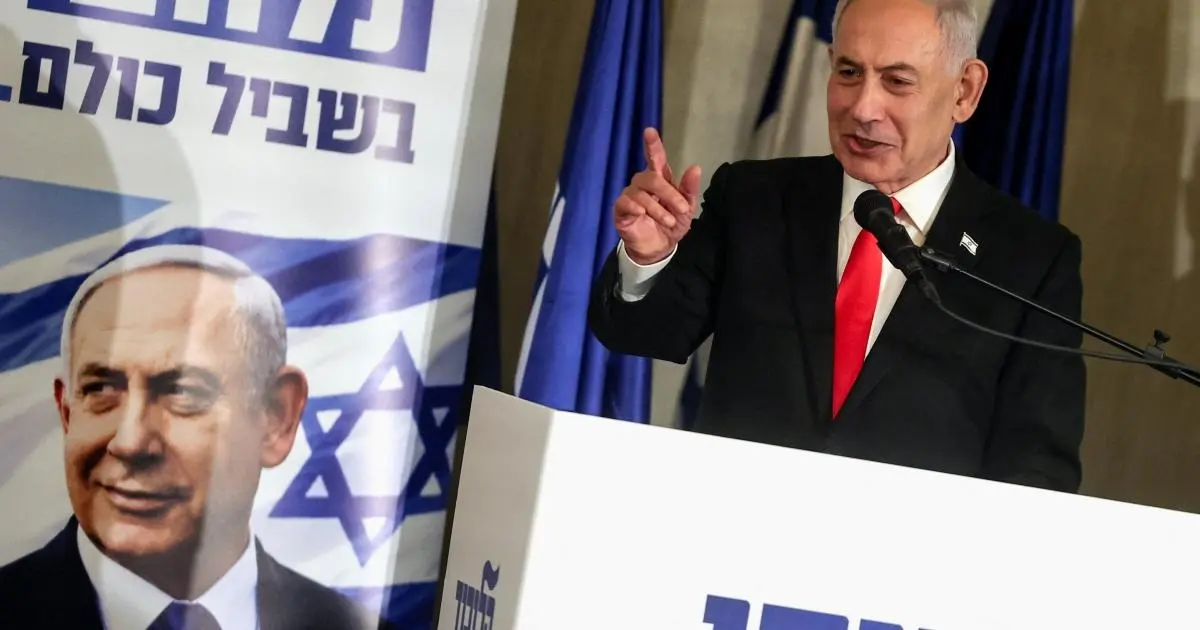
Israeli Prime Minister Benjamin Netanyahu has dominated his country’s politics for the last four decades, and his profound influence will not end even if voters eventually push him out of office. Over the course of his extensive tenure as Israel’s longest-serving prime minister, Netanyahu has dramatically reset the baseline terms of the nation’s security politics. His persistent rejection of Palestinian statehood has successfully pushed the concept firmly out of mainstream political debates, while his longtime agitation for aggressive confrontation against Iran is now widely accepted policy across Israel’s entire political and security establishment.
Before his first term as prime minister, Netanyahu was already a deeply divisive figure in domestic politics. In 1993, acting as the leader of the parliamentary opposition, he publicly likened Prime Minister Yitzhak Rabin’s historic Oslo Accords with Palestine Liberation Organization leader Yasir Arafat to British Prime Minister Neville Chamberlain’s appeasement of Adolf Hitler ahead of World War II. His inflammatory rhetoric emboldened hardline Israelis who considered any territorial compromise with the Palestinians to be treasonous, an atmosphere that contributed to the climate surrounding the assassination of Rabin in 1995.
Today, once-extreme policies and positions have become thoroughly normalized under Netanyahu’s watch. He has presided over a multi-year military campaign characterized by mass destruction and displacement in Gaza, resulting in the deaths of more than 70,000 Palestinians. Furthermore, his government has integrated far-right politicians into pivotal ministerial roles. This includes National Security Minister Itamar Ben-Gvir, who was barred from serving in the Israeli army in his youth due to his involvement with extremist groups, and Finance Minister Bezalel Smotrich, who has openly stated that Israel needs "to wipe out Gaza" and replicate what it "did in Gaza" within the West Bank. Defense Minister Israel Katz has similarly voiced support for applying the "Gaza model" to the West Bank and even parts of southern Lebanon.
Netanyahu now faces the prospect of losing power. His persistent attacks on Israel’s judiciary, ongoing corruption trials, and steady refusal to take direct accountability for the severe security lapses that preceded Hamas’s terror attacks on Israel on October 7, 2023, have generated unprecedented levels of opposition among the Israeli public. A change in national leadership could certainly trigger profound shifts in domestic policy. However, whether Netanyahu exits the political stage this week or years down the road, his overarching national security vision will outlast him. He has achieved the catastrophic success of crushing domestic support for Palestinian national aspirations while institutionalizing a permanent war footing to confront Iran. Netanyahu has fundamentally altered how Israelis conceptualize their country’s security, turning his own uncompromising positions into an established reality. Future leaders may bring distinct management styles to Israeli defense policy, but for the foreseeable future, they will operate strictly within the boundaries Netanyahu has drawn.
The Two-State Illusion
Netanyahu is certainly not the first Israeli prime minister to reject Palestinian national aspirations. In a widely cited 1969 interview, Golda Meir famously asserted that there was "no such thing" as a distinct Palestinian nation. Menachem Begin embraced the 1978 Camp David Accords with Egypt strictly because the agreement did not require him to negotiate the status of the Palestinians. Later, Yitzhak Shamir refused to permit independent Palestinian representation at the 1991 Madrid Peace Conference.
The critical difference in contemporary Israeli politics is that the very idea of Palestinian statehood is no longer even up for debate. This transformation did not happen overnight. Rabin’s assassination led to the systematic dismantling of the Oslo framework, which was ostensibly intended to produce an independent Palestinian state but in practice yielded limited self-governance alongside ongoing Israeli military control across much of the West Bank. Persistent attacks by Palestinian militant groups throughout the 1990s steadily deepened public skepticism regarding the viability of peace, clearing the path for Netanyahu’s initial election victory in 1996.
Even so, when Netanyahu’s first term concluded in 1999, subsequent politicians actively worked to keep the possibility of a political settlement alive. Israeli voters elected leaders such as Ehud Barak and Ehud Olmert, both of whom proved open to territorial concessions and engaged in serious, albeit ultimately unsuccessful, U.S.-backed peace negotiations. Barak also spearheaded a unilateral Israeli military withdrawal from southern Lebanon in May 2000. Even the notoriously hawkish Ariel Sharon—whose provocative visit to the Temple Mount in Jerusalem later that year helped ignite the Second Intifada—ultimately evacuated roughly 9,000 Israeli settlers and initiated a complete withdrawal of ground forces from the Gaza Strip in 2005.
However, in the absence of a negotiated diplomatic solution, the conflict deteriorated on all fronts. Hamas won the Palestinian legislative elections in Gaza in 2006 and seized full territorial control by 2007. Routine military clashes between Israel and Hamas quickly became the norm, with major conventional wars erupting in 2008, 2012, 2014, and 2021. Netanyahu returned to the premiership in 2009, immediately following the first of those major post-withdrawal military confrontations. As Israel grappled with frequent rocket fire from Gaza and cross-border missile attacks from Hezbollah in the north, Netanyahu systematically linked the worsening security environment to Israel’s earlier territorial withdrawals, heavily bolstering his domestic case against future compromises.
Netanyahu’s policies also irreversibly altered realities on the ground in the West Bank. Even before his return to power, in the wake of the Second Intifada, Israel constructed a massive concrete separation barrier that encroached significantly onto internationally recognized Palestinian land. A dense network of Israeli military checkpoints throughout the West Bank severely restricted Palestinian freedom of movement and access to East Jerusalem. Once back in office, Netanyahu accelerated policies—most notably the aggressive expansion of settlements—that directly threatened the territorial viability of any future Palestinian state. Furthermore, he encouraged a deepening political rift between Hamas in Gaza and the Palestinian Authority in the West Bank by facilitating over a decade of Qatari financial transfers to the Hamas-run administration, effectively undermining the broader Palestinian national project.
Even the diverse coalition led by Naftali Bennett and Yair Lapid, which briefly unseated Netanyahu from 2021 to 2022 on a promise of national change, did not substantially depart from his foundational positions. Significantly, this coalition—the only one capable of pushing Netanyahu aside in over a decade and a half—boasted strong right-wing security credentials, with Bennett himself being a long-standing opponent of Palestinian statehood. Rather than pursuing peace initiatives, Bennett and Lapid focused heavily on the Abraham Accords, brokered during the first Trump administration, which secured normalization agreements with several Arab states without requiring any concrete progress toward Palestinian statehood.
By the eve of October 7, 2023, vocal supporters of Palestinian statehood had all but vanished from the mainstream Israeli political establishment. The devastating attacks that day virtually guaranteed that total opposition to a Palestinian state would become the unyielding national norm. Today, no prominent Israeli political leader, even within the opposition, speaks openly about ending the occupation of Gaza and the West Bank. Following an extensive military campaign that destroyed vast swaths of Gaza and killed tens of thousands of Palestinians, Israel has regained direct military control over nearly 70 percent of the territory. Simultaneously, Israeli settlers in the West Bank—whose population has more than doubled since the signing of the Oslo Accords—have launched increasingly frequent attacks on Palestinians. With the Israeli government and military largely turning a blind eye or tacitly condoning the violence, West Bank Palestinians find themselves focused primarily on basic survival rather than statehood. Consequently, regardless of election outcomes, the path to a two-state solution remains effectively closed.
Call to Arms
Netanyahu’s hardline posture regarding Iran has been equally consistent throughout his political career. As early as 1992, serving as a member of the Knesset, he warned that Iran was actively racing to develop nuclear weapons and insisted that the perceived threat must be uprooted entirely. More than three decades later, Netanyahu found a U.S. partner in President Donald Trump who was willing to launch the direct military campaign against Iran that the Israeli leader had long sought. The initial strikes occurred in June 2025, when the United States and Israel targeted key Iranian nuclear facilities. A broader military campaign targeting the Iranian leadership followed on February 28. In a video message kicking off the expanded hostilities, Netanyahu declared, "Together with the U.S., we will strike the terror regime hard and create the conditions that will enable the brave Iranian people to cast off the yoke of this murderous regime."
Initially, the Israeli public and political establishment expressed near-uniform support for the war. Opposition leader Yair Lapid publicly hailed it as a "just war." By June, public opinion polls registered growing domestic criticism regarding Netanyahu’s management of the broader conflict, but very few Israeli politicians questioned the underlying necessity of maintaining intense military pressure on Iran. Active strategic planning for subsequent military operations has continued unabated. When Yair Golan, leader of the left-wing Democrats party, criticized the killing of Iranian Supreme Leader Ali Khamenei as a tactical mistake that merely empowered an even more extremist leadership, he faced swift and universal condemnation across the entire Israeli political spectrum.
This broad consensus marks a sharp departure from past debates among Israel’s military, intelligence, and political elites. When Netanyahu’s government first seriously weighed a conventional military strike against Iranian nuclear facilities in 2012—sparking deep anxiety in Washington—Israeli leaders were far from unified. Figures such as Meir Dagan, former director of the Mossad intelligence agency, openly opposed a military strike and questioned its strategic utility. That specific debate was sidelined when the Obama administration negotiated an interim nuclear agreement with Tehran via back-channel diplomacy through Oman in 2013, an accord that deeply infuriated Netanyahu and which he tried unsuccessfully to dismantle prior to the final 2015 signing.
Netanyahu’s aggressive opposition to Barack Obama’s diplomatic efforts also faced domestic pushback from politicians who feared that campaigning against the deal would permanently rupture Israel’s bipartisan standing in Washington and alienate the U.S. Democratic Party. While the Israeli government officially opposed the agreement, several prominent security figures argued that the deal offered strategic benefits by successfully postponing Iranian nuclear capabilities for a decade or more. Benny Gantz, former chief of staff of the Israel Defense Forces, publicly described the agreement as an "achievement." Even Ehud Barak questioned whether Trump’s eventual withdrawal from the pact, orchestrated with Netanyahu’s enthusiastic backing, represented the optimal strategy.
However, those internal debates largely evaporated after the U.S. formally withdrew from the Iran nuclear agreement in 2018. As Tehran resumed its nuclear enrichment program and conventional diplomacy stalled, Netanyahu seized the moment to escalate Israel’s ongoing shadow war. Mysterious explosions at the Natanz nuclear facility in 2020 and 2021 were widely attributed to Israeli intelligence operations, as was the targeted assassination of Iran’s top nuclear scientist in November 2020. Even during the tenure of the Bennett-Lapid coalition, official policy on Iran remained fundamentally unchanged. Although less overtly confrontational in rhetoric, that government maintained staunch opposition to any U.S. return to the nuclear agreement, arguing that renewed sanctions relief would simply finance regional proxy networks.
Following the events of October 7 and Netanyahu’s return to full executive authority, Israel dramatically escalated its kinetic campaigns against Iran and its regional allies. These actions included high-profile targeted strikes in Tehran and Beirut that eliminated the leadership of both Hamas and Hezbollah, alongside direct, tit-for-tat missile exchanges with Iran throughout 2024. Aside from domestic criticism accusing Netanyahu of timing military escalations to serve his immediate political survival, opposition figures such as Lapid and Gantz consistently backed the government’s actions, aligning with a public that strongly favored open military confrontation.
Ultimately, Israeli leaders have firmly embraced Netanyahu’s preference for military preemption over diplomacy across multiple fronts. The foundational doctrine that preventive military action is the primary tool for managing potential threats has guided operations not only in the Palestinian territories but also in southern Lebanon and post-Assad Syria. In September 2025, Israel crossed a significant regional threshold by launching its first direct military strike inside a Gulf Arab state, targeting Hamas leadership in Doha, Qatar. Through these actions, war has effectively become Israel’s normal state of affairs.
More of the Same
Even if Netanyahu is ultimately removed from office, Israel’s overarching approach to national security is unlikely to experience a fundamental shift. While the political opposition has articulated clear differences from the current ruling coalition regarding domestic governance, judicial reform, and civil society, major strategic fissures regarding the Palestinian conflict, Iran, and regional military campaigns remain largely absent. As many local political analysts routinely observe, the parliamentary spectrum of the Israeli opposition remains "50 shades of right."
Gadi Eisenkot, who has emerged as Netanyahu’s most prominent political rival, might implement tactical adjustments such as slowing West Bank settlement expansion or cracking down on extremist settler violence if he assumes the premiership. However, those steps would represent administrative adjustments rather than strategic departures. Eisenkot has explicitly dismissed the prospect of ending the West Bank occupation or advancing a genuine two-state solution, having previously labeled the concept "delusional" in the wake of October 7. Other leading opposition figures, such as Naftali Bennett, remain ardent ideological supporters of settlement growth and vocal opponents of Palestinian statehood.
Similarly, a new administration would not fundamentally overhaul Israeli policy in Gaza. While widespread public and political resentment exists regarding Netanyahu’s handling of the war—particularly his resistance to cease-fire agreements that could have saved civilian hostages—there is far less institutional concern regarding the broader humanitarian impact of the conflict on Palestinians. An Eisenkot-led government might show greater willingness to advance stalled international reconstruction frameworks for Gaza, but like Netanyahu, it would reject any ceding of Israeli security control without the complete disarmament of Hamas.
More fundamentally, Israeli leaders across the political divide now view territorial control as an indispensable pillar of national security, whether in Gaza, the West Bank, southern Lebanon, or Syria. As Middle East scholar Nathan Brown has observed, ongoing debates within Israel regarding security doctrine focus increasingly on how Israeli military predominance should be exercised rather than whether it should be maintained at all. While a new government might explore a nonaggression pact with Syria requiring the withdrawal of Israeli forces from border zones—assuming robust U.S. backing—deep-seated political opposition makes even such localized withdrawals highly improbable, and ceding ground elsewhere remains entirely off the table.
Regarding Iran, no major Israeli political figure advocates for a change in strategic course. Domestic criticism of Netanyahu’s Iran policy has centered almost exclusively on his perceived failure to prevent short-lived diplomatic arrangements, such as interim understandings floated by Washington that most Israelis view as overly accommodating to Tehran. Israeli military planners continue to prepare actively for future conflicts, including scenarios requiring unilateral action against Iranian nuclear infrastructure. Maintaining this permanent war footing enjoys broad cross-party support, with opposition leader Lapid even arguing that Israel should expand its campaign to target all major Iranian energy infrastructure to entirely collapse the national economy.
Waiting for a Change
Netanyahu would have found it significantly more difficult to drive his hardline vision into the mainstream had he faced a political opponent capable of articulating a compelling, fundamentally alternative vision for Israel’s regional positioning and path to peace. The contemporary Israeli opposition has produced no equivalent to Yitzhak Rabin—no prominent leader willing to break with past positions, speak candidly to the public about the genuine compromises required for lasting peace, and invest in painstaking diplomacy. Instead, Netanyahu’s prolonged dominance has stifled robust national debate on security matters, aligning the defense establishment squarely behind an uncompromising worldview that relies continuously on military force.
Furthermore, Netanyahu has faced minimal strategic pushback from Washington. Even as public sentiment regarding Israel has shifted notably across both major U.S. political parties, successive American administrations have proven increasingly reluctant to leverage diplomatic and economic tools to curb contentious policies such as settlement expansion. This lack of external pressure, combined with the willingness of several Arab states to pursue normalization agreements without demanding concrete progress toward Palestinian reconciliation, has empowered Netanyahu to pursue hardline objectives without consequence. It has similarly silenced domestic dissenting voices within Israel, who could no longer convincingly argue that such policies would damage the country’s vital international alliances.
Regional realities continue to complicate Netanyahu’s long-term worldview; the ongoing plight of Palestinians resonates deeply with foreign publics, placing practical limits on how far key regional actors like Saudi Arabia are willing to go in normalizing diplomatic ties. Yet future Israeli leaders may remain unconcerned by these diplomatic friction points, convinced that Israel’s advanced military capabilities and technological edge render it too strategically valuable to be isolated. Many contemporary Israeli politicians readily dismiss the growing regional consensus that views Israel’s aggressive posture as a primary driver of instability.
A serious reversal of Netanyahu’s security policies will remain impossible until a new Israeli leader emerges with a bold, viable alternative strategy for achieving lasting regional peace—and possesses the political skill necessary to bring the public along. As long as the United States remains Israel’s indispensable political and security partner, facilitating that strategic shift will ultimately require Washington to transition from enabling actions to actively pushing back against territorial occupation, settlement expansion, and reckless military escalation.
None of those shifts are occurring within the current Israeli political cycle, nor are they likely to materialize anytime soon. Netanyahu has succeeded decisively in dismantling domestic support for Palestinian national aspirations while normalizing permanent military confrontation with Iran. It is a powerful and enduring legacy, but it is not one that leaves Israel, the broader region, or the international community in a more secure position.