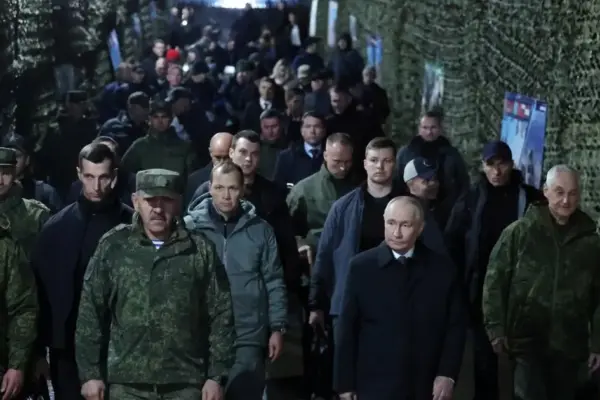
For decades, Vladimir Putin has played the long game, steadily working to subjugate Ukraine while simultaneously cultivating ties with Donald Trump. Today, success at the latter endeavor is allowing the Russian leader to recover from significant failures at the former. After nearly five years of thwarted Russian objectives in the brutal war on Ukraine, the U.S. president is actively helping Moscow win.
By easing economic sanctions, cutting off vital military and economic assistance to Kyiv, disrupting intelligence cooperation, and openly pressuring Ukrainian President Volodymyr Zelensky to accept Putin’s territorial war aims, the current administration is making a successful Russian annexation of substantial Ukrainian territory—along with de facto control over Kyiv’s future political decisions—more likely than at almost any point since the full-scale invasion began in February 2022.
Since Putin launched his sweeping assault, battlefield momentum has swung back and forth between the warring sides. Russian forces initially held a distinct advantage at the start of the conflict. However, by the fall of 2022, Ukraine had successfully seized the offensive, liberating vast swathes of territory once held by Russian troops. The advance was so dramatic that Washington briefly worried Putin might resort to using a tactical nuclear weapon to halt Ukrainian momentum.
The war eventually settled into a tragic, grinding stalemate along an expansive frontline—until last spring. Momentum briefly returned to Ukraine after Kyiv deployed new long-range missiles capable of striking high-value targets deep inside Russian territory. These were supplemented by new midrange drones designed to attack Russian supply routes in occupied eastern Ukraine, alongside improved interceptor drones that bolstered defenses against relentless aerial assaults on Ukrainian urban centers. During this phase, Putin’s army proved entirely incapable of advancing along the frontline, and Ukrainian troops even managed to make incremental progress in liberating occupied land.
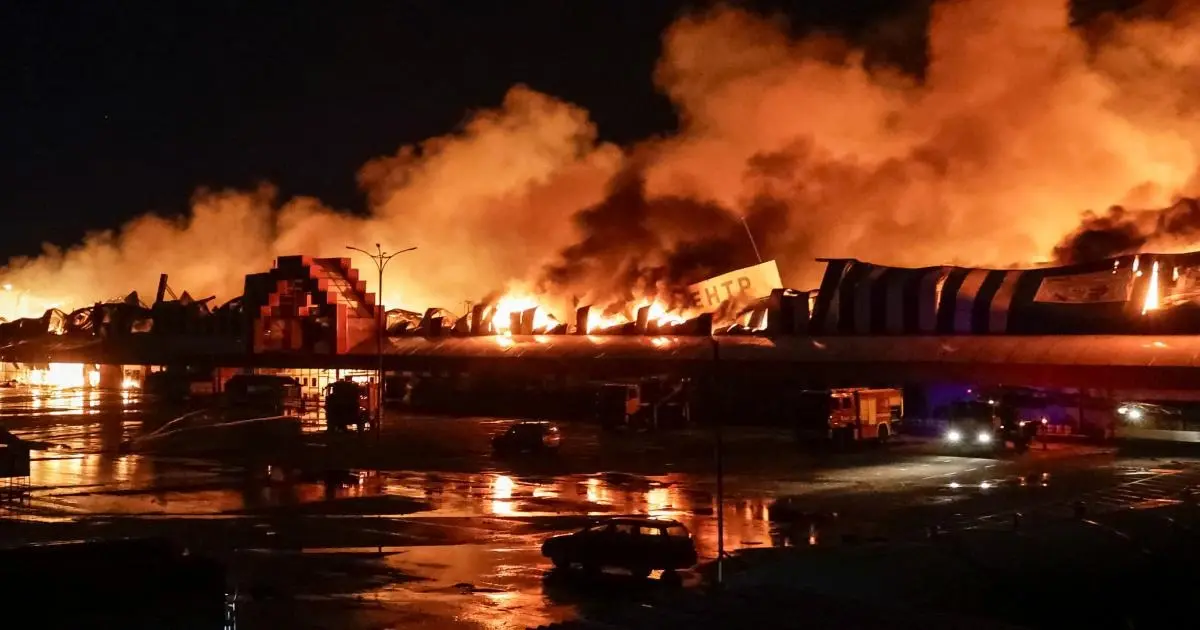
However, a dramatic shift in Washington has helped return the momentum directly to Russia. Stymied on the physical frontline, Putin has shifted his core strategy toward terrorizing Ukrainian society through massive rocket and drone strikes targeting both civilians and the civilian infrastructure upon which their basic livelihoods depend—particularly energy grids and water supplies. This campaign is driven by the calculations that a suffering, freezing population will ultimately pressure Zelensky to capitulate.
Advanced weaponry has made this systematic bombing campaign especially brutal. Moscow has ramped up the mass production of ballistic missiles and introduced a new drone model, the Geran 5, which is equipped with a powerful Chinese rocket engine that Ukrainian air defenses struggle to intercept. Because Russia possesses a larger troop pool, a vastly greater domestic military production capacity, and newly acquired advanced weaponry, Putin remains convinced that he can afford to sustain a prolonged war despite previous tactical stalemates.
Trump’s active support has deeply bolstered Putin’s belief that time is firmly on Russia’s side. Over the course of just the last few weeks, Trump and his political allies have significantly expanded their backing of Moscow. Actions have included the suspension of existing sanctions, purchases of Russian diesel fuel, sudden disruptions to Ukraine’s access to vital Starlink and Starshield satellite communications systems, and vocal demands that Zelensky must step down from power.
“It is equally clear that when some partners ease the pressure on Russia,” Zelensky noted recently, “it only reinforces Putin’s belief that his goals are within reach.”
The combination of dwindling support from the United States—particularly regarding dwindling air defense interceptors—alongside faster Russian drones and increased missile barrages threatens to make the coming winter the most brutal yet for the Ukrainian population.
OUR MAN IN WASHINGTON
Putin’s long game with Trump began years ago, driven not by any single immediate objective, but by the strategic calculation that Kremlin influence over the American figure might eventually prove useful—a classic and long-standing KGB tactic. Now, that investment has yielded profound returns.
Years before Trump first launched his presidential campaign, Russian political actors close to Putin pursued commercial business ties with the then-real estate mogul. Most famously, this included Trump collaborating with Emin and Aras Agalarov to host the Miss Universe pageant in Moscow back in 2013. Later, Putin orchestrated unprecedented foreign interference operations during the 2016 U.S. presidential election designed to assist Trump and damage his Democratic opponent, Hillary Clinton. While proving the exact numerical impact of the stolen and published Clinton campaign emails—combined with a massive social media disinformation campaign—remains impossible, the underlying reality that Putin sought to sway the election outcome is beyond question.
By 2017, Putin’s cultivation of Trump began to yield atmospheric and diplomatic dividends. Trump openly expressed deep admiration for the Russian strongman. More shockingly, during a joint summit with Putin in Helsinki in 2018, Trump publicly expressed doubt regarding the unanimous findings of his own intelligence community concerning Russian election interference, choosing instead to endorse Putin’s flat denials.
Yet, during his first term in office, Trump’s rhetorical adulation translated only marginally into actual, sweeping changes in official U.S. policy toward Moscow. This legislative and policy friction occurred largely because several senior officials within Trump’s own national security team—including National Security Adviser H.R. McMaster, Secretary of Defense James Mattis, and Secretary of State Mike Pompeo—effectively constrained the president from executing a complete, unvarnished pro-Russia policy pivot.
Following Trump’s reelection in 2024, however, the Kremlin’s patient courtship began to produce tangible, high-stakes results. Most consequentially, Trump abruptly ended direct U.S. military and economic assistance to Ukraine. Before this policy shift, the United States stood as Ukraine’s single largest international benefactor.
While Trump has continued to permit American private companies to sell a limited volume of arms to European governments—who then transfer those weapons onward to Ukraine—even that secondary pipeline has faced periodic administrative disruptions. The resulting flow amounts to a mere trickle of weapons and ammunition compared to the robust packages previously delivered by Washington. Furthermore, the specific armaments Ukraine desperately needs most—interceptors for its Patriot missile defense batteries—are in critically short supply globally, exacerbated by the fact that the U.S. military has expended large numbers of them during concurrent conflicts in the Middle East.
Additional U.S. actions have systematically undermined Ukraine’s geopolitical standing while aiding Moscow. Trump has repeatedly insisted that Ukraine will never be permitted to join NATO. He extended red-carpet treatment to Putin during an Alaska summit, where the two leaders discussed pressuring Kyiv into ceding the remainder of the eastern Donbas region, an area Putin has sought to conquer since 2014.
Trump has also periodically berated Zelensky in public and private settings. Most dramatically, during a tense February Oval Office meeting, Trump interrupted the Ukrainian leader mid-sentence, shouting, “You’ve done enough talking. You’re not winning this . . . You don’t have the cards.”
Although Trump has occasionally pivoted back toward more cordial rhetoric regarding the Ukrainian president, he has frequently returned to open hostility, echoing Kremlin talking points by publicly declaring that it is “time for Ukraine to get a new president.”
Over the past two weeks, the administration’s support for Putin’s war effort has visibly escalated. Trump lifted existing economic sanctions to permit the lucrative sale of Russian diesel exports, providing Moscow with billions of dollars in fresh revenue to directly finance ongoing military operations. He also issued an executive order suspending new sanctions outlined in the Lindsey O. Graham Sanctioning Russia and Iran Act of 2026, legislation he had signed into law just weeks earlier.
Simultaneously, new administrative lapses have emerged regarding the sharing of specialized intelligence that only the United States is capable of providing. Most damagingly, Ukraine has experienced severe disruptions in its access to Starlink and Starshield satellite communications networks operated by SpaceX—a company owned by Elon Musk, a prominent political backer and former administration official. Kyiv relies heavily on these services to pilot its domestic reconnaissance and strike drones, as well as to track and intercept incoming Russian aerial threats.
While it remains unclear whether the U.S. government or Musk independently ordered the communications blackouts, the tactical consequences were immediate and unmistakable: a higher volume of Russian drones and rockets successfully struck Ukrainian civilian and military targets, Russian ground weaponry edged closer to the frontline, and a significant number of Ukrainian counter-drone units dropped out of the sky mid-operation.
Behind the scenes, associates of Putin and Trump have also engaged in negotiations regarding new commercial and financial deals. These discussions include proposed acquisitions of assets owned by the major Russian oil company Lukoil by American investors, the potential sale of the currently dormant Nord Stream 2 natural gas pipeline connecting Germany and Russia, and secret Russian financial investments in a liquefied natural gas project located in Alaska. If brought to fruition, these joint ventures will inject substantial new revenues into the Russian economy, further undercutting international isolation and underwriting the war in Ukraine.
CAN THE PENDULUM SWING BACK?
Despite the mounting pressures, the Ukrainian public is far from capitulating. According to recent domestic polling, a solid majority of citizens firmly believe that their country must continue fighting to preserve its sovereignty. Nor are European allies abandoning the cause. Although Putin initially calculated that the withdrawal of American military and financial aid at the start of Trump’s second term would trigger a swift Ukrainian military collapse or political surrender, he severely underestimated the willingness and capability of European nations to step into the void and sustain Kyiv’s defense.
Furthermore, Ukrainian defense technology companies are working frantically to innovate and manufacture new domestic weapons capable of intercepting the surging volume of Russian ballistic missiles and high-speed Geran 5 drones. While the strategic pendulum has undeniably swung in Russia’s favor for the moment, Ukrainians have repeatedly defied international expectations and regained battlefield momentum in the past, proving they retain the resilience to do so again.
Shifts in American domestic politics could also alter the trajectory of U.S. policy, particularly in the wake of upcoming midterm elections. Broad swaths of the American public remain deeply skeptical of Trump’s embrace of Putin and the abrupt abandonment of a democratic ally, creating significant domestic political friction for the administration’s current diplomatic pivot.
If opposition lawmakers capture control of one or both chambers of Congress in the midterm elections, they could leverage their new legislative mandate to launch rigorous congressional investigations into controversial U.S.-Russian business deals, introduce bipartisan legislation to legally mandate the resumption of American military and economic aid, outlaw communications blackouts, and enforce existing statutory sanctions laws. Even Trump himself has demonstrated a historical capacity for unpredictability regarding Putin, having once wondered aloud whether the Russian leader was “tapping me along”—a pivot he could theoretically execute once more.
At the same time, Putin must recognize that his long-term cultivation of Trump represents a wasting political asset. No future American president—whether Democrat or Republican—is likely to maintain or institutionalize Trump’s uniquely accommodating Russia policy. Furthermore, as the midterm elections approach, Trump enters lameduck status, naturally diminishing his unilateral power to dictate U.S. foreign policy over the remaining years of his term.
Given these shifting political realities, analysts suggest Putin would be wise to pursue serious, good-faith negotiations toward a cease-fire immediately. His geopolitical odds of securing a permanently favorable settlement are likely to diminish significantly from this point forward.