Voice-to-text technology has long promised a seamless bridge between spoken thought and written communication, yet developers routinely face a persistent hurdle: raw automated speech recognition (ASR) transcripts are messy, unpunctuated, and laden with conversational filler. Addressing this industry-wide friction point, SuperWhisper officially launched its S1 family of models on August 19, 2026. The release introduces three proprietary models—S1-Voice, S1-Language, and S1-mini—built around a singular core philosophy: that voice transcription tools can achieve superior speed and accuracy without requiring the platform to train on user data.
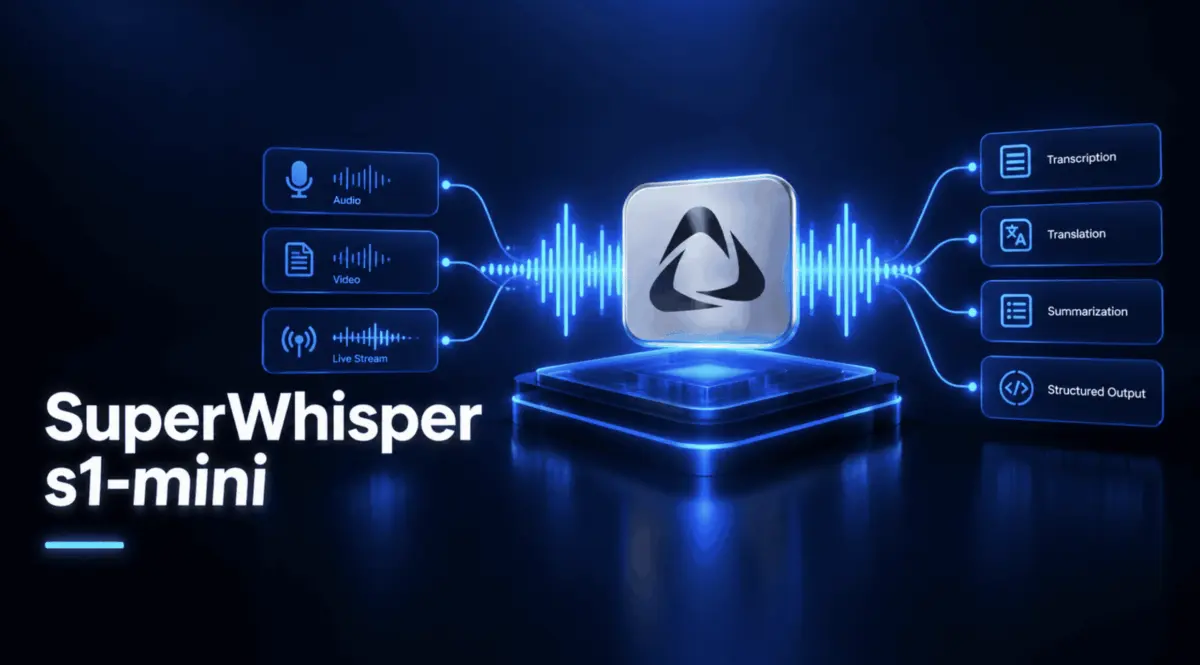
While two of the newly introduced models are hosted in the cloud, the third offering, S1-mini, represents a significant development for local, privacy-focused deployment. S1-mini is a 0.6-billion-parameter model featuring open weights that operates entirely on a standard laptop CPU, performing one specific text-normalization task with notable precision.
The S1 family is structured to divide the responsibilities of speech processing across distinct specialized models rather than relying on a single, monolithic engine. S1-Voice functions as SuperWhisper’s proprietary cloud speech-to-text model, designed to replace external automatic speech recognition engines with an optimized transcription backend. Evaluated across eight independent benchmarks—including complex meeting audio and earnings calls—S1-Voice achieved an average word error rate of 6.8 percent, which the company reports is the lowest among fifteen models tested, alongside a 2.2 percent error rate on LibriSpeech data.
Positioned downstream from transcription is S1-Language, a cloud-hosted instruction-following model engineered for advanced text cleanup, custom formatting rules, and meeting-note structuring. S1-mini occupies a similar downstream cleanup role but diverges sharply by prioritizing completely offline operation over cloud flexibility. Published directly on Hugging Face, S1-mini is the only model in the newly launched family with open weights, executing entirely locally with zero network requests.
The engineering approach behind S1-mini breaks from conventional small language model design. Rather than optimizing for broad, general-purpose helpfulness, developers placed a strict design constraint on the model, characterizing its behavior as ruthlessly obedient. The model is intentionally programmed to refrain from adding unvoiced content, correcting factual inaccuracies, softening profanity, altering dialects, or editorializing the speaker’s original intent. Its sole operational objective is to transform raw, lowercase, unpunctuated ASR transcripts into clean, readable written text.
Performance metrics cited in the model documentation indicate that this narrow optimization strategy yields measurable accuracy gains. When evaluated against a held-out benchmark set comprising 7,519 English cases across 104 transcripts that were unseen during training, S1-mini achieved a 94.8 percent token accuracy and an 11.6 percent text-edit error rate. Formatting capabilities demonstrate similar precision, particularly within email structures, where the model successfully identified greeting lines 99.3 percent of the time and sign-offs 97.9 percent of the time. Furthermore, the model exhibited robust handling of edge cases, showing degenerate behaviors such as looping or truncation in fewer than one percent of generations. When presented with input consisting entirely of filler noise, the model returned an empty string 98.6 percent of the time rather than hallucinating content to bridge the silence.
User control over the output is managed through a structured control line prepended to every input, regulating styling, structure, and context. The styling axis adjusts capitalization and contraction handling across a spectrum from casual to formal. The structure axis governs prose or list formatting, employing a conservative threshold that requires at least three genuine items before generating bullet points. The context axis toggles between general and email modes, the latter of which initiates greeting and sign-off formatting rules. Because these three axes were trained independently, developers can combine them flexibly while retaining reliable output.
A critical implementation detail highlighted in the model documentation involves its architectural lineage. Because S1-mini was fine-tuned from Qwen3-0.6B, it inherits the underlying chat template, which defaults to an active thinking mode. However, S1-mini was trained with thinking explicitly disabled and contains no reasoning traces within its training data. Consequently, developers integrating the model must explicitly set the generation parameter to disable thinking; failing to do so results in the model emitting an empty thinking block and terminating generation without producing usable output.
This emphasis on structural obedience distinguishes S1-mini from the broader ecosystem of transcript cleanup methods. Developers typically address raw ASR output by routing text through general-purpose chat models paired with broad cleanup prompts, or by deploying significantly larger local models that consume substantially more hardware resources. S1-mini demonstrates that a narrowly focused architecture can match or exceed the performance of larger, unspecialized models on this specific task while maintaining a tiny resource footprint. With 596 million unique parameters, the model runs smoothly on standard laptop hardware without requiring a dedicated graphics processing unit.
Within SuperWhisper’s internal ecosystem, the three models serve complementary operational roles rather than competing for the same use case. Cloud users typically pair S1-Voice with S1-Language for flexible, server-side processing, whereas offline users deploy S1-mini alongside a local ASR engine.
For technical integration, the model relies on a system prompt establishing its role as a text normalizer, paired with deterministic decoding strategies. Because normalization is treated as a deterministic transformation rather than a creative writing task, the model configuration utilizes greedy decoding by default to eliminate unwanted variance in the generated output. In practice, processing raw spoken dictation through this pipeline converts conversational filler and false starts into polished prose or structured email formats in a single pass.
Developers evaluating the model for commercial integration can access the weights through standard Hugging Face repositories or utilize GGUF quantized builds optimized for local inference frameworks such as llama.cpp, Ollama, and LM Studio. Licensing terms follow the Apache 2.0 framework with an additional attribution clause requiring the model to retain its designated name and creator identification wherever deployed. As developers increasingly seek reliable on-device processing capabilities for voice-driven applications, the introduction of specialized, resource-efficient normalization models marks a notable shift in how automated speech transcripts are refined for human readers.