JavaScript Object Notation, universally known as JSON, remains one of the most reliable and ubiquitous formats for storing and exchanging data across modern Python applications. For everyday tasks and relatively modest files, Python’s built-in json module functions exceptionally well, offering a straightforward, dependable mechanism to parse and load documents directly into memory with a simple function call. However, as data infrastructure scales and data science projects ingest increasingly massive files, developers frequently run into a classic architectural bottleneck: memory exhaustion.
When handling small to medium datasets, standard loading methods create minimal friction. Yet, the moment a file grows to several hundred megabytes or expands into the gigabyte range, traditional parsing approaches begin to strain system resources. The underlying cause lies in how standard parsing operates. Standard methods read an entire JSON document from disk, parse every single node, and instantiate the corresponding Python objects—such as dictionaries, lists, strings, and numerical values—all at once in the computer’s volatile memory before a developer can even begin analyzing the data. Consequently, a file that occupies a relatively modest footprint on a hard drive can demand exponentially more random-access memory once converted into a web of native Python structures.
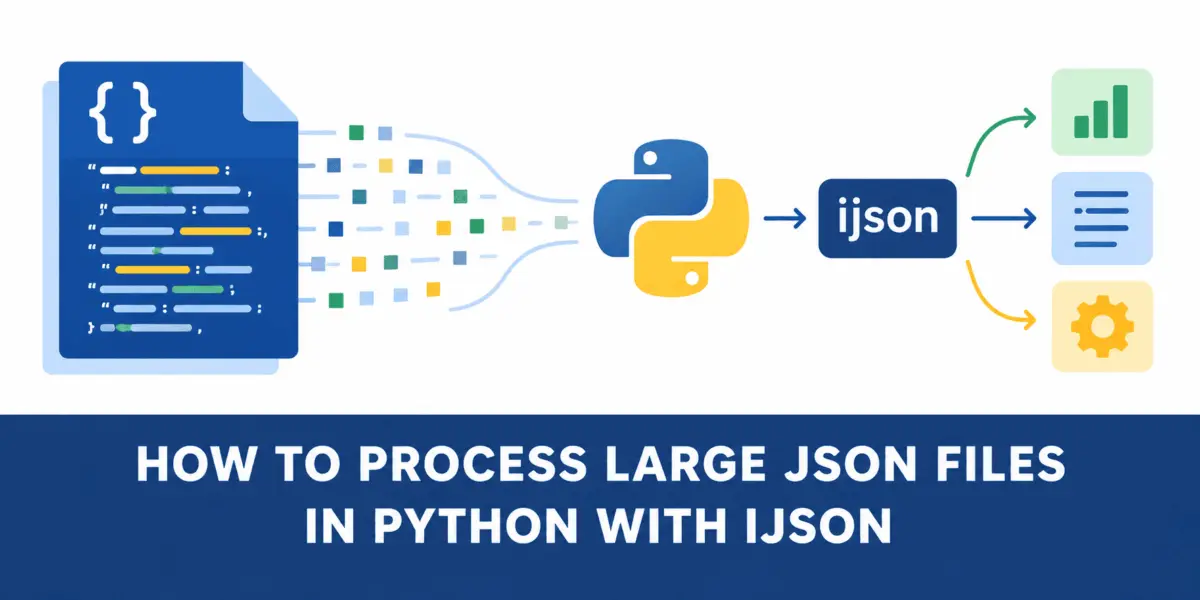
To address this widespread performance challenge within the data engineering and machine learning communities, developers are increasingly turning toward iterative parsing strategies. Among these alternatives, the ijson library has emerged as a prominent tool, offering an incremental approach to data processing that sidesteps the traditional requirement of loading an entire document into memory at once.
Examining the Memory Impact of Standard JSON Parsing
To understand the mechanics of this memory constraint, data engineers often look to benchmark experiments using real-world geographic data, such as the widely studied San Francisco City Lots dataset. Weighing in at approximately 181 megabytes, this particular file is large enough to clearly illustrate the sharp contrast between loading an entire document into memory versus streaming its contents iteratively.
Structured around the standard GeoJSON specification, the dataset features a primary FeatureCollection format containing a root dictionary with metadata keys alongside a massive array of individual features. Each feature represents an individual land parcel, mapping out intricate details including property numbers, street designations, and complex geometric polygon coordinates that outline the physical boundaries of each lot on a map.
When developers approach this dataset using standard loading techniques, the code appears deceptively simple and entirely correct from a functional standpoint. A script opens the file, passes the file stream to the built-in loader, extracts the collection of features, and iterates through them to tally specific criteria, such as counting how many parcels are located along a major thoroughfare like Market Street.
Despite its simplicity, this approach forces the system to execute a heavy sequence of operations long before the actual data analysis logic can even begin. The computer must read the complete file from storage, parse every individual JSON object, construct thousands of nested Python dictionaries, allocate memory for lists and nested string identifiers, and finally populate every single polygon coordinate—even if the specific data analysis task only requires a couple of minor property attributes.
Memory profiling measurements reveal the true cost of this operational model. When a standard loading script processes the land-parcel dataset, system memory consumption jumps dramatically. The reason the resulting memory footprint far exceeds the original file size on disk comes down to object overhead. A simple key-value pair in a raw text file expands significantly once translated into the runtime memory management system of the Python interpreter, multiplying the resource requirements for every nested array, string key, and numeric coordinate stored within the document.
Streaming Data Incrementally with Iterative Parsers
To resolve the memory scaling problem without sacrificing data integrity, developers utilize iterative parsing libraries that change the fundamental workflow of data ingestion. Rather than demanding that an entire document reside in memory simultaneously, an iterative parser reads and processes a file sequentially, handling records one at a time before discarding them from memory.
By utilizing specific structural pathways, such as targeting items within a designated array like the feature collection, an iterative parser retrieves individual records directly from the input stream. This setup alters the memory requirements of the application entirely. Instead of maintaining a massive tree of nested Python objects representing an entire metropolitan area’s land records, the system only needs to allocate memory for the single record currently under review, alongside a small parsing buffer and localized counters.
Comparative benchmarks between traditional loading methods and iterative streaming underscore the architectural benefits of this approach. While a standard loading approach can cause peak memory usage to skyrocket to over 800 megabytes for an 181-megabyte file, streaming the exact same dataset can keep peak memory consumption close to baseline operating levels, saving hundreds of megabytes of RAM during execution.
Industry experts note that streaming parsers do not necessarily guarantee faster execution speeds in every scenario. If a workstation or cloud server possesses an abundance of available RAM, traditional loading methods can sometimes parse a document rapidly because all data resides directly in memory. However, the definitive advantage of iterative streaming lies in resource stability. As enterprise datasets continue to grow, applications built on streaming architectures ensure that memory consumption remains flat and predictable, preventing unexpected out-of-memory crashes and allowing data pipelines to scale efficiently regardless of the input file’s ultimate size on disk.