The United Kingdom has launched targeted economic sanctions against Cryptomus, a chameleon-like digital asset platform that blockchain analysts and cybersecurity experts identify as a critical conduit for illicit financial flows. According to international investigators, the platform has long facilitated payments linked to ransomware attacks, narcotics trafficking, darknet marketplaces, financial fraud, and cybercrime services that actively help the Russian government circumvent western financial restrictions and sanctions.
Announced on October 8, the U.K. Foreign, Commonwealth & Development Office issued strict sanctions against Cryptomus—which has operated under various corporate guises including Certa Payments and Xeltox Enterprises—for processing transactions that directly benefit the Russian state and its isolated financial institutions. The sweeping measures immediately freeze any assets held by Cryptomus within British financial institutions and legally bar UK-based companies, citizens, and entities from engaging in any commercial or virtual business relations with the platform. Alongside Cryptomus, the U.K. government also targeted several other associated virtual payment platforms, including VexPay, TokenSpot, and the Tsunami Payments service, in an effort to choke off the infrastructure supporting illicit networks.
The crackdown highlights the evolving methods used by cybercriminal syndicates and sanctioned states to move money across borders. As detailed in a December 2024 investigative report by KrebsOnSecurity titled “How Cryptocurrency Turns to Cash in Russian Banks,” Cryptomus has served as an indispensable payment processor for dozens of underground Russian cryptocurrency exchanges and rogue websites peddling specialized cybercrime tools. Since its emergence in 2022, the platform has repeatedly rebranded and altered its corporate facade to evade law enforcement. Most recently, following a massive regulatory backlash, the platform launched a parallel service under the name “Heleket” to maintain its high-volume illicit operations.
The broader international impact of these platforms has been heavily documented by blockchain intelligence firms. Following the U.K. announcement, blockchain data analytics leader Chainalysis published an assessment noting that the newly sanctioned entities form the backbone of the infrastructure supporting Russia’s wartime economy. Chainalysis reported that Cryptomus and Heleket rapidly evolved into premier payment hubs for illicit activity, noting that the combined services received more illicit funds across tracked categories than traditional cryptocurrency mixers. Furthermore, the number of illicit counterparties interacting with these platforms surged dramatically, exceeding 900 distinct malicious entities in a single month in late 2025.

Independent blockchain intelligence firms have continuously tracked the staggering scale of the platform’s operations. In April 2026, analytics firm TRM Labs released data showing that Cryptomus had processed more than $7 billion in transactions since its inception in 2022. This enormous volume included extensive financial flows tied to heinous operations, such as vendors trading in child sexual abuse material, international terrorist financing networks, and sophisticated human trafficking rings.
TRM Labs also observed that while Cryptomus experienced a temporary cratering in transaction volume after instituting formal “know your customer” (KYC) rules to appease regulators, the operators quickly adapted. Rather than reforming their business model, they bypassed compliance entirely by launching Heleket as a parallel service designed specifically to sustain no-KYC payment processing for criminal clientele.
Richard Sanders, a veteran blockchain analyst and investigator who spent months meticulously mapping out the payment infrastructure of Cryptomus and interacting directly with its network of users, emphasized the strategic significance of the British intervention. Sanders noted that while Canada previously levied a record-shattering CAD $176 million fine against Cryptomus in late 2025 for severe anti-money laundering violations, monetary penalties alone are often insufficient against deeply entrenched, evasive criminal enterprises. Because Canada’s fine proved ultimately unenforceable and uncollectible, the platform simply continued its operations unfazed.
Writing on LinkedIn following the UK’s announcement, Sanders pointed out the vital distinction between administrative fines and targeted economic sanctions. A financial penalty does not inherently stop a digital currency payment processor from executing transactions, whereas comprehensive sanctions effectively dismantle the operation by cutting off its access to the global financial system.
The investigation into Cryptomus has consistently revealed murky corporate structures designed to obscure ownership and evade scrutiny. During the 2024 investigation, records showed that Cryptomus shared a designated Vancouver mailing address with dozens of other foreign currency dealers and money transfer businesses—none of which maintained any physical presence at the location. When Canadian regulators pursued enforcement and levied the CAD $176 million penalty for systemic anti-money laundering failures, the platform appealed the fine, spun up Heleket as a no-KYC alternative, and continued handling vast sums of suspect funds.

Furthermore, Sanders highlighted that the U.K. sanctions represent a historic milestone in international law enforcement cooperation. It marks the first known instance of a “Five Eyes” nation—the intelligence-sharing alliance comprising Australia, Canada, New Zealand, the United Kingdom, and the United States—formally sanctioning a cryptocurrency operation that was originally incorporated within the jurisdiction of another Five Eyes partner.
The sprawling nature of Cryptomus raises fundamental questions about how obscure digital entities manage to project legitimacy and secure authorization to offer global financial services. The answer points toward a bizarre nexus of phantom financial institutions, dubious regulatory bodies, and unrecognized geopolitical territories.
Investigators previously uncovered that the sole shareholder of Certa Payments, the parent company behind Cryptomus, was a 25-year-old Ukrainian woman. Alongside Cryptomus, she also headed several other shell corporations, including the WS Management and Advisory Corporation. This entity brazenly billed itself as an exclusive regulatory body responsible for overseeing and issuing licenses for cryptocurrency operations, foreign exchange brokerages, and online gaming businesses incorporated within the Western Sahara, a disputed region in northwest Africa that lacks widespread international recognition as a sovereign state.
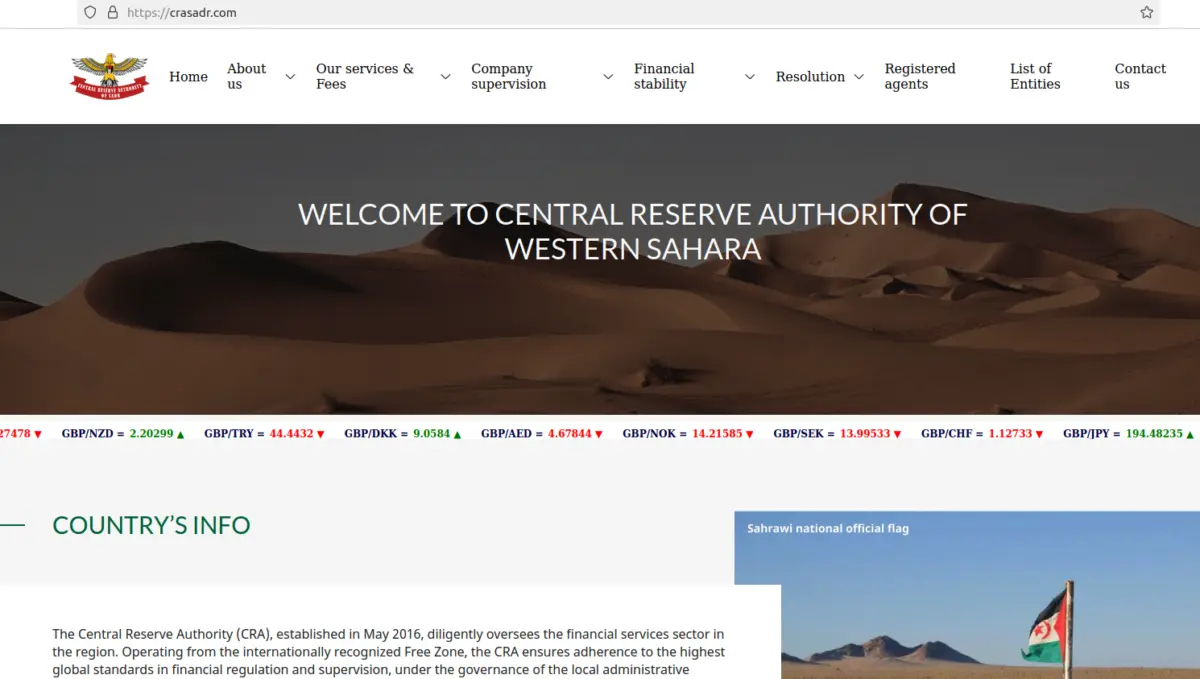
The administrative arm of this scheme operated through digital storefronts such as crasadr.com, the purported website of the Central Reserve Authority of the Western Sahara. This self-styled authority published lists of entities allegedly granted official licenses to operate global crypto, gaming, and forex services. Technical infrastructure analysis revealed deep connections between these fronts; one of Certa Payments’ former web domains shared a server with a dozen other suspicious domains, including rasd-state.ws, which served as the digital home for the phantom reserve authority.
With the United Kingdom now bringing the full weight of its economic sanctions against Cryptomus, VexPay, TokenSpot, and Tsunami Payments, the network faces an unprecedented international blockade designed to sever its liquidity, isolate its operators, and finally neutralize a key financial lifeline for cybercrime and sanctions evasion.